





















Coloma Deep Dive
What the Community Thinks About Coloma
Reviewers generally agree that Coloma is a tight, fast Wild West city-building game that rewards planning. They disagree more about whether its choices stay fresh over repeated plays. Meeple University, which covered the Kickstarter preview, a full overview, and a quick playthrough, comes away enthusiastic. Its hosts describe a game that moves quickly, asks players to pick from many possible plans, and leaves them wanting to try a different approach next time.
Board Games UnLocked is more measured. Its reviewer placed Coloma fifth on a list of disappointing 2019 games, stressing that the game is not bad and that several of its mechanics are appealing. The complaint was that the strongest line of play can become obvious, so that the game feels like it has one correct way to win. Getting Games approached the game through its Prospects expansion, while Pair of Dice Paradise described the base game as combining simultaneous action selection, worker placement, and hand management. The Hunger Gamer, a regular player, named Coloma their most-played game of the month and called it a really fun game that still holds up.
Core Mechanics That Define Coloma
Simultaneous Action Selection
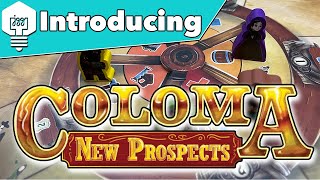
Each turn, every player simultaneously chooses one wedge of the central wheel, and the Barker tile blocks one of the normal actions in a predictable way. The bust marker then moves to cover the wedge chosen by the most players, which makes crowded actions less valuable and pushes players to diversify away from their opponents. Meeple University's overview explains that the bust penalty is the main reason to avoid the crowd, and its playthrough shows how a covered space can cost a player an entire turn's worth of building. Pair of Dice Paradise noted that players can either react to what they see or try to guess what opponents will do, and that groups can play the selection with tabletop-style reveals if they prefer. Board Games UnLocked, by contrast, said it did not care for designs where everyone can effectively do everything each round, which is the complaint that simultaneous selection tends to attract from players who prefer more direct competition.
Tableau Building
Coloma's buildings do more than score points when they are placed. Players construct buildings that stay in front of them and trigger when the matching action is activated, so a single well-timed action can chain several bonuses. Meeple University's overview highlights how buildings can be upgraded into hotels to house leftover workers, and how bridges and rivers feed the end-game scoring. Getting Games explained that the Prospects expansion pushes this further by having tableau cards trigger on the icon being activated rather than only when a location is hit. Reviewers describe the result as a slow build toward a few strong combinations, where early setup determines how much the late game can produce.
The Coloma Experience
Satisfying Engine
Reviewers describe the pleasure of watching a board and tableau start working together. In the Meeple University playthrough, the players talk through how a river survey and a bridge can unlock extra horses, and how each new bonus makes the next action more valuable. The feeling is one of gradual acceleration rather than one dramatic swing. The Hunger Gamer, who has played Coloma repeatedly, described the core loop as holding up across many sessions, and the reviewer's continued return to the table suggests that the engine's payoff is consistent enough to reward experimentation.
Interactive and Dynamic Play
Because every choice is made at the same time, the game turns into a constant reading of the table. Players watch where the Barker and bust markers are heading, consider where opponents are likely to go, and decide whether to follow the crowd or deliberately avoid it. Pair of Dice Paradise highlighted the need to watch opponents closely, because points can be taken away as well as gained. The tension is less about direct attacks and more about the knowledge that other players' decisions will reshape the value of every action on the wheel.
What Makes Coloma Stand Out
Simultaneous Choices That Reward Diversifying
Reviewers consistently praise the way the bust marker turns the most popular action into a trap. Meeple University's overview presents this as the central tension of the game: a player who optimizes too obviously will be punished by the crowd, so the best turns often come from doing something slightly different from what everyone else is doing. Pair of Dice Paradise echoed this, describing the simultaneous selection as the element that makes each round feel like an exercise in second-guessing the table.
Short Games With Many Paths to Victory
Coloma's pacing is one of its most frequently praised traits. Meeple University noted that the game has only 15 turns, and that the turns move quickly while players spend much of their time gathering the resources they need. Pair of Dice Paradise pointed out that there are many ways to score points, including buildings, camps, bridges, and fights with outlaws, so the scoring rewards a range of approaches. The combination of brisk turns and multiple scoring routes is what leads reviewers to describe the game as one they want to replay with a different plan.
Potential Drawbacks
A Dominant Line That Can Flatten the Table
Board Games UnLocked's main criticism was that Coloma can settle into one dependable strategy, which the reviewer described as the way to win. The reviewer compared this to Crusaders, where a single optimal approach became the path most players would take every time. The concern is that once that line is known, many turns start to look the same, and the game's variety depends on whether the group is willing to deviate from it. The reviewer also said the game would probably be better with more players, which makes this concern more pronounced at smaller counts.
Solo Play and Pacing
The Hunger Gamer reported that the AI bot included in the box did not work well for them, and they have been adapting their own version of the opponent. Meeple University, while praising the game's speed, also suggested that its length is a balancing act: the reviewers felt it was just right, though they acknowledged it might be on the short side. Players who depend on a solo opponent or who want a longer session may find the experience less satisfying than the group reviewers describe.
If You Enjoy Coloma
Players who enjoy Coloma's resource juggling will find similar satisfaction in Anno 1800. The Hunger Gamer described it as an engine builder with a resource system that should not work, yet remains deeply satisfying to play, which mirrors the way Coloma rewards careful management of gold, money, and workers. Players who appreciate Coloma's competitive tension and the sense of watching a plan come together will recognize the same pattern in Crusaders, the title Board Games UnLocked compared directly to Coloma. For players who enjoy a tight, cooperative pressure to keep up with the table, The Loop offers a similar experience of managing multiple threats while trying to reach a shared goal, as The Hunger Gamer noted when describing its pandemic-style approach.
What Reviewers Are Saying
"It's got that really rapid feel, um, you only get 15 turns in the game. Yes, the turns are pretty quick, and you do have to spend a lot of it gathering the different sorts of resources, yeah, that you need."
— Meeple University
"The reason why it was disappointing was because all the pieces were there for a great game, but in my experience it was one of those games that end up being like, this is the way to win."
— Board Games UnLocked
"I love this game but I did not think it was going to show up anytime soon or maybe ever again on the most played games of the month, because I usually break it out once maybe, but it just came out several times for me."
— The Hunger Gamer