





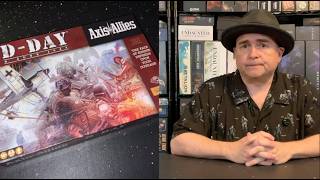
Axis & Allies: D-Day Deep Dive
What the Community Thinks About Axis & Allies: D-Day
Axis & Allies: D-Day occupies an interesting place in the wargaming landscape. The Discriminating Gamer initially dismissed it, finding the 2001 release a departure from classic Axis & Allies design, but a replay of Renegade's 2004 reprint completely reversed that judgment. The joy of rediscovery transformed initial skepticism into genuine enthusiasm, particularly once the advanced rules came into play. Reviewers from The Discriminating Gamer and The Dice Tower converge on the same insight: D-Day succeeds precisely because it abandons the sprawling eight-hour campaign format for a more focused, tactical skirmish on the Normandy beachhead. The map itself carries emotional weight. One reviewer recalled playing it after visiting Normandy, noting how moving pieces across zones they had actually walked created an unexpected resonance with the history.
Core Mechanics That Define Axis & Allies: D-Day
The 16-Step Order Card System
D-Day's backbone is a deliberate, methodical turn structure governed by a deck of 16 order cards. Each round, players reveal cards in sequence, determining which phase executes next. The sequence encompasses naval bombardment, fighter placement, anti-aircraft fire, bomber strikes, unit movement, battle resolution, and reinforcement. Unlike the freeform resource-spending of traditional Axis & Allies, this rigid structure means both players move and attack in a choreographed dance, reducing the kind of strategic variability that defines the Europe and Pacific games. The elegance lies in predictability: each player knows what is coming and when, allowing tactics to flourish within known constraints.
Fortune Cards and Tactics Cards
The advanced rules that Avalon Hill included in D-Day are what elevate the core experience. Fortune cards, drawn at each step, introduce contingency. A die roll might grant all Allied units an extra movement point or reduce them by half. These moments carry genuine consequences: reviewers report rolling a 12 on reinforcements in one flank and a 3 on the other, swinging the entire game's momentum. Tactics cards offer one-time special abilities that either side can deploy, creating tense decisions about when to spend them. Reviewers were emphatic that these cards should never be omitted: fortune and tactics represent the unpredictable friction of actual warfare and the reason to replay the game. Without them, the system feels mechanical. With them, it sings.
The Axis & Allies: D-Day Experience
Focused, Tactical Engagement
The Dice Tower reviewer crystallized why D-Day appeals to a specific audience: it delivers Axis & Allies in 2-3 hours rather than 8+. The smaller scope, tighter unit economy, and specific beaches create strategic puzzles without the sprawl. Reviewers describe a game where every decision carries weight precisely because resources are scarce. How do you push inland when reinforcements are limited? Which objectives are defensible with the units you actually command? The Normandy setting grounds these questions in historical reality, yet the gameplay never slides into simulation; it remains pure tactics.
Tense Resource Management
Reinforcements drive the game's momentum, and they arrive unpredictably. Rolling dice to determine how many units enter each turn creates genuine tension. Reviewers report moments of frustration when the dice betrayed their plans, yet acknowledged this mechanic as a double-edged sword: it adds narrative interest and prevents either side from dictating terms too easily. The game is not about perfect planning but about adapting when fortune shifts the board.
What Makes Axis & Allies: D-Day Stand Out
A Shorter, More Accessible Format
Compared to Axis & Allies: Europe or Pacific, D-Day is a revelation for players who love wargames but lack evening-length availability. The two to three-hour playtime means the game completes in a single session. Reviewers emphasized that this is not a simplified version; it is a different kind of Axis & Allies game, one that trades empire-building for focused combat. The map itself is well-regarded for its clarity and scope: neither overwhelming nor cramped, it captures the historical confusion and geography of the invasion without drowning the player in detail.
Dice and Components That Feel Right
Reviewers singled out the physical experience. The Axis & Allies hit dice included in the box are praised for their tactile quality and visual satisfaction. Rolling a fist of custom combat dice creates the satisfying ritual of wargaming. The board components, the card stock, and the unit sculpts all read as solid craftsmanship. One reviewer complained about rectangular storage boxes when square ones would be more practical, and another noted a missing blockhouse from their copy, but these are minor griefs in an otherwise well-produced package.
Potential Drawbacks
Reinforcement Luck Without Mitigation
The fortune cards notwithstanding, reviewers identified a real problem: the pure dice-roll mechanic for reinforcements has no meaningful mitigation. A player can roll poorly on their critical flank multiple turns in a row, completely undercutting their strategy through no tactical fault. One reviewer rolled a 12 on their left reinforcement zone and a series of 3s on the right, leaving them unable to defend a key objective. The criticism is not that chance exists but that players have no way to hedge against it. Some luck is atmospheric; this much can feel punishing.
The Game Favors German Defense
Multiple reviewers noted an imbalance: the Germans have the advantage. Most described it as approximately 60/40, tilting slightly toward German victory. Reviewers had mixed reactions. One appreciated the challenge, comparing it favorably to Dune: War for Arrakis, which they also found skewed but still engaging. Another remarked that the Allies must maximize every action to overcome German entrenchment, which feels thematically appropriate but strategically asymmetrical. If you like playing against odds and don't mind a game that requires the underdog to execute nearly flawlessly, this is acceptable. If you expect parity, expect frustration.
If You Enjoy Axis & Allies: D-Day
Reviewers recommend exploring other Axis & Allies titles in the tactical mold. Axis & Allies: Stalingrad and Axis & Allies: Guadalcanal both follow similar patterns: smaller maps, fewer units, shorter playtimes. If the appeal of D-Day is the condensed wargaming experience and the fortune cards' narrative tension, Stalingrad delivers that in a different theater. Battle of the Bulge offers another focused engagement, this time at Winter. If you want the Allies to fight a high-chance opponent, Dune: War for Arrakis shares D-Day's philosophical approach to asymmetrical balance. For those drawn to the historical setting and the card-driven chance system, the reprint from Renegade remains in print; reviewers confirm it is worth seeking out, especially if you commit to playing with advanced rules.
What Reviewers Are Saying
"I am just having a ball. I am having so much fun with this game. This is just great."
— The Discriminating Gamer
"I will never play this game without those advanced cards. It would just be too vanilla for me. I really like the highs and the lows that come with these cards."
— The Discriminating Gamer
"This is one of the first Axis and Allies I played that was not a giant campaign. It wasn't the Axis and Allies Europe or Access and Allies Pacific, but rather more specific, smaller units on the board, and I found it to be an enjoyable, quicker time."
— The Dice Tower