





Tapestry: Fantasies and Futures Deep Dive
What the Community Thinks About Tapestry: Fantasies and Futures
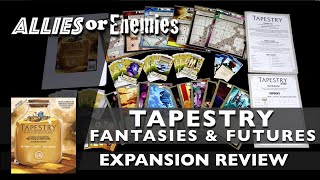
Tapestry: Fantasies and Futures lands as the third and reportedly final expansion for Stonemaier Games' civilization engine, and reviewers across multiple channels embrace it as a thoughtful capstone that respects what makes the base game work while layering on thematic flavor and mechanical nuance. The expansion draws from science fiction, fantasy, mythology, and even comic book lore to create an entirely fresh roster of playable cultures. Allies or Enemies opens with genuine enthusiasm, calling it a well-executed "more stuff expansion" where the stuff is genuinely good, particularly for players who have already logged many hours with Tapestry. Tabletop Tolson calls it a potential "Desert Island game," praising the endless replayability it brings to an already dynamic system. Grant Lyon's retail roundup highlights the tight integration between new mechanics and existing systems, while The Board Game Garden's Jenna simply loves the additional civilization options and keeps coming back to the game repeatedly.
Core Mechanics That Define Tapestry: Fantasies and Futures
Charm Bonuses on Tapestry Cards
The expansion introduces charms: one-time bonuses that trigger when you play tapestry cards adjacent to other cards with charm icons. This mechanic sits comfortably between subtle and impactful. When a charm activates, players gain rewards ranging from resources and victory points to clearing their tapestry deck or drawing new cards. What reviewers appreciate most is how charms layer into existing card play without requiring new mental overhead. Kimberly at Tabletop Tolson describes the charm cascade as the "coolest" element of the expansion, explaining that charms on the left or right (or both) of cards activate when adjacent cards are played, creating cascading engine effects that reward careful tableau building. These bonuses feel like natural extensions of the game's scoring engine rather than forced additions.
Expanded Civilization Asymmetry
The ten new civilizations represent the largest civilization expansion since the base game, each with distinct mechanical hooks that pull players in different directions. Merfolk hold onto extra tapestry cards for deferred scoring, Elder Ones spend saved cards for resource generation, Genies and Fey Folk focus on bonus scoring, Werfolk gamble with coin flips for space exploration, Psionics gain control over randomness through extra die rolls, and the Illuminati benefit whenever other players use dice they have activated. Reviewers consistently praise the breadth. Allies or Enemies notes that after more than thirty civilizations across all versions, the well should have run dry, yet these feel genuinely fresh and different. Tabletop Tolson can't stop playing them, drawn to the variety and the constant discovery of new strategic angles. Even when expressing occasional skepticism about advanced capital mats, reviewers agree that the new civilizations alone justify the expansion for players invested in replayability.
The Tapestry: Fantasies and Futures Experience
Thematic Levity and Magical Worldbuilding
The base Tapestry, while mechanically elegant, has occasionally felt thematically dry to reviewers. Fantasies and Futures injects personality through playful references to Gremlins, wizards, unicorns, X-Men, and dimensional rifts. The six new advanced capital city maps lean heavily into fantasy aesthetics: a Quagmire haunted by Will-o'-the-Wisps, a polar region with ley lines, a Nether World inhabited by imps, and a City in a Bottle that reshapes your entire capital board. These are not merely cosmetic. The thematic layering works because it reflects the mechanical hooks underlying each civ and city mat. Allies or Enemies summarizes this perfectly: after loving Tapestry but finding it occasionally dry, the tongue-in-cheek humor and magical creature flavor breathe new life into the experience without compromising the game's elegant design.
The Rulebook as Unifying Force
Rarely does an expansion's rulebook become a selling point, yet Fantasies and Futures achieves something remarkable: a comprehensive, consolidated rulebook that covers the base game, all prior expansions, and solo variants in one manageable volume. Reviewers consistently describe this as worth the expansion's price alone. Allies or Enemies calls it the first time a rulebook was genuinely the most exciting element of an expansion, noting it eliminates the frustration of cross-referencing multiple rule sheets. Tabletop Tolson praises the rulebook's thoughtfulness in smaller, easier-to-manage proportions that still deliver complete setup instructions, icon references, and specific guidance for each expansion combo without forcing you to read unnecessary sections. This consolidation provides psychological relief for players who have accumulated multiple expansion boxes: finally, one source of truth replaces the scattered papers.
What Makes Tapestry: Fantasies and Futures Stand Out
A Comprehensive Rulebook That Unifies Three Expansions
While prior expansions added mechanical depth, Fantasies and Futures solves a persistent pain point for the engaged audience: rulebook fragmentation. The new rulebook condenses the core game and all expansion content into a single volume with clear instruction for mixing and matching expansion modules. It includes icon reference guides, separate solo variant rules, and setup guidance that scales from base game only through maximum expansion complexity. Reviewers call this approach brilliant and thoughtful, noting that it makes the entire Tapestry ecosystem feel cohesive rather than cobbled together. The rulebook even comes in a more manageable size. This is not merely quality-of-life improvement; it signals respect for players who have invested in the full experience.
Ten Thematic Civilizations That Spark Immediate Interest
Beyond pure mechanical diversity, the new civilizations tap into archetypal fantasy and science fiction tropes that make discovery feel rewarding. Playing as the Illuminati and scoring free victory points whenever opponents roll dice is mechanically clever but also narratively satisfying. The Werfolk capture the risk-reward tension of mythic transformation. Celestials leverage capital city mechanics in fresh ways. These civilizations do not exist in a vacuum: they integrate with the charm system, the new tech cards featuring super-powered abilities like teleportation and levitation, and the expanded phase-five income card. Reviewers highlight that each civ feels like a complete thought, a full pathway to victory, rather than a narrow gimmick. This abundance of viable strategies is what keeps the game feeling fresh even after dozens of plays.
Potential Drawbacks
Requires Ownership of All Prior Expansions for Full Content Access
Players new to Tapestry or those who own only the base game will feel significant limitations with Fantasies and Futures. While the expansion stands alone mechanically, reviewers note that the charm system and phase-five mechanics reward owning Arts and Architecture in particular. The comprehensive rulebook assumes players are mixing modules, which means newcomers must parse setup instructions for scenarios they do not own. Some tech cards and tapestry card effects interact specifically with mechanics from earlier expansions. This is not a failure of design, but it does mean that the expansion functions best as a capstone purchase for collectors rather than an entry point for casual audiences.
Advanced Capital Mats Lack Breakthrough Innovation
While the six new advanced capital city mats are visually appealing and thematically cohesive, some reviewers express mild indifference toward them compared to the civ roster. The impact is incremental rather than transformative. Players note that base capital maps remain fully functional and competitive, so the advanced versions feel optional rather than necessary. This is a minor critique in an otherwise praised expansion, but it suggests that if budget is tight, the new civilizations and tapestry cards offer more mechanical novelty than the city mats.
If You Enjoy Tapestry: Fantasies and Futures
Fans of Fantasies and Futures should prioritize Tapestry itself and the prior expansions, Tapestry: Plans and Employees and Tapestry: Arts and Architecture. The earlier expansions provide the landmark system and the critical Arts track that complement Fantasies and Futures' charm and phase-five mechanics. Beyond the Tapestry family, players drawn to civilization games with modular replay value and low rules overhead should explore Sid Meier's Civilization: A New Dawn, which shares Tapestry's focus on asymmetric leader abilities and branching development paths. Those who appreciate the fantasy and sci-fi theming layered into otherwise dry mechanics might enjoy games like Starfinder or games with strong narrative scaffolding over economic systems, such as Spirit Island or Brass: Birmingham, depending on what balance appeals most.
What Reviewers Are Saying
"The big selling point really is the theme. We love Tapestry, but with a few notable exceptions it's always felt a smidge dry, so it's nice to see some tongue-in-cheek references to Gremlins and wizards to liven things up a bit. The new civilization and city maps are all interesting and a bit different, and even though there are a few new ideas here, there's almost no new rules overhead."
— Allies or Enemies
"Now everything is in one rule book, which makes it so much more streamlined, cuz we're always playing with everything anyway. This is the first time that a rule book was probably the most exciting thing from an expansion. The rule book has saved me so much, like, papers around the table."
— Allies or Enemies
"The charm bonuses, oh, the charm bonuses are so cool. They're the coolest because you get to have the thing on the left or the right or both of them if you place down a tapestry card on that particular side of it. So if there's a tapestry card and you play this down and the charm is on the left, you're gonna get that thing, you're gonna get a resource or you're gonna get a new tapestry card."
— Tabletop Tolson