







Tapestry: Arts & Architecture Deep Dive
What the Community Thinks About Tapestry: Arts & Architecture
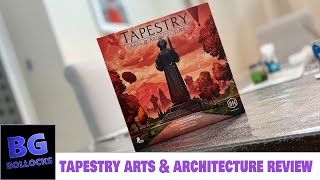
Tapestry: Arts & Architecture is the second expansion for the civilization-building board game Tapestry, designed by Jamey Stegmaier and Mike Young and published by Stonemaier Games. Reviewers see it as a major evolution of the base game, introducing substantial new content rather than incremental balance tweaks. The expansion is particularly praised for how it expands the game's strategic landscape while maintaining the elegant simplicity that makes Tapestry approachable. Players appreciate that Arts & Architecture offers new ways to pursue victory without invalidating existing strategies, giving every player multiple paths to success.
Core Mechanics That Define Tapestry: Arts & Architecture
The Arts Track: A Fifth Path to Victory
The centerpiece of this expansion is the introduction of a fifth advancement track dedicated to the arts. Unlike the four tracks in the base game (science, technology, exploration, and military), each tied to a specific resource, the arts track embraces flexibility. Players advance using wild resources, spending any combination that totals the required cost across their turns. Reviewers highlight that this freedom makes the arts track feel like a genuine alternative rather than a specialized niche. The track unlocks three special landmarks associated with the theme and provides access to the game's most exciting new components. Because advancing on the arts track is always an option, not a locked choice to a particular resource type, it offers a compelling answer for players who find themselves holding resources that don't align with their other strategic plans.
Masterpiece Cards and Stacking Rewards
Masterpiece cards represent the mechanical heart of the arts track experience. When players land on designated spaces, they claim one of these cards from a display and place it on their player mat, where it begins generating ongoing rewards immediately. The genius of the system lies in stacking. Unlike most board game effects, multiple masterpiece cards stack visibly, and at the beginning of each income turn, the player activates all of them simultaneously. A player who has accumulated even three or four masterpieces can generate cascading bonuses that ripple through their entire turn. Reviewers describe the experience as "lucrative" and note that building a masterpiece engine becomes its own pathway to dominance. Some masterpieces grant victory points based on completed rows or columns in the capital city; others offer resources, conquest abilities, or tech card upgrades. The randomized display of three face-up masterpieces also creates a subtle tension: should you pursue the cards you need, or deny them to your neighbors?
The Tapestry: Arts & Architecture Experience
Strategic Depth Without Overwhelming Newcomers
One of the expansion's most praised qualities is its restraint. Reviewers note that Arts & Architecture adds a fifth track and a handful of powerful new cards, but it does not fundamentally alter Tapestry's DNA. The expansion is described as a "gentle expansion" that respects the original game's elegance. Players who want to ignore the arts track entirely can do so, and the game remains balanced. New players do not face an avalanche of new rules; the arts track works exactly like the other tracks in terms of placement and movement. This design choice means the expansion serves both veterans hungry for fresh complexity and newcomers who simply want more of what they already love. The new civilization mats and advanced capital city maps add nuance without requiring a rulebook rewrite.
Engaging Capital City Puzzles
The expansion introduces six new advanced capital city maps that replace the standard 3x3 grids with asymmetric layouts. The archipelago variant, for example, features islands separated by impassable water, forcing players to complete oddly shaped districts rather than uniform grids. The cavern map requires building from top to bottom, blocking completion of lower sections until upper rows are filled. The swamp features lily pads that count as completed spaces but incur point penalties if left visible at game end. Reviewers find these maps particularly satisfying because they create new tactical puzzles every game while remaining thematically coherent. The cloud city allows repositioning of income buildings during the income phase, reflecting the thematic notion of drifting clouds. These maps don't just add visual variety; they force players to reconsider how they build, introducing moments of genuine spatial reasoning and forward planning that deepen the puzzle experience at the core of Tapestry.
What Makes Tapestry: Arts & Architecture Stand Out
Miniatures That Unify the Aesthetic
Each new landmark included in the expansion comes with a beautifully painted 3D miniature. Reviewers emphasize that these are not merely decorative; they create a cohesive visual language across all expansions. Unlike some board game expansions where new components feel aesthetically disconnected from the original, these buildings match the color palette, design language, and level of detail already present in Tapestry. Players appreciate the care taken to make the expansion feel like it belongs, not like it was bolted on. Some reviewers explicitly note that these miniatures are the "nicest part" of the physical package, even while acknowledging that the real gameplay value lies elsewhere.
Inspiration Tiles as Customizable Power
Inspiration tiles function as upgrades to a player's personal income mat. When claimed via light-bulb symbols on the arts track, each player selects one of four unique tiles to place on their board, permanently covering one of their base income rows with an enhanced version. These tiles typically provide additional resources or points beyond what the original row delivered. Reviewers appreciate that inspiration tiles allow players to customize their engine in ways that align with their chosen civilization and strategy. A player building toward specific resources can claim a tile that boosts those yields, or pivot toward victory point generation. The tiles reward forward planning and create moments where a player realizes they've assembled a particular synergy that the tile perfectly amplifies.
Potential Drawbacks
Advanced Capital Maps and Spatial Confusion
While most reviewers praise the advanced capital city maps, several note that the archipelago and other non-rectangular grids require careful spatial reasoning. Players unfamiliar with reading irregular grids report having to laboriously verify each row and column by hand, slowing down the pacing. The archipelago in particular is described as throwing players off because their brains are "wired" to scan regular grids. Some players find themselves second-guessing completed districts and double-checking their work more often than they would on a standard mat. This is not a flaw in design so much as a consequence of increased complexity; reviewers appreciate the added challenge but acknowledge it introduces friction for spatial reasoners who find themselves checking and rechecking their work.
Table Space and Higher Player Count Friction
With the addition of a fifth track, Tapestry now demands more real estate on the table, particularly at higher player counts. The game box no longer fits all components once all three expansions are combined, and at five players with the new arts track prominently displayed, the board presence becomes cramped. Reviewers note that players must figure out exactly how to arrange everything so everyone can reach the board and clearly see their progress on all five advancement tracks. This is a logistical rather than a mechanical concern, but it is worth noting for groups with smaller tables or those who plan to combine all three expansions into a single game.
If You Enjoy Tapestry: Arts & Architecture
Arts & Architecture pairs seamlessly with the base Tapestry game and the first expansion, Plans & Employees. Reviewers emphasize that if you love the civilization-building puzzle at Tapestry's core, this expansion deepens that experience without changing what makes it compelling. The addition of masterpiece card engines and the arts track's wild resource flexibility create a game that rewards more varied strategies than the base game alone. The new civilization mats (collectors, gamblers, urban planners, relentless, and renegades) each introduce distinct mechanical flavors that ensure no two civilizations feel redundant even across all three expansions. Reviewers also highlight other civilization-building games with similar DNA: Through the Ages, Civilization, and Clash of Cultures offer comparable blends of tableau-building, track advancement, and long-term strategy, though none combine those elements quite the way Tapestry does.
What Reviewers Are Saying
"I can't imagine playing without the fifth track of arts and architecture which now you have five tracks that you're working your way up that you are paying resources for and getting some insanely cool stuff with."
— Tabletop Tolson
"With this new advancement track it's not as cut and dry, there's a new layer of complexity that will cause some analysis paralysis definitely but it also just adds more to your strategy and there's just a lot more that you can do with the game."
— Before You Play
"This is a very gentle expansion, I think. It's probably the way to put it. There are some expansions that add a whole lot of new mechanics and sometimes, you know, breaks the simplicity or elegance a game used to have."
— Meeple University