





Tapestry: Plans and Ploys Deep Dive
What the Community Thinks About Tapestry: Plans and Ploys
Tapestry: Plans and Ploys is the 2020 expansion from Stonemaier Games for Tapestry, the civilization-building game designed by Jamey Stegmaier. Reviewers treat it as a faithful extension of the base game rather than a reinvention. Jack of The Cardboard Herald notes that the original drew a mix of praise and criticism over its balance and its sense of being underdeveloped, and that this expansion mostly fleshes out the elements already in the box.
The consensus among reviewers is that the expansion is worthwhile for players who already enjoy Tapestry. Jack says the variety and interaction are the base game's strongest qualities, and the expansion leans into them with more sieves, more tapestries, and more buildings. Rodney Smith of Watch It Played takes a more descriptive approach, walking through the new components and rules without delivering a verdict. The hosts of The Mill, Dusty Crane and Josh, offer an unboxing that focuses on first impressions of the art and components and on anticipation for the first game.
Where reviewers diverge is on necessity. Jack concludes that nothing in the box feels essential, and that players who are ambivalent about Tapestry will likely find the expansion is not worth buying. Players who love the sieve building, the interaction, and the solo mode, by contrast, are told the expansion is worth exploring.
Core Mechanics That Define Tapestry: Plans and Ploys
Counter-Trap Ploy Cards
Jack calls the new trap-style cards the most dramatic change in the expansion. Traditionally, a player who conquers a region risks an opponent's trap, but these cards can be played in response to a conquer action and carry alternate effects. Rodney Smith explains that Doublecross can be discarded when another player tries to play a trap against you, cancelling the trap and granting five victory points. Surprise Party works similarly: the normal rule that a trap denies the middle island achievement also applies, but the defender topples an outpost instead and gains 15 points. The Mill describes Stolen Plans as a way to cancel a trap and take a random tapestry card from the trapper's hand. Jack says that trapping a trap is a feature Jack is a big fan of, and the Mill notes that the cards finally give players tools to counter traps rather than simply absorbing them.
Landmark Draft and Tiebreaker
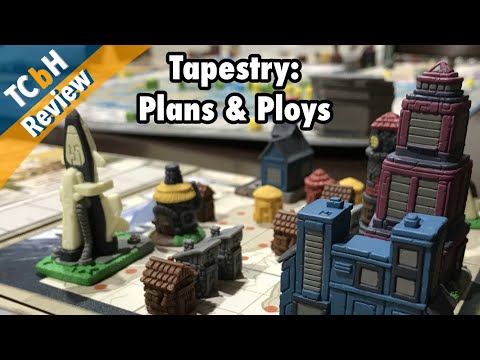
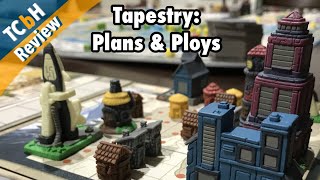
The expansion adds seven unique painted landmark miniatures and five landmark cards, along with landmarks such as the Monolith, Stadium, Urban Farm, Digital Studio, Skyscraper, Game Store, and TV Station. Rodney Smith describes the setup: the player going last draws landmark cards equal to the number of players, each person picks one, and the rest pass counterclockwise until everyone has a landmark. This avoids competition for the same landmark and gives each player a distinct goal to chase. Rodney also highlights a new tiebreaker, which replaces the original rule: "If players are tied for the most points, the one with the tallest miniature in their capital city wins." The Mill praises the landmark buildings as a visual highlight of the box.
The Tapestry: Plans and Ploys Experience
Growing Agency and Variety
Jack describes the expansion as increasing player agency. Sieves are more complex, with goals such as assigning bonuses based on landmarks already received, rewarding players who cover normally impassable spots in their capital, or gaining territory bonuses from the surrounding geography. The new civilizations feel powerful and versatile, and the new tapestries encourage particular styles of play for their era, with Engineering granting an immediate bonus by upgrading a new technology. Jack notes that a sieve such as the Advisors can feel powerful or despicable, depending on whether you are the one dealing out the garbage cards. The emotional center of the expansion is that tension between satisfying combinations and the frustration of facing them.
Solo Play With Extra Overhead
Jack's solo experience is warmer than Jack's view of the box as a whole. Jack describes the base game's solo mode as one of Tapestry's best features, and says the expansion's new autonomous opponents, the Hucksters, add real challenge. The Hucksters collect tokens and cards that count as additional landmarks for their scoring, and when a player's action would grant one of these cards, they can take it from the Hucksters instead of the draw pile. The five Automa scenarios also introduce inventive new challenges, such as a scenario in which progress on other tracks is gated behind advancing a chosen favorite track. Jack's qualification is that these scenarios add their own rules to remember, so Jack often has to consult the manual, which means new challenges come with new overhead.
What Makes Tapestry: Plans and Ploys Stand Out
The Advisors and the New Civilizations
Jack names the Advisors as Jack's favorite of the new civilizations. Their ability hands out unsolicited advice: when an opponent would draw a tapestry card, the player gives them one from their own hand instead. Jack says the new civilizations, as a group, sit on par with the most dynamic and interesting of the original factions, encouraging certain styles of play while feeling versatile. Rodney Smith points out that the ten new asymmetric civilization mats can be shuffled in with the originals, and that in a five-player game every person could be offered a choice of two of the new ones.
Artwork and Presentation
Reviewers consistently praise the polish of the components. Jack says the base game's polish and presentation are a highlight, and the expansion carries that over with a dedicated burlap sack for exploration tiles and a new storage bag. The Mill's hosts are enthusiastic about the artwork by Andrew Bosley, whose illustrations also appear in Everdell, and they single out the civilization cards and the new buildings for their look. Rodney Smith adds that the rulebook includes designer notes explaining the reasoning behind the new additions, which makes the expansion feel considered rather than bolted on.
Potential Drawbacks
Balance Questions From New Variables
Jack's central criticism is that the new civilizations and tapestries introduce more variables that can call the balance into question, layered on top of a base game that already faced balance concerns. Jack notes that the back of the rulebook includes errata patches for existing factions, which address much of the original balance problem. In Jack's group's games, nothing about the new content felt overpowered, but the trickiness and versatility of the new material are likely to prompt ongoing questions about how it compares with the originals. Jack suggests that stickers or replacement cards for the patched factions would have been a helpful way to address the known issues in print.
Setup, Storage, and Essentialness
Jack argues that the expansion does not feel essential, since it adds variety to a game that already has plenty of it without addressing the base game's known issues. The expansion also adds components that increase the overhead of the box. Jack chose to leave the landmark tokens in the box because Tapestry is already a chore to set up, and Jack notes that the new buildings mean the game cannot be consolidated into a single box without removing the inserts. Rodney Smith similarly observes that the solo scenarios come with special setup instructions, new in-game rules, and unique goals, so players need to track each one carefully.
If You Enjoy Tapestry: Plans and Ploys
Reviewers position the expansion as a way to deepen Tapestry rather than replace it. The base game remains the essential reference point: players who like the interplay of sieves, civilizations, and tapestries will find more of what they already enjoy, and players who value a strong solo mode will find the Automa scenarios and Hucksters a meaningful addition. Jack's advice is that players who dislike the base game, or who only occasionally bring it out, will not gain much from the expansion. Players who already love Tapestry, on the other hand, are likely to find Plans and Ploys worth their time, especially for the counter-trap cards and the new civilizations.
What Reviewers Are Saying
"My biggest criticism is that nothing about this really feels essential. Tapestry already has so much variety just rammed right in there, and it's not really wanting more, and the things that this expansion does add doesn't really address any of the issues people had with the base game."
— Jack, The Cardboard Herald
"With the expansion there's also a new tiebreaker rule instead of the original one. If players are tied for the most points, the one with the tallest miniature in their capital city wins."
— Rodney Smith, Watch It Played
"Tapestry has taken the place of Scythe, possibly for Josh's favorite game, so this is going to be kind of a him getting to see this for the first time too."
— Dusty Crane, The Mill