




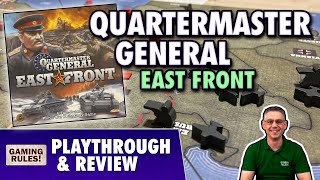
Quartermaster General: East Front Deep Dive
What the Community Thinks About Quartermaster General: East Front
The discussion here comes from Gaming Rules!, the channel run by Paul Groen. It covers a full live playthrough against their opponent Bill, along with a monthly video log where the game gets a shorter but warm write-up. Paul admits to not having noticed the game until spotting it on Board Game Arena, even though the physical version came out in 2023. Paul treats the two-player game as a step up from the six-player original, though only slightly, and places it below South Front in complexity.
Overall the tone is enthusiastic without being uncritical. Paul calls the combat cinematic, describes the rulebook as clear and full of examples, and singles out the reaction cards as the part of the design that makes the game tactical. Paul is also candid that a new group has to absorb the supply rules before the game clicks. The live stream reflects that learning process, with the table checking the rulebook, correcting setup and draw details, and talking through timing questions as they go. An earlier monthly log adds a brief note that Paul had played East Front on Board Game Arena, had picked up the physical copy, and really likes it.
Core Mechanics That Define Quartermaster General: East Front
Supply lines and interdiction
Supply is the mechanic reviewers keep returning to. A unit is in supply when it can trace a path back to a supply flag, and that path can run through spaces the player controls even when no piece is standing there. The counterweight is interdiction. Infantry, tanks, and planes can cut an enemy line across adjacent land, fleets and planes can cut it across adjacent water, and planes are the most flexible because they can cut supply where a tank cannot. Units that fall out of supply can move back into supply but cannot attack, and they cannot voluntarily step into an unsupplied space. In the stream, an advancing tank threatens to cut a route, and the players work through whether the units behind it can still trace supply, which shows how quickly a single move can change the board.
Two actions, reactions, and a hand that matters
Every card has two uses. A player can spend it for the printed action, or hold it as a reaction during the opponent's turn. Each turn runs through a first movement step, two action steps, a second movement step for tanks and fleets, a supply check, and a draw. Among the actions, a player can play a card, use a contingency card, discard a card to move a piece, discard one or two cards to conscript units, or make a desperate attack by discarding two cards. Reactions include retreat, anti-air, naval combat, standfast, and exchange, and they alter how casualties are taken. The table notes that playing reaction cards reduces your options on your own turn. The stream shows that tension in real time, when a player looks at a strong card and realizes the reaction printed on it is the one they need to keep.
The Quartermaster General: East Front Experience
Cinematic back-and-forth in battle
Paul's strongest praise is aimed at the rhythm of combat. An attack can be answered with a retreat, an anti-air card that makes a lost plane count as if it never existed, or a standfast, so the attacker has to decide again and again whether to press on. Paul describes how that back-and-forth turns into something quite cinematic, even though the underlying system is just playing cards and removing units. Each exchange feels like a small dramatic beat rather than a bookkeeping step, which is why the battles stay memorable long after the cards are put away.
Historical texture from the card text
Gaming Rules! treats the deck as a kind of history lesson. The cards are meant to represent things that actually happened, and Paul sees the same approach in the base game, where campaign-level events such as the Atlantic war made it difficult for the Allies to invade. The live stream spends time on Barbarossa, the initial invasion that stalled before the winter, and the Soviet move of production east of the Urals, and the table agrees that the game plays out in a similar shape. The war's clock also comes up repeatedly, with the observation that time is on the Russian side, so the historical framing shapes how the whole game is read.
What Makes Quartermaster General: East Front Stand Out
One player, two factions
Even in a two-player game, the Axis player controls two factions: the Germans and the Pact, a group of nations that assisted Germany. Their pieces are visually distinct, but they can share spaces. When the Axis player attacks, only one faction can join a given attack, and when the Axis defends, both factions defend as one. Gaming Rules! calls this one of the game's peculiarities, and it carries into the cards, many of which can be played only if they refer to the faction of the piece. The result is a game where the Axis player has to think about which group of troops is moving, not just which pieces are on the board.
A series that scales up
East Front is part of a series designed to combine. Gaming Rules! notes that South Front and the upcoming West Front can be linked into one epic game for five or six players that runs about five or six hours. Paul stresses that groups need to know what they are getting into before attempting it, or the game can turn into a mess. East Front and South Front also share most of their rules but feel different in play, with East Front giving two actions per turn and South Front giving one. That difference is enough for Paul to say that if you own one and enjoy it, the other is worth getting too.
Potential Drawbacks
The supply rules and reaction tension
Reviewers are careful not to call the game tricky, but they agree that mastering supply is the main hurdle. The rules for interdiction, supply paths, and out-of-supply movement need to be in hand before the game reads smoothly. The live stream shows the table pausing to check details such as how many cards are drawn each turn and whether a sustain attack card can be used in winter. Reactions carry a similar cost, since a player with no cards in hand during the opponent's turn is vulnerable. These are first-play concerns, and the reviewers expect them to ease with experience.
Early pressure and a comeback that can arrive late
Scoring happens in set rounds, and each controlled star counts as a point. Russia starts with more stars, so Germany has to push early or lose the long game. Gaming Rules! sees the German side needing that early push, and the stream repeats the point that time is on the Russian side. The stream also shows how a lack of reinforcements can stall an attack, with one player noting they could not raise enough forces to mount a counterattack. Paul expects the Soviets to grow stronger as the late-war cards arrive, which means a German side that stalls has little time to recover.
If You Enjoy Quartermaster General: East Front
- Twilight Struggle: Paul compares the feel of East Front to Twilight Struggle, where knowing the cards lets an experienced player anticipate what the opponent will do. Paul notes that the more you learn the cards, the more skillful the game becomes. Players who enjoy that kind of card knowledge rewarding practice should find East Front familiar.
- Quartermaster General (base game): The stream calls East Front more complicated than the six-player original, though only by a small margin, and describes the original as a World War II game for six that is snappy to play in about two hours. Players who want the same card-driven feel with a lighter entry point should start there.
- War of the Ring card game: Paul is a fan of designer Ian Brody, who also designed War of the Ring. Reviewers do not compare the two games' play in detail, so this is the link to follow rather than a verdict on how they feel.
- Quartermaster General: South Front: Paul describes South Front as the more demanding sibling, with one action per turn instead of two, and admits a slight leaning toward it. Players who like the East Front card economy and want more difficulty should try it next.
What Reviewers Are Saying
"You get this really interesting interplay between the way that the attacking and defending forces work. [...] The battles end up being quite cinematic for just a simple system of playing cards and removing units."
— Gaming Rules!
"The supply rules are I'm not going to say tricky, but once you get the supply rules, that's part of the biggest learning thing for this game. Yeah, I really like the idea that it's got supply cuz it's so crucial."
— Gaming Rules!
"You are vulnerable. Yeah, that's what I love about the card system is that it has the reactions on and they're just as important as the actual cards themselves for the actions."
— Gaming Rules!