


Tucana Builders Deep Dive
What the Community Thinks About Tucana Builders
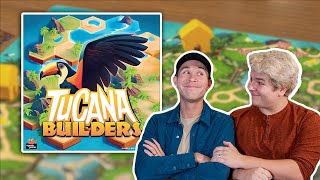
Reviewers present Tucana Builders as a tile-placement route builder that is related to, but distinct from, Trails of Tucana. It is not a retitled edition. Trails of Tucana is the original roll-and-write, and in the kovray review the group played that version first, calling it the first version of the game. The publisher description read aloud in Getting Games calls Tucana Builders a sequel to that award-winning title. Chairman of the Board describes it as a more physical, component-driven version of the original, with hex tiles placed on a board instead of routes drawn on sheets.
The overall verdict is positive but measured. Kovray calls the game fun and very accessible, yet places it beside Kuruba, Savannah Park, and Caldera Park as a tile filler and says they would still pick those titles over it. Getting Games is drawn to the look of the pathing, and Chairman of the Board, who enjoyed the original, says they want to get this version onto the table soon. Reviewers agree that the appeal lies in the route puzzle and the scoring tension it creates, while the randomness of the tile draw is the element that divides opinion.
Core Mechanics That Define Tucana Builders
Tile Placement
Each turn begins with a terrain card being revealed. Every player then draws a random tile from the central pool and places it on the matching terrain of their own player board. Kovray describes the arc of a game as a board that slowly becomes more restrictive, so the early placements feel open and the later ones force players to fit their paths around what they have already built. Path tile quantities are shown on each player sheet, and the goal of every placement is to create routes that carry animals back to their huts.
The wild card softens that constraint. Kovray explains that players can use it to place the drawn tile on a different terrain type, and that a wild card is available in each of the two rounds. Kovray also sums up the core loop as drawing the right tiles and hoping they line up to make the routes work, which is exactly the tension the wild card is designed to relieve.
Compound Scoring
Scoring is built from several independent tracks that combine at the end. At the close of each round, each animal that reaches its corresponding hut is worth a point. Toucans are wild and can score multiple times if they head to different homes, and each connection a toucan makes is worth a point as well. Connecting huts gives no direct benefit, but every hut scores the animals that arrive there, so an animal heading to a connected hut can score twice. Getting Games highlights the knock-on effect of the first round: connections that score in round one score again in round two, so an early high score keeps paying out. After the second round, the lowest scoring track is counted once more, and the player with the most points wins.
The Tucana Builders Experience
Quick, Tactile Play
Tucana Builders is built around a short and steady rhythm. Two rounds of twelve turns each means every player places one tile per turn, and kovray notes that this keeps the game moving at a brisk pace that makes it easy to come back to. The setup is also a pleasure in its own right, since players lay out the small tokens and tiles by hand before the first card is revealed. Kovray points to that tactile quality as a reason the game works as an introduction for people who have not played many board games, and calls it very accessible and easy to teach.
Early Planning Versus the Endgame
The round one score acts as an intermediate checkpoint, and that checkpoint shapes the whole game. Kovray describes a genuine balancing act: a player can score heavily in round one and build toward a stronger second round, or score lightly to keep flexibility for a larger payoff at the end. Because the end-of-game scoring is so rewarding, the design nudges players to build important connections early without overcommitting. Kovray captures the emotional arc of this tension well, describing how a game can begin with a promising puzzle and then turn into a frustrating one when the tile needed to finish a connection never appears. When the perfect tile does arrive and completes a long route, the payoff feels excellent.
What Makes Tucana Builders Stand Out
Replayability Through Variable Setup and Achievements
Replayability is central to the praise. Each game begins with a variable setup drawn from setup cards and starting cards, so the boards and tile flows differ from session to session. Chairman of the Board singles out the original Trails of Tucana for lacking replayability because its sheets were always the same, and this version directly addresses that complaint. For a more competitive layer, the advanced variant has players draw two random achievement cards at the start and race to complete their objectives first, earning a higher point value for doing so. Kovray says the variability keeps the tiles feeling fresh, and that racing for achievements is what makes the game especially fun to play.
The Wild Toucan Mechanic
The toucans are the most distinctive element of the scoring. Because they are wild, a single toucan can head to different huts and score more than once, and each connection it makes adds another point. Kovray singles this out as the dynamic that can really help a player score a lot of points, and enjoyed managing it while racing for achievements. Combined with the wild card, which lets a player redirect a drawn tile to another terrain type, the toucans give players a flexible route to recovering from a poor draw. That flexibility is what keeps the moments of a perfectly lined-up tile exciting rather than merely lucky.
Potential Drawbacks
Tile Draw Randomness
The most common criticism is that the tile draw can frustrate planning. Kovray warns that because players draw from a pool, they may keep drawing similar tiles, and that the distribution, while real, does not guarantee a balanced experience. A player can set up a strong connection and then never draw the tile needed to finish it, and kovray notes that players who want everything to fall into place may find this hard to enjoy. Player count also changes how the randomness feels. At two players the pool is larger and less visible, so players are unsure what will come up. At five players more tiles surface during play, so the table sees which ones have already been drawn and can hope for the rest.
A Light Design for Crunch Seekers
Kovray describes Tucana Builders as a pretty light game in terms of its mechanics, with the core built around simple route building. Players who want something crunchier, with deeper systems or heavier decisions, may find it lacking. The game asks for spatial awareness and planning rather than complex engines, and that simplicity is part of why it works as an accessible title. For players who want more depth from a tile-laying game, this is the trade-off to weigh before buying in.
If You Enjoy Tucana Builders
Kovray compares Tucana Builders most directly to Kuruba, Savannah Park, and Caldera Park, which Kovray groups together as tile fillers. If you enjoy the feel of tile-laying puzzles, those games deliver a similar satisfaction of fitting pieces together for points. Kovray is candid about still choosing those titles over this one, but also says that fans of that style will find Tucana Builders great.
For fans of the original, Trails of Tucana is the natural companion. It is a distinct, roll-and-write game that Chairman of the Board describes as enjoyable, and reviewers treat the two as sharing a theme and an adjacent feel while playing quite differently. Trying the original alongside this version lets you compare the roll-and-write sheets with a physical board and a shared tile pool.
What Reviewers Are Saying
"I think the route building is interesting. I think the dynamic of making your routes, especially with the wild toucans, can really help you score a lot of points."
— kovray
"I love the look of the pathing that can be happening in games like this. I think this one is drawing my attention a lot more than Trials of Tucana did."
— Getting Games
"I really did enjoy the original Trails of Tucana but I thought the replayability was somewhat lacking because you always have the same sheets each time. This one's a more physical component version of the game."
— Chairman of the Board