




Arkham Travel Guide Deep Dive
What the Community Thinks About Arkham Travel Guide
Arkham Travel Guide arrives as a creative collision: a Lovecraftian roll-and-write that manages to feel both thematically inventive and mechanically grounded. Reviewers embrace the premise with genuine enthusiasm. The game generates immediate engagement through its high-concept hook, yet opinions diverge on whether the theme fully delivers or merely sits atop solid mechanical foundations. Most reviewers praise the core experience, though concerns about production quality and complexity keep some from offering unqualified endorsements. Overall, the game succeeds at what it attempts: a roll-and-write that channels Lovecraft's Arkham setting into an adventure about tour guides navigating monster-infested streets.
Core Mechanics That Define Arkham Travel Guide
Collaborative Dice Drafting
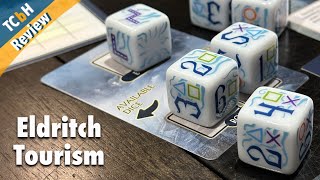
The heart of Arkham Travel Guide lies in its interpretation of dice drafting. Unlike traditional random roll-and-write systems where a single player's roll determines everyone's options, Arkham Travel Guide empowers the table to shape each round collaboratively. Five dice roll, then players take turns removing dice from the pool, narrowing down to the final two that determine coordinates on the map. This shared decision-making creates moments of negotiation and denial that reviewers find surprisingly engaging. The system echoes On Route's elegant design, translating that proven formula into Arkham's grimmer setting. By ceding control to the group rather than chance, the game grants players meaningful agency while maintaining the uncertainty of dice rolls.
Route Building and Map Interaction
Players chart pathways through a coordinate-based map, connecting locations to form tours that score points for tourists and landmarks of various types. The game layers additional strategic depth through Arkham-specific mechanics: mystic shops that grant one-time powers drawn each round, and gates that permit warping to non-adjacent locations. These features create pathfinding puzzles where clever routing multiplies rewards. The final scoring combines tourist types with landmark types along your chosen route, meaning the route itself becomes a puzzle. Reviewers note that while the mechanics can feel mathematical, they reward careful planning and spatial thinking.
The Arkham Travel Guide Experience
Comedic Dissonance and Goofy Charm
The game's greatest strength lies in its tonal audacity. Being a tour guide in an actively haunted Lovecraftian city shouldn't work as comedy, yet the premise generates genuine delight. Reviewers describe encountering Elder Gods and horrible places while dutifully shepherding tourists as darkly funny. Rather than play Arkham as cosmic horror, the game asks you to find the absurdity in maintaining professionalism amid otherworldly catastrophe. This comedic edge distinguishes Arkham from other Lovecraft-themed games that trade entirely in dread and despair.
Mechanical Tension Beneath the Surface
Despite its lighthearted veneer, Arkham Travel Guide builds genuine tension through its final boss encounter. Before game end, players confront one of four Old Ones (Cthulhu, Yog-Sothoth, Dagon, or Shub-Niggurath), depending on random outcome. How well you've avoided horrible places and leveraged otherworldly creature abilities determines whether you gain rewards or lose tourists. This late-game swing introduces a push-your-luck element that can dramatically reshape final scores. The mechanic feels thematic and strategic rather than arbitrary, forcing players to balance aggressive route-building against defensive positioning. This tonal shift from goofy planning to tense resolution adds texture and replayability.
What Makes Arkham Travel Guide Stand Out
Thematic Integration That Serves Gameplay
Many roll-and-write games drape theme over mechanical skeletons with little regard for coherence. Arkham Travel Guide stands apart because its Lovecraftian setting directly informs how the game functions. Dice represent chaotic forces you collaborate to control. Routes evoke pathfinding through a dangerous city. Tourists become stakes in your quest for advancement. Even the turn structure, where players remove dice before coordinates materialize, mirrors the collaborative tension of an adventure party choosing their next destination amid uncertainty. Reviewers consistently note that this integration elevates the experience beyond generic paint-by-numbers, making players feel they're genuinely navigating Arkham's nightmare streets.
Dual-Game Value and Replayability
Arkham Travel Guide ships with two complete games: Arkham Travel Guide and Insmouth Travel Guide, each offering distinct mechanics and systems. Insmouth adds personal character powers and bonus route dice, creating variation from the base Arkham experience. This dual structure mirrors proven designs like Ticket to Ride and its geographic variants. For a modest price point, players receive genuine value and incentive to return repeatedly. The coordinate-based map changes each game, ensuring the puzzle never feels solved. Reviewers praise both versions for maintaining the core appeal while adding fresh strategic layers and exploration opportunities.
Potential Drawbacks
Production Quality Compromises
Arkham Travel Guide arrives in a blister pack without dedicated storage. This packaging choice proves problematic: the packaging splits easily and provides no resealing solution. The included dry-erase markers present a more serious issue. Reviewers report that markers lack sufficient darkness and precision to make clear marks on the map. In poor lighting, green and red marks become nearly invisible, forcing players to source external markers just to make the game playable. These production decisions undermine an otherwise engaging experience, turning play setup into an exercise in frustration before the game even begins.
Mathematical Complexity and Mechanical Weight
While praised for its elegant dice-drafting core, Arkham Travel Guide can feel mathy and dry during play. The coordinate system, tourist-type multipliers, landmark scoring, and special ability tracking create layers of accounting that benefit analytically-minded players but may alienate those seeking lighter experiences. The game doesn't feature escalating momentum or narrative arcs beyond the final boss encounter. For experienced roll-and-write players, this measured approach works fine; for families or casual players, the mechanical weight may prove heavier than expected for its playtime.
If You Enjoy Arkham Travel Guide
Players drawn to Arkham Travel Guide's collaborative dice-drafting should explore On Route, the design that clearly inspired this game's core mechanic. Both reward careful route planning and shared decision-making, though On Route situates itself in modern cities rather than cosmic horror and plays as the simpler of the two. Beyond that direct lineage, the appeal is for players who want their roll-and-write to come with a real thematic hook: a goofy premise up front, and a genuine mechanical sting waiting in the final boss encounter.
What Reviewers Are Saying
"The theme does make it a little bit more goofy in a good way and inviting and interesting and a little bit more funny as you're arranging your things. I like that there's a decent amount of risk that you start building up throughout the game as you try to decide how far you can really stretch yourself."
— The Cardboard Herald
"It's a lot more than just a simple roll and write game. I actually class it as a mediumweight game that might be a little bit too much for families, whereas I think the original On Route is quite a bit simpler, but it's cool. It actually felt quite thematic, especially with the boss fight at the end."
— Gaming Rules!
"They take the roll and write mechanisms of a game I covered on the channel On Route, which I thought was an absolutely brilliant pathbuilding roll and right. They take them and they take it out of the modern world where players are competing tour guides just trying to map out the best path through modern real world cities and instead changed it to we're still a tour guide trying to map out the ideal path through monster infested New England villages which just sounds really really cool to me, and it still has that same kind of cozy feel to the gameplay, but with Cthulhu trying to keep your tour people alive."
— Rahdo Runs Through