







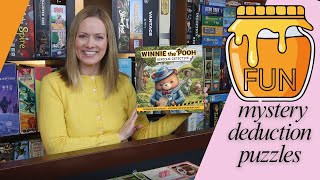
Winnie the Pooh: Serious Detective Deep Dive
What the Community Thinks About Winnie the Pooh: Serious Detective
Winnie the Pooh: Serious Detective arrives as one of the most unusual licensed games to emerge in recent years. Reviewers describe it with genuine surprise and delight: the premise itself is disarming. Here is a detective mystery game built not in a gritty urban setting or fantasy noir, but in the Hundred Acre Woods with Christopher Robin and friends. Reviewers note that on paper, the concept sounds like "absolute madness," yet in practice it works. The game delivers layered nostalgic storytelling that speaks to adults while remaining accessible to clever children, turning beloved characters into investigators solving genuine mysteries rather than simply reminiscing.
What unites reviewer reactions is how seriously the game takes its premise. This is not a novelty product playing the IP for laughs. The narrative design, artwork, and overall tone demonstrate that the designers understand the Winnie the Pooh world deeply enough to transplant detective-mystery conventions into it without breaking character. Reviewers praise how the game captures the literary charm and whimsy of A.A. Milne's original works while building something entirely new.
Core Mechanics That Define Winnie the Pooh: Serious Detective
Exploration and Story Card Revelation
Players explore locations within three fictional worlds, revealing story cards that piece together mysteries. Each card offers testimonies, observations, clues, and puzzles that must be assembled logically to solve the case. The game uses action dice to determine which locations players can visit and which actions they can take. Movement, investigation, and conversation all consume actions rolled from shared and personal dice. As reviewers note, the card system creates a natural timer; players have limited opportunities to reveal information before running out of actions, forcing strategic decisions about which threads to pull and when.
Cooperative Deduction and Puzzle-Solving
The core experience is collaborative deduction. All players work together, pooling observations to deduce who committed what and why. Reviewers highlight that puzzles are a key element; some are straightforward to solve once players understand the logic, while others require lateral thinking. The game includes multiple smaller puzzles woven into the narrative alongside the overarching mystery, giving the experience rhythm and payoff. Each player character brings a unique special ability that influences how they gather information or modify dice results, ensuring roles feel distinct and meaningful during play.
The Winnie the Pooh: Serious Detective Experience
Nostalgic Immersion in Beloved Worlds
Reviewers consistently describe the experience as immersive in a literary sense. The game invites players to inhabit iconic fictional spaces from childhood: the Hundred Acre Woods, Wonderland, and Camelot. Rather than a pastiche or parody, the game uses these settings genuinely; it asks "What if Winnie and his friends became detectives?" and follows that thread sincerely. The voice acting reading and atmospheric writing create a sense of stepping into an animated adventure where mystery has intruded into familiar comfort. This nostalgic quality appeals strongly to adult players who cherish these characters, while the whimsy and gentle tone remain appropriate for younger players who may not grasp all the story layers.
A Reading-Heavy Narrative Experience
The game delivers mystery through extensive reading. Story cards contain narrative exposition, character dialogue, and contextual clues, and players must read these aloud to each other to understand the investigation. Reviewers note this is both a strength and a drawback: the writing is engaging and captures the literary charm, but it can lead to "voice weariness" during longer play sessions. By the end of a case, some players report feeling the cumulative weight of reading. However, this also creates natural entry points for players to share the reading load, turning the experience into a collaborative storytelling session rather than a silent puzzle-solving exercise. The game works best with engaged players willing to inhabit the tone and invest in the narrative.
What Makes Winnie the Pooh: Serious Detective Stand Out
A Fresh Take on Detective Games
Detective games are crowded territory, but Winnie the Pooh: Serious Detective distinguishes itself by rejecting the murder-mystery formula. Instead of bodies and crime scenes, mysteries are rooted in character and consequence: rabbits go missing, kingdoms fall into chaos, familiar places become strange. This approach feels fresher than standard detective fare and makes the game genuinely suitable for families in a way that post-apocalyptic crime procedurals cannot be. Reviewers appreciate that the game offers puzzle-solving and deduction without the darker elements of its genre cousins, expanding the detective archetype rather than merely reproducing it.
Sequential Case Design with Lasting Consequences
The three cases included in the box are not isolated adventures. Each case directly affects the next in mechanical and narrative ways. Choices made in Case One influence the setup and experience of Case Two. This legacy-like structure is unusual in cooperative mystery games and creates replay value tied to consequence. Reviewers note that elements carry forward between cases, giving players reasons to reflect on their detective work and how decisions ripple through the Hundred Acre Woods. The game treats its three mysteries as a single connected narrative arc rather than three standalone puzzles, rewarding players who notice callbacks and shifts in the world state.
Potential Drawbacks
Playtime Extends Well Beyond the Box
Winnie the Pooh: Serious Detective claims 75 to 90 minutes per case on its box, but reviewers consistently report actual playtime runs to two to two and a half hours. This is a significant gap that affects planning. Casual players expecting a quick evening mystery may find themselves deep into a long narrative commitment. Those playing a full case back-to-back, or multiple cases in a single session, will face substantial time investment. Reviewers recommend treating each case as a distinct evening and accounting for the full 90 minutes of immersion, not the 75 minutes promised.
Heavy Reading Load Requires Engagement
The narrative relies entirely on reading story cards, and the sheer volume of text means players must commit to the experience. For groups that prefer minimal narrative overhead or quick card explanations, the constant reading and dialogue can feel tedious rather than enriching. There are no skippable elements; each card contains puzzle clues, so players cannot skim or speed through. Groups will need to decide beforehand whether they are in the mood for an extended storytelling experience. Those who are will find the writing charming; those who are not will feel the game pulling them toward immersion rather than play-and-move-on efficiency.
If You Enjoy Winnie the Pooh: Serious Detective
Players drawn to Winnie the Pooh: Serious Detective will likely appreciate other narrative-driven mystery and deduction games. Detective: City of Angels shares the investigative framework and collaborative problem-solving but sets it in a noir Los Angeles; reviewers note it has a similar "gather clues and deduce truth" loop. Detective: A Modern Crime Board Game offers deeper complexity and multiple solution paths, appealing to those who want puzzles with fewer obvious answers.
For lighter deduction without the reading burden, Detective Club emphasizes social deduction and inference in a party-game format. The Chameleon and Fake Artist Goes to New York explore deduction through different mechanics but share the collaborative "figure out what is true" thread. Detective City of Angels stands closest in tone and scope: cooperative, narrative-rich, and grounded in playful but genuine mystery.
What Reviewers Are Saying
"The game captures the Winnie the Pooh world and storytelling and characters. I found it incredibly easy to speak, let's say, like Rabbit or like Eeyore. There are some really specific things to characters that make people feel like they're playing with someone different than other players."
— Tabletop Tolson
"This game asks the question, "What if classic tales were reimagined as thrilling detective adventures?" This game features Winnie the Pooh and other characters from children's stories, now turned into detectives solving cases in fictional worlds like the Hundred Acre Woods, Wonderland, and Camelot. This is a narrative-driven game that allows players to explore locations, uncover clues, and discover puzzles. On the face of it, this sounds like absolute madness, and I'm here for it."
— Totally Tabled
"Using action dice and exploring the locations, players reveal story cards with testimonies, observations, puzzles, everything that true detective work is made of. Winnie the Pooh and his friends are doing some work."
— Our Family Plays Games