









Collect! Deep Dive
What the Community Thinks About Collect!
Collect! has emerged as a sleeper hit among board gamers who value fast-paced card games with genuine player interaction. Reviewers consistently praise its accessibility and charm, though opinions diverge on whether the game has staying power for serious hobbyists. The consensus is clear: this is a game that works exceptionally well at what it sets out to do, even if what it does is more modest than what some players prefer. The community appreciates its compact footprint and family-friendly design, with particular enthusiasm from players who discovered it trending on Board Game Arena. Where reviewers part ways is on depth. Some see rich strategic layers lurking beneath the simple rules; others view the game as primarily a vehicle for interaction and luck-driven fun.
Core Mechanics That Define Collect!
Set Collection
At its heart, Collect! is a set collection game. Players gather cards representing jungle animals and score when they assemble matching sets. The most straightforward path to victory is gathering four identical animals and arranging them adjacent to each other in their row. This core mechanic drives decision-making every turn: do you take the card in front of you, risk rejecting it for a second option, or play an animal ability to interrupt another player's progress? The elegance lies in how the mechanic remains immediately understandable while supporting multiple strategies and alternate win conditions.
Interactive Card Abilities
Each animal in Collect! grants a unique ability that transforms it from passive currency into an active game piece. The crocodile destroys another player's cards. The crab repositions cards within a row, allowing players to manipulate their own tableau or sabotage opponents. The monkey enables card swaps with other players. The hermit crab grants an extra turn. The lion and octopus provide alternate win conditions: one of each color, or three pairs anywhere in your row. The parrot, perhaps the most memorable, lets a player predict which animal sits atop the deck, gaining it for free if correct. This distribution of powers creates a system where card play transcends simple draw-and-place mechanics, embedding hidden information and observational skill into every decision.
The Collect! Experience
Negotiated Chaos
Collect! generates a particular kind of tension: the pull between trying to win and trying to prevent others from winning. Reviewers repeatedly describe games where the optimal play is to deny points rather than pursue them, creating a dynamic where sabotage feels equally rewarding as progress. The luck involved in deck draws is genuine, but luck alone doesn't determine victory. Players who pay attention when others reveal cards, who remember face-down positions, and who time their abilities strategically can turn random card draws into orchestrated comebacks. This interplay produces moments of genuine surprise and satisfaction when memory pays off or when a clever ability play unravels an opponent's carefully built position.
Accessible Engagement
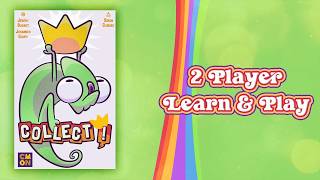
Collect! teaches itself through play. Reviewers appreciate that players learn each animal's power when they encounter it rather than memorizing a rulebook beforehand. This design choice makes the game approachable for casual players and children without sacrificing depth for experienced ones. The artwork is cute and thematic, with animals rendered in a style that appeals across age groups. Setup and cleanup are minimal. A game runs short enough to fit into a social evening without dominating the table, yet feels substantial enough that the outcome matters to players invested in their collections.
What Makes Collect! Stand Out
Ingenious Simplicity
Collect! achieves remarkable depth through constraint. The game is simple enough that new players grasp the win condition within a turn or two, yet the strategic layers that emerge through repeated play rival games with twice the complexity. The design forces meaningful decisions: keeping a card versus revealing it to future players, using an ability to progress your own position versus sabotaging someone else's, timing when to take face-up cards versus fishing for unknown cards. This simplicity-meets-strategy balance is precisely what makes the game work for both casual and engaged players. Reviewers note that despite its modest footprint and straightforward mechanics, the game creates situations that feel genuinely clever.
Observational Strategy
Collect! rewards attention in ways many games do not. When a player declines a card and places it face-down, that information becomes valuable later. When reviewers describe playing memory-based strategies, they highlight the parrot ability as exemplary: six turns later, when a player remembers which animal sits buried and successfully predicts it, the game delivers a moment of genuine satisfaction. This observational layer transforms what could be a purely luck-driven experience into one where the engaged player has a meaningful edge. The game remains accessible to those who prefer not to track such details, but players who do gain real advantages.
Potential Drawbacks
Limited Depth for Extended Play
Reviewers who keep games long-term note that Collect! sometimes lacks the staying power of heavier titles. The base game can feel thin compared to games with greater mechanical complexity or thematic integration. While the team mode variant adds strategy, reviewers familiar with deeper set-collection games sometimes find themselves gravitating toward those titles instead of returning to Collect! repeatedly. The game excels as a filler or gateway experience but may not satisfy players who play primarily for strategic depth or who expect significant replayability from every purchase.
Imbalance in Crowd Dynamics
Collect! thrives in groups that embrace direct interaction and occasional cutthroat play. When all players prioritize sabotage over progress, games can devolve into an interaction spiral that feels more chaotic than strategic. Additionally, reviewers noted that in four-player games, a crown distribution mechanic exists where only three half-crowns can be awarded per round; the fourth player to win a crown automatically wins the entire game, which can feel arbitrary to players who earned their crowns first. The game works best when played in the spirit of fast, fun engagement rather than as a serious competitive experience.
If You Enjoy Collect!
Players who appreciate Collect!'s ability-driven set collection will find similar satisfaction in Sea Salt and Paper, a game that shares comparable strategic depth wrapped in accessible rules. If the memory and observational elements appeal to you, Exploding Kittens offers comparable spiky player interaction, though Collect! features more sophisticated card abilities and a richer turn structure. For those who discovered Collect! and want to explore further into set-collection mechanics, Connect Four serves as a historical reference for the positional goal Collect! emulates in card form, while Jaipur</strong offers a more competitive two-player variant on the collection and card-draw formula with richer negotiation elements.
What Reviewers Are Saying
"There's plenty of luck and chaos, but it's fun trying to use your powers to ride that chaos. Like with my favorite card, the parrot, when you play it, you name another animal that you think is on top of the deck, you flip it and if you're right, you get that animal for free."
— Actualol
"It's a really ingeniously simple smallbox game that has the similar sort of kind of level of strategy as Sea Salt and Paper if you've ever played that game."
— Board Game Sanctuary
"Collect is a queue manipulation game, which is a mechanism that might sound like two words that were just randomly put together, but I can assure you that it most likely probably is not. In Collect, the king of the jungle is gone, and now the animals are in chaos. With no one in charge, every species is ready to claw, crawl, or chomp their way to the top by forming alliances of animals represented by four cards of the same type."
— Game Night Picks: Pair of Dice Paradise