




PIRATE BORG Core Rulebook Deep Dive
What the Community Thinks About PIRATE BORG Core Rulebook
The tabletop gaming community has embraced PIRATE BORG Core Rulebook with enthusiasm, viewing it not merely as a reskin of Mörk Borg but as a substantial expansion that adds layers to the system. Reviewers consistently praise Free League Publishing's execution: the book design captures a dark Caribbean aesthetic that feels cohesive and intentional, and the production quality rivals industry standards. The consensus centers on surprise: a pirate-themed variant contains enough mechanical depth and content (including naval combat rules and a full sandbox adventure) to feel like multiple core rulebooks compressed into one package. Reviewers appreciated the game's compatibility with the broader Mörk Borg ecosystem while standing on its own as a complete offering.
Core Mechanics That Define PIRATE BORG Core Rulebook
D20 Resolution and Ability Checks
PIRATE BORG uses a straightforward d20 system where players roll to meet or exceed a target number (typically 12) and add an appropriate ability modifier. The core abilities are strength, agility, toughness, presence, and spirit, with spirit being a unique addition that separates spellcasting from charisma, a departure reviewers appreciated as cleaner game design. Combat rolls follow this same pattern: melee attacks use strength, ranged attacks use presence, and defense uses agility. Because players always roll and the mechanic is transparent, the game plays quickly and remains accessible to newcomers, a quality reviewers noted made it ideal for both solo play and introducing others to the system.
Naval Combat and Ship Management
The standout mechanical layer PIRATE BORG adds is naval combat, complete with ship stats (hull points, armor, agility, crew capacity, broadside weapons, and special abilities). Ships become tactical entities with their own action economy: captains can order the crew to fire broadside weapons, raise or drop sails, ram enemies, board other vessels, repair damage, or activate relics and rituals. Reviewers found this system substantial enough to anchor entire adventures while remaining rules-light compared to dedicated naval wargames. The inclusion of various ship types, from rafts and dinghies to galleons and man-of-wars, plus undead variants like ghost ships, gives players meaningful choices about what they sail and how they engage in sea-based conflicts.
The PIRATE BORG Core Rulebook Experience
Dark Caribbean Atmosphere
Reviewers described the experience of playing PIRATE BORG as one immersed in a creepy, atmospheric version of the Caribbean. The setting places players in an alternate history where France, Spain, and colonial powers vie for control while undead rise and a hallucinogenic drug called Ash circulates through the underworld. This isn't straightforward swashbuckling; it's swashbuckling shadowed by horror. The book's art direction, consistently praised as beautiful and evocative, reinforces this mood without becoming oppressive. Reviewers felt the aesthetic grounded the fiction in a specific place and time while leaving room for the weird and supernatural to intrude.
Moments of Chaos and Improvisation
The actual play captured in Dice Tower's multi-episode playthrough showed PIRATE BORG generating chaotic, unexpected moments: characters leveling up in a trapped castle, engaging in a tense liars dice game with an undead creature that led to backstabs and improvisation, stumbling through exploration and making discoveries that cascaded into combat. Reviewers appreciated how the system's simplicity let the GM move quickly between negotiation, exploration, and combat without getting bogged down in rules. The feel was less "gritty tactical simulation" and more "adventure story with random complications and humor."
What Makes PIRATE BORG Core Rulebook Stand Out
Beautiful Book Design and Production Quality
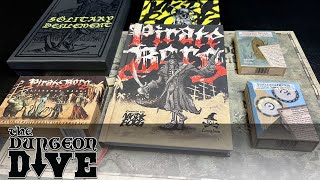
Free League Publishing's reputation for high-quality components held true in PIRATE BORG. The book itself received specific praise for layout, readability, and dark art direction. Reviewers noted it felt like a premium product: the paper stock, the visual hierarchy of information, the quality of included maps and tokens all contributed to the sense that this was a thoughtfully produced game, not a quick cash grab. One reviewer noted the book is beautiful enough to read for pleasure, a testament to the design-forward approach.
Comprehensive Content Baked Into One Package
PIRATE BORG Core Rulebook does not require supplemental purchases to run full campaigns. The book includes character classes with depth (brute, rapscallion, buccaneer, swashbuckler, zealot, and special classes like haunted soul and tall tale), extensive tables for generating random encounters, maritime travel rules, cargo and careening mechanics, a full bestiary ranging from dire crocodiles to undead pirate captains, magical items called relics, 20 arcane rituals for spellcasting, sea shanties that grant special powers, the naval combat system, and the Curse of Skeleton Point, a complete sandbox island adventure with detailed NPCs, locations, and random encounter tables. Reviewers felt this was exceptional value, as it delivers what would normally require a core book plus two expansion books in a single volume.
Potential Drawbacks
Complexity of Naval Combat for New Players
While reviewers praised the naval combat rules, they acknowledged that ship-to-ship combat introduces moving parts (crew assignments, positioning, broadside angles, repairs, morale) that can require a first run-through before the table feels comfortable with pacing. For groups that have never played naval combat, the learning curve exists, though reviewers found the rules clear enough that a single playthrough resolves most confusion.
Compatibility Expectations with Mörk Borg
Because PIRATE BORG is both a full standalone game and compatible with Mörk Borg, groups expecting one or the other may find surprises. Players hoping to drop PIRATE BORG modules directly into their Mörk Borg campaigns will need some adaptation due to thematic differences (one is a sinking world apocalypse, the other is undead Caribbean piracy). Conversely, players expecting PIRATE BORG to be purely different from its parent system may be surprised at how much system DNA it shares.
If You Enjoy PIRATE BORG Core Rulebook
Players who enjoy PIRATE BORG Core Rulebook's mechanics will find satisfaction in Mörk Borg, the parent system that established the d20, ability-based approach and the doom-world apocalyptic vibe. Those drawn to PIRATE BORG's narrative focus and modular design will appreciate Forbidden Psalm, which uses compatible mechanics in a different setting and supports both skirmish-scale combat and larger campaigns. Solo players can extend PIRATE BORG using Solitary Defilement, a comprehensive oracle system for journaling solo play that reviewers noted integrates seamlessly with the game's open tables and random encounter generators. Fans of the swashbuckling action without the undead horror can find similar mechanical simplicity in Dungeons & Dragons 5th Edition, though PIRATE BORG's focus is tighter and its production more visual.
What Reviewers Are Saying
"While it is a re-theming of Mark Borg, to me it feels like it has a lot more to offer than just a simple re theming. To me, this core book feels like Mork Borg along with a few core supplements baked in to the basic experience, and I do really appreciate that."
— The Dungeon Dive
"Again, from this unbelievable company, Free League Publishing, who just knock it out of the park every single time. We are going to be taking a look at the starter set for Pirate Borg. And it is Adventures in the Dark Caribbean."
— Rob's Tabletop World
"Like Mörk Borg, Pirate Borg is absolutely overflowing with handy tables, which make it a very easy game to solo because there are all kinds of random things that you can roll up."
— The Dungeon Dive