






Fantasy Realms: Greek Legends Deep Dive
What the Community Thinks About Fantasy Realms: Greek Legends
Fantasy Realms: Greek Legends has earned a warm reception as a thoughtful refresh of the Fantasy Realms card game line. Reviewers consistently praise the modern graphic design and thematic integration of Greek mythology, though opinions diverge on whether the added complexity serves or hinders the core experience. The general consensus is that this is an accessible, fast-playing card game that delivers memorable moments through clever card combinations and a cleaner presentation than its predecessors. Some reviewers find the new mechanics enhance the game, while others feel they add unnecessary layers to what works best as a light filler.
Core Mechanics That Define Fantasy Realms: Greek Legends
Hand Management and Card Drafting
Fantasy Realms: Greek Legends centers on hand management through a simple but elegant drafting loop. On your turn, you draw a card from either the top of the deck or from a face-up discard area, then you must discard a card to that shared middle area. This open discard area is the heart of the game's decision-making. Unlike traditional rummy-style games where you're building toward a single optimal hand, here each card you hold scores differently depending on what else you have in your final tableau, creating a puzzle of interdependencies. The game moves quickly, typically ending when the shared discard area accumulates 10 cards, which usually happens within 10 to 15 turns. This tight timeframe forces you to constantly weigh holding good cards against the strategic value of what you leave available to opponents.
The Afterlife Mechanism
The most significant addition to this version is the afterlife, a personal discard area where certain cards can be sent instead of going to the public discard. These cards remain part of your final hand for scoring purposes but incur a minus 10 penalty. The mechanic introduces both opportunity and risk. Some cards are worth significantly more when in the afterlife thanks to bonus text, making that penalty a worthwhile trade-off. Other cards, particularly heroes, can be forced into the afterlife by monster cards, turning an otherwise valuable asset into a liability. The afterlife creates a secondary layer of tactical decisions. Do you strategically send a card there to unlock combos with other cards that care about the underworld, or do you avoid it entirely? The mechanism thematically represents the Greek underworld while mechanically providing options for hand optimization that didn't exist in earlier versions of the game.
The Fantasy Realms: Greek Legends Experience
Satisfying Combo Discovery
Playing Fantasy Realms: Greek Legends feels like a constant hunt for synergies. The satisfaction comes from spotting a card in the discard pile that works perfectly with your hand, or from slowly building a constellation of related cards that multiply each other's values. Reviewers describe the experience as rewarding in the moment because you can usually score points on nearly every card by game end, rather than feeling locked into needing one specific combo. The streamlined iconography makes the card interactions intuitive even on first play. When Poseidon is on the board with aquatic creatures, it makes thematic sense that they work together. Medusa and Perseus have an obvious mechanical relationship. This thematic integration turns what could be abstract cardboard puzzles into a narrative of mythological conflict and alliance.
Fast, Accessible Gameplay
The game lives up to its positioning as a quick opener or filler. Turns move briskly because the core decision is binary: draw from deck or discard, then discard something. Games last 20 to 30 minutes even with table talk and careful consideration of plays. This brevity appeals to players who want tableau-building satisfaction without the commitment of heavier euros. The new graphic design aids accessibility significantly. Where the original Fantasy Realms required learning what items and generic fantasy concepts meant, Greek Legends builds on cultural familiarity. Players recognizing Greek mythology immediately understand why certain cards interact. The game also softens the extreme swings of the original. You are less likely to end up with zero-point cards because there are more paths to scoring and more flexibility in how you build your hand.
What Makes Fantasy Realms: Greek Legends Stand Out
Exceptional Graphic Design and Presentation
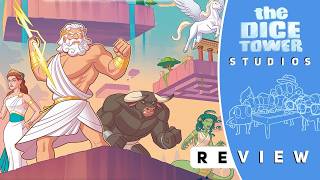
The visual upgrade from earlier Fantasy Realms editions is undeniable. The artwork is bright, colorful, and evocative, with card iconography that communicates card function at a glance. One reviewer called it "the best looking of these games," and multiple reviewers highlighted how the cleaned-up graphic design eases learning compared to the confusing original presentation. The cards practically teach themselves through visual hierarchy and clear symbol usage. This is not merely cosmetic; the improved presentation directly supports gameplay by making scoring conditions obvious and reducing rules lookups. For a game that already plays fast, cutting cognitive friction through design means more time enjoying the experience and less time puzzling over card text.
Thematic Coherence in Mechanics
The designers made a deliberate choice to embed Greek mythology not just in theme but in mechanical function. Monsters present genuine threats that force heroes into the afterlife. Quests carry zero points until you fulfill their conditions, just as mythological quests require completion. Gods work well with creatures who served them. The theme is not window dressing applied to abstract mechanics; it is the lens through which mechanics become intuitive. This coherence reduces the learning curve. A newcomer unfamiliar with the rules but familiar with the Heracles myth can reasonably infer that the Twelve Labors card works with monsters. This is a rare achievement in card games, where theme and mechanics usually live in separate worlds.
Potential Drawbacks
Complexity and Iconography Overhead
The expansion from the original Fantasy Realms brings more card types, more scoring conditions, and more symbols to track. Reviewers noted that the iconography, while improved, still requires a learning curve on first play. The afterlife penalty, the distinction between living and dead heroes, the multiple card types, and the various scoring bonuses create cognitive load even in a game that plays quickly. First-time players may feel lost despite the good graphic design. Subsequent plays resolve this, but the initial teaching moment is non-trivial. For a game positioned as a quick filler, some feel the rules overhead contradicts that promise.
Afterlife Mechanism as a Double-Edged Addition
While the afterlife provides interesting options, some reviewers felt it tips the game toward unnecessary complexity. The mechanism introduces more maneuvering and decision-making than earlier Fantasy Realms versions, which some saw as adding work rather than fun. The minus 10 penalty is steep enough that sending cards to the afterlife always feels consequential, but not all cards benefit from it, creating situations where the mechanic feels tacked on. Reviewers who prefer Fantasy Realms as a light, frictionless filler game felt the afterlife slightly compromises that goal by forcing more deliberation than the core loop demands.
If You Enjoy Fantasy Realms: Greek Legends
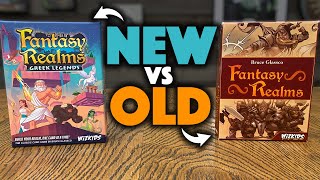
The obvious next stop is the original Fantasy Realms. Man vs Meeple, which compared the two side by side, sees Greek Legends as the closest thing to a straight new version of it, so fans of either will feel at home in the other, with Greek Legends offering the more thematic presentation.
The same card-combo chassis has also been reskinned as Fantasy Realms: Marvel Remix and a Star Trek edition, Star Trek: Missions. Reviewers split on these. The Discriminating Gamer names the Star Trek version as a personal favorite, while Tom Vasel of The Dice Tower thinks it made the game too complex and considers the Marvel edition the one that brought it back to a simpler place.
What Reviewers Are Saying
"Even if you have the slightest of familiarity with Greek legend, you're going to see a lot of connections that make a lot of sense with the way the mechanics work on a lot of the cards."
— Man vs Meeple
"It's bright, it's colorful, it's evocative, it's thematic. I really like that. this is not a deeply thematic game but the cards kind of sell you on the world the Greek mythology world."
— The Discriminating Gamer
"It's not necessarily bad. It's not nearly as bad as Star Trek, which went way off on the complexity scale and it just was very confusing. This one also looks really good. It's the best looking of these games."
— The Dice Tower