





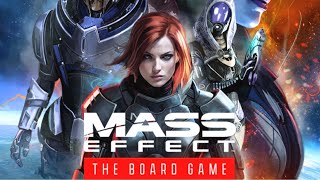

Mass Effect: The Board Game – Priority: Hagalaz Deep Dive
What the Community Thinks About Mass Effect: The Board Game – Priority: Hagalaz
Mass Effect: The Board Game – Priority: Hagalaz sits at an interesting intersection: it is unapologetically a game for fans of the beloved sci-fi franchise, yet reviewers consistently emphasize it succeeds as a standalone tactical experience. The shared passion for both the video game universe and Eric Lang's design philosophy comes through strongly in community discussion. Reviewers praise it as a "fan service game" that captures the essence of Mass Effect without simply slapping the theme onto an existing mechanical framework. The game's arrival as a cooperative tactical experience, rather than the real-time squad combat of the video games, is recognized not as compromise but as thoughtful translation, offering "all the depth" of the source material while allowing time for deliberate tactical thinking.
The consensus centers on the game's ability to balance accessibility with meaningful mechanical depth. It is lighter than some rival dungeon crawlers (sitting comfortably between Jaws of the Lion and Descent: Legends of the Dark in complexity), yet remains demanding enough to reward careful planning and squad coordination. Reviewers note the game "works best in short stints" rather than marathon sessions; a single mission takes around 40 to 45 minutes, and the entire five-mission campaign can be completed in an evening. This brevity is intentional and, by account of designer Eric Lang, central to the vision: a story-driven campaign that respects players' time commitment while preserving narrative coherence and player agency.
Core Mechanics That Define Mass Effect: The Board Game – Priority: Hagalaz
Shared Dice Pool and Cooperative Negotiation
The game's most distinctive mechanical feature is the shared dice pool. Each round, one player rolls all twelve action dice, then each player in turn order selects three dice to activate their character's abilities. The remaining dice pass to the next player, creating a cascading scarcity that forces genuine negotiation. Reviewers consistently highlight this as innovative, separating the game from other cooperative adventures by introducing a moment-to-moment resource management layer. The mechanic introduces risk-reward calculation: do you take the actions you need now, or leave high-value dice for teammates? This design choice transforms the cooperative experience, shifting focus beyond the typical "who does what" tactical questions into territory where player agency and team communication feel genuinely high stakes. The pool shrinks visibly as each player takes their three dice; allies must discuss openly what each person needs, creating a natural social dynamic that reinforces the squad feel.
Paragon and Renegade Choice System
The second pillar of Mass Effect's design philosophy, that "your choices matter," manifests through parallel victory conditions on each mission. Players can pursue a Paragon path (typically harder, offering more narrative reward) or a Renegade path (more direct, granting mechanical advantage). These are not moral judgments in the board game sense; they are presented as straightforward vs. slightly harder approaches, true to the tone of the video games. Choosing Paragon yields extra dice (broadening future tactical options), while Renegade earns tokens that allow players to modify die values on the fly (tightening control). The rewards reinforce the playstyle thematically: Paragon spreads resources, Renegade concentrates them. Beyond mechanical payoff, choices affect the narrative progression: which missions become available next, how the story unfolds toward the finale, and the final war readiness score. This integration of choice into both mechanics and story is praised by Lang as central to capturing what made Mass Effect's RPG structure compelling, now compressed into a format playable in an evening.
The Mass Effect: The Board Game – Priority: Hagalaz Experience
Tactical Coordination Under Pressure
The flow of play creates a rhythm of planning, reaction, and risk. After players commit their dice actions (moving squad members, attacking enemies, completing mission objectives), a hazard card activates enemies and introduces fresh complications. This pattern mirrors crisis-management games like Pandemic but with a tactical map dimension that rewards positioning and line-of-sight awareness. Combat is deterministic (damage values are fixed based on range and cover, not dice rolls), so the tension derives from whether players positioned themselves correctly to achieve their objectives before enemies close in. Escalation cards introduce a subtle timer: three face-up escalation cards trigger a shuffle of the hazard deck, marking progress toward mission failure. The game explicitly does not reward grinding or farming for resources; reviewers note there is always "too much to do on any given map," forcing meaningful abandonment of secondary goals. This design creates palpable tension, with players often finding themselves biting their nails as the final rounds approach, while keeping individual missions fast enough that regrouping between them feels natural rather than exhausting.
Narrative Agency Without RPG Bloat
The game's narrative sits in a mission book, with short story passages that branch based on completed objectives and player choices. Reviewers describe the writing as "excellent," capturing the voice and tone of the characters without padding. Story snippets are "short and snappy," offering flavor and direction without requiring lengthy passages at the table. Between missions, players read paragraphs that guide their next choice: which of two or three available missions to pursue, whether to attempt a loyalty mission, and, implicitly, what kind of ending they are working toward. The narrative framework creates a sense that choices ripple forward; a paragon victory in one mission unlocks different story beats and may open or close subsequent mission options. This is more constrained than a full RPG, but reviewers consistently frame it as elegant distillation rather than limitation. The designers deliberately excluded romance subplots and detailed equipment loadouts precisely to keep the experience lean, trading some series authenticity for playability. For those seeking a quick gateway into dungeon crawlers or campaign games, the structure delivers a complete story arc (beginning, middle, end) without demanding a year of weekly sessions.
What Makes Mass Effect: The Board Game – Priority: Hagalaz Stand Out
Eric Lang's Design and Modiphius' Restraint
Eric Lang is one of the board game industry's most respected designers, known for tight mechanical innovation and thematic coherence. Lang's involvement here is flagged by reviewers as a major positive; the game is "solid" rather than a slapped-on licensed product. The design process itself involved Calvin Wong as co-designer, described by Lang as "the world's biggest Mass Effect fan," ensuring deep series knowledge informed every mechanical choice. Modiphius Entertainment, the publisher, demonstrated restraint by rejecting the impulse toward a 150 to 200-dollar miniature-heavy box that demands hours of homework before play. Instead, they committed to accessibility: quick setup (the map is printed on the mission book page itself), clear victory conditions, and streamlined character advancement. The custom dice and character sheets are quality components, yet the game avoids the bloat trap many licensed products fall into.
Replayability Through Branching and Limited Upgrades
A five-mission campaign might seem short, but it branches meaningfully. Players choose one of three opening missions, then navigate branching choices that can lead toward a five-mission-long narrative or a shorter three-mission path, with optional loyalty missions for specific characters adding further variation. On replay, different character selections, different choices (Paragon vs. Renegade), and different mission sequencing create genuinely distinct experiences. Character progression is capped: each hero can unlock only a handful of skills across their available branches, yet more skills exist than any player can gain. This forced scarcity creates a sense of specialization that encourages multiple campaigns. Reviewers describe the experience as inherently replayable without requiring expansion purchases: one box yields numerous distinct campaigns.
Potential Drawbacks
Rules Complexity and Missing RPG Depth
The rulebook is "sticky," particularly at first encounter. Multiple rule interactions exist, and reviewers note the book would benefit from an index; they found themselves flipping back and forth to verify specific mechanics. The complexity is described as "intermediate-to-advanced" rather than introductory, so this is not a game for teaching board games to complete newcomers. However, once learned, the flow is smooth. More significantly, dedicated Mass Effect fans expecting deep RPG character building are disappointed. The game omits equipment loadouts, weapon selection, and romance storylines, hallmarks of the video game series. Reviewers understand the design rationale (keeping the game lean) but note the absence. For players seeking authentic RPG progression, the streamlined upgrade system feels limiting, even if it serves the campaign's accessibility.
Production Choices and Play Length Constraints
Enemy tokens are thin cardboard rather than plastic chits or capsules, a cost-saving measure that some find tactilely unsatisfying (though production overall is praised). More jarringly, the box includes a dry-erase pen but no eraser, forcing players to improvise with fingers, saliva, or tissues, an oversight for a game so built around dry-erase sheets. The game is explicitly "not" designed for three to four-hour sitzes. Playing all five missions back-to-back risks fatigue; reviewers recommend spacing missions across multiple sessions. While each mission is brief enough for a quick after-work play, marathon play can feel repetitive because some missions share similar mechanical objectives, even if the narrative context shifts.
If You Enjoy Mass Effect: The Board Game – Priority: Hagalaz
Readers drawn to this title should explore Jaws of the Lion, which pairs similar mission-book setup with a slightly heavier rule set and longer campaign. Descent: Legends of the Dark offers deeper character customization and dungeon crawler aesthetics, though at greater time investment. Gloomhaven similarly provides a legacy campaign structure, though its complexity and length are substantially higher. For those new to dungeon crawlers, Mass Effect serves as an excellent entry point precisely because it avoids overwhelming admin and time commitment while delivering legitimate tactical depth. Conversely, players already invested in Gloomhaven or Descent may find Mass Effect refreshingly light, ideal for a change of pace.
What Reviewers Are Saying
"The shared dice pool I found it that is very innovative way now there is a very short campaign with just five up to five missions and normally what make a really good Dungeon Crawler or more RPG games stuff like that and the same Mass Effect game is the evolution of the characters because of course when you play game like this or a dungeon crawl in general you're getting attached to your to your character, absolutely. You bring them up from Level zero to be level 99 and shooting Fireballs from the eyes or stuff there. Doing it in five missions how is it going to work? Cool, they do it really well, it's quite simple, you can get a maximum of three experience points per mission, if you get three experience points you can unlock any new ability."
— Board Stupid
"This is a game for Mass Effect fans and it's not like they just slapped the theme on a crap game, this a solid game and they put a real solid game and it's a great theme, so if you love Mass Effect I think it's obvious like this is going to be something that you might be interested in, but it's not only for if you're a Mass Effect fan that definitely adds up to a very solid game, a very solid action Dungeon Crawler more on the lighter side."
— Board Stupid
"Mass Effect was the game that pioneered the idea that your choices matter, that was every game that in the history of RPGs has been influenced by Mass Effect on that, so we want to capture that in the most accessible format possible. So this is a campaign game for an audience that doesn't have the time to play like a thousand hours of campaign, you can play a campaign in an evening, but also the choices you make in each session do profoundly affect the future choices that you make."
— Board Stupid (Eric Lang, Designer)