





Eternal Palace Deep Dive
What the Community Thinks About Eternal Palace
Eternal Palace has emerged as a quiet standout in the dice placement genre, praised by reviewers across multiple channels for delivering strategic depth wrapped in a package far more accessible than its abstract ruleset might suggest. Reviewers consistently return to the same core insight: this game is defined by a single elegant mechanic that produces genuinely meaningful decisions, paired with an exceptionally beautiful visual execution that elevates play into something close to art. The game has proven itself adaptable to different play groups and ages, with Board Game Dad noting that even younger players can grasp and enjoy it despite its layer of abstraction. Where Allies or Enemies emphasize the puzzle-like purity of the design, Getting Games highlights the interactive depth beneath the surface. There is genuine enthusiasm here, particularly around the dice grouping mechanic and the painting-based scoring system that gives Eternal Palace its distinctive identity.
Core Mechanics That Define Eternal Palace
Dice Placement
At the heart of Eternal Palace sits one of modern board gaming's clearest expressions of the dice placement mechanic. Players roll all of their dice and immediately face a structural choice: how to group them. This is where the game's genius emerges. Rather than rolling dice and moving a token based on the result, Eternal Palace treats the grouping decision as the real player agency. As Board Game Dad explains, players must consider whether they want more groups with lower totals or fewer groups with higher totals, because each group's sum will determine which actions they can take. The game from Alley Cat Games, published in 2020, gives lower-valued actions compensatory benefits to offset luck, ensuring that even smaller dice groupings feel mechanically sound rather than purely punitive.
What makes this system shine is the simultaneous revelation. Players hide their grouped dice behind a screen, commit to their groupings unseen, and only then reveal their choices together. Allies or Enemies captures the depth of this design decision perfectly: if you roll a one, three, and two, you can keep them separate for three small actions, or smush the three and two together into a five, leaving your one alone. This grouping choice plays out identically across the table, creating a guessing game where each player reads table position and probable strategy rather than reacting to observed play.
Track Advancement
The painting tracks represent Eternal Palace's second essential pillar. Players are not merely collecting points in the abstract; they are building paintings on an easel by advancing up various tracks. Each action on the board drives movement along a specific track tied to a section of the palace's aesthetic. Multiple visits to a single track layer completed paintings in segments. As Allies or Enemies notes, the requirement to visit a track more than once to complete artwork creates an interesting balance of wanting to reach resources first because you pay more if someone else is already there, while also needing to complete your artwork segments for bonuses. The game includes a scaling system where consecutive numbers in your artwork earn additional points, rewarding planning and specialization across turns.
The Eternal Palace Experience
Surprising Accessibility
The most striking observation across multiple reviewers is how Eternal Palace defies its abstract appearance. Board Game Dad, who initially doubted whether their six-year-old could handle such a conceptually difficult game, discovered that the child not only understood the rules but nailed the first play. The reviewer went into teaching with low expectations, having read the ruleset and worried the abstraction would not translate to young players. Instead, everyone at the table engaged with the game meaningfully. This pattern repeats across enthusiast circles where Eternal Palace continues to work for mixed-age and mixed-experience groups. The theme of noble families helping the Emperor rebuild his palace serves not as a heavy narrative framework but as elegant window dressing on what is fundamentally a game about spatial and numerical decision-making.
Beautiful Abstraction
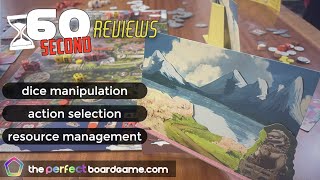
Eternal Palace achieves a rare balance between mechanical purity and aesthetic presence. The physical board itself becomes part of the appeal, with beautifully rendered paintings emerging as players progress through the game. Reviewers consistently cite the components and artwork as what truly sells the experience. Rather than serving as mere score tracking, the easels and paintings actively reward player choices in a way that feels thematic and satisfying. When players advance a track and earn their next painting segment, they are literally building visual art on the board. This representational approach to scoring transforms point accumulation from an abstract calculation into something that feels meaningful and visually distinctive. The game's beauty matters to its enjoyment in ways that go beyond component quality.
What Makes Eternal Palace Stand Out
The Dice Grouping Decision
No reviewer discussing Eternal Palace can avoid the dice grouping mechanic because it is genuinely the core draw. Board Game Dad identifies it directly: the best part of this game is determining how you want to group your dice. This single decision point generates the entire strategic experience. On every turn, players face a real problem to solve. Do you prioritize flexibility with smaller groups, or do you commit to a bold strategy with a few high-value actions? The simultaneous reveal prevents anyone from gaming the system by watching others first. Every player makes their commitment blindly, transforming the mechanic into a table-wide guessing game where reading your opponents becomes critical. It is a mechanic that rewards both careful probability calculation and table psychology.
Painting-Based Victory
Eternal Palace's approach to scoring feels fresh and tactile. Rather than tallying victory points in the traditional sense, players build paintings on their easels by advancing tracks. This direct representation of progress gives the game visual feedback that standard point tracks cannot match. Allies or Enemies praises this system for making scoring feel integrated into the theme and world of the game. The paintings become proof of your decisions, your priorities, and your playstyle. The bonus for consecutive numbers in a painting rewards planning and specialization, encouraging players to think multiple turns ahead about which tracks to invest in. This creates a form of engine building without the heavy cognitive load of traditional economic games.
Potential Drawbacks
Icon Clarity and Thematic Confusion
Allies or Enemies raises a fair concern that the icons used in the game could be clearer. Reviewers note wishing the game felt more thematic in its presentation, with the relationship between painting the palace and rebuilding the palace remaining somewhat unclear on first read. While this does not derail the experience, especially once rules are understood, it does create a minor friction point for new players. The abstraction, while ultimately strength, requires some explanation and cannot be fully intuited from the components alone.
Forced Specialization
Another recurring observation is that players can feel somewhat forced to specialize in certain action spaces rather than pursuing flexible strategies. The track system naturally incentivizes returning to the same locations to complete paintings, which can create a sense of constraint if you are trying to explore diverse strategies. While this specialization is likely intentional game design, it does narrow the viable approach spaces available to players who prefer exploring multiple paths to victory.
If You Enjoy Eternal Palace
Reviewers who praise Eternal Palace frequently mention Castles of Burgundy and Marco Polo as spiritual cousins. Players who enjoy Eternal Palace's dice placement tension and the interplay between luck and grouping strategy will find similar satisfaction in Castles of Burgundy, which also uses dice to determine actions while providing tools to mitigate unfortunate rolls. Marco Polo offers comparable interactive play where player choices directly block others' access to resources. The pulling sensation of competing for limited tracks in Eternal Palace translates directly to the rondelle systems and resource constraints in these designs. Beyond these specific titles, anyone drawn to beautiful, mid-weight euro games with elegant core mechanics should investigate Eternal Palace. It offers the cerebral satisfaction of a puzzle with the social engagement of genuine player interaction.
What Reviewers Are Saying
The best part of this game is determining how you want to group your dice. Players must consider whether they want to have more groups with lower totals or fewer groups with higher totals. The nice thing is many of the lower valued actions will give the player some sort of benefit to offset luck later in the game.
— Board Game Dad
You roll your dice and then you put them behind your screen and you put them into chunks. So you can have them by themselves, like if you've got a one, three, and a two, you can have a one, three, and a two, or you can smush that three and two together to make that one a five. That is an interesting decision, and it's a really cool mechanic.
— Allies or Enemies
"Interacting with this very beautiful board and these beautiful paintings, I think, is what really sells the game. I was a little surprised. I read the rules and I thought, this isn't gonna fly, my kids aren't, it's too abstract. And then I taught them the rules and we gave it a shot and everyone really enjoyed it."
— Board Game Dad