




Snow Planner Deep Dive
What the Community Thinks About Snow Planner
Snow Planner has earned quiet but genuine enthusiasm from the board game community, particularly among reviewers who appreciate both thematic depth and mechanical innovation. The game resonates most strongly with players who enjoyed Grand Austria Hotel, as it captures that same spirit of hospitality and guest management while introducing its own fresh systems. Reviewers consistently praise the game's puzzle design and thematic coherence. While the overall corpus of player discussion is still growing, the reviewers who have engaged with Snow Planner describe it as a satisfying, approachable Euro with real strategic meat. There is broad agreement that the game succeeds at what it sets out to do: create the tension and satisfaction of running a premium ski resort during peak season. Some reviewers discovered Snow Planner through Japanese distribution channels before its wider North American release, adding to the sense of a carefully designed game finding its audience gradually rather than through hype.
Core Mechanics That Define Snow Planner
Dice Placement with Resource Scaling
Snow Planner is built on dice placement as its primary decision point. Players take turns placing dice onto different action spaces on the main board, and the pip value of the die placed determines the magnitude of the reward or action that follows. A die showing five pips might grant five croissants or five snow tokens, while a two-pip die grants only two. This elegant system creates a constant strategic tension: spend your higher-value dice now to accelerate your current plans, or hold them back for later when you might need a bigger payoff. Over the course of a round, as dice accumulate on the board, players navigate which actions to unlock and when to claim them. The designer, 14games, builds the entire action economy around this single mechanism, making every pip count and every placement decision meaningful.
Guest Extension and Multi-Night Stays
The signature system that sets Snow Planner apart is its guest extension mechanic. When you invite a guest to stay in your hotel, they can remain for up to three nights if you continue to satisfy their conditions. Each night of stay triggers escalating bonuses that shift up your board, rewarding you increasingly as the guest enjoys their extended vacation. This transforms guest management from a transaction (get paid, move on) into a puzzle of sustained satisfaction. You must plan ahead to ensure you can provide what the guest wants on each subsequent night, all while managing your dice rolls and competing with other players for the same guests and resources. The longer you keep a guest happy, the more valuable they become, and VIP guests especially offer powerful bonuses that can swing the game. This layering of days and escalating rewards creates a rhythm that mirrors the actual experience of a luxury resort managing relationships with cherished return visitors.
The Snow Planner Experience
Cozy Theming and Aesthetic Immersion
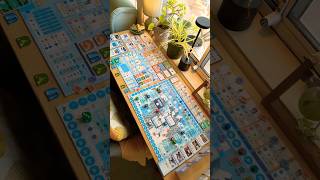
Snow Planner wraps its strategic systems in a thoroughly thematic ski resort setting that reviewers consistently describe as charming and evocative. The artwork and components work together to create what one reviewer calls "snowy, on-the-ski-hills vibes." This is not a game that abstracts its theme; every action carries real flavor. You are not gaining generic resources, you are earning croissants for your guests and snow tokens for seasonal activities. Your guests are not abstract points; they are people who ski, dine, and seek Instagram moments at your resort. The tile-placement hotel-building system uses three different types of window tiles to create the visual puzzle of a hotel facade, reinforcing the sense that you are literally designing and decorating a real place. Reviewers note the gorgeous artwork throughout, and the game succeeds at making players feel like they are managing an actual establishment. This thematic coherence is not window dressing; it makes strategic decisions feel like real hotel management rather than point optimization.
Satisfying Spatial and Temporal Puzzle
Underneath the cozy theming sits a genuinely tight spatial and temporal puzzle. At any given moment, you are juggling multiple competing constraints: which rooms to add to your hotel and in what configuration, which guests to pursue and for how many nights, what resources you need to keep guests happy versus what you can spend on events, and which dice values you have available in your pool versus which you want to save. The puzzle deepens because you are doing this while other players compete for the same guests and the same resource spaces. One reviewer describes Snow Planner as "a very satisfying puzzle" that they want to table frequently, and the satisfaction stems from how all these systems interlock. Solving the room-placement puzzle unlocks bonuses. Satisfying guest conditions leads to longer stays. Longer stays generate the points that win the game. Every good decision cascades into the next one, creating that sense of engine-building satisfaction that keeps players returning to the table.
What Makes Snow Planner Stand Out
The Guest Extension System as a Novel Twist on Hospitality Themes
While Grand Austria Hotel established the template for guest management in board games, Snow Planner does not simply replicate it. The introduction of multi-night stays with escalating bonuses adds a dynamic layer that Grand Austria Hotel does not have. Instead of each guest being a single transaction, extended stays reward planning and consistency. This system forces you to think not just about who you invite, but how long you can sustain their satisfaction. It creates natural narrative arcs within a single game: a guest arrives on day one, you scramble to keep them happy through day two, and by day three, they have become so valuable that protecting their stay becomes a tactical priority. This novelty within a familiar framework makes Snow Planner feel fresh even to players well-versed in Grand Austria Hotel. Reviewers explicitly call out this mechanism as the coolest system in the game, suggesting that it is the primary draw for those seeking something new in the hospitality-management genre.
Approachability Paired with Strategic Depth
Snow Planner walks a careful line between accessibility and depth. The core mechanic is simple to understand: place a die, gain resources based on its pip value, spend those resources to build your hotel and satisfy guests. New players can grasp the loop within a single turn. Yet the puzzle of managing dice pools, timing guest acquisitions, and optimizing room configurations offers enough decision complexity to sustain repeated plays. The game includes a solo mode, signaling that it has been designed with both multiplayer and solitaire players in mind. Reviewers note that the game has been available primarily through Japanese distribution, suggesting it is a product of careful iteration and playtesting rather than a mass-market release designed by committee. This combination of elegant simplicity and hidden depth makes Snow Planner appealing to a wide range of players, from those seeking a cozy, manageable evening game to those who want to dive deep into optimization.
Potential Drawbacks
Moderate Complexity May Deter Pure Casual Players
Snow Planner is not a light game, even though its core mechanic is easy to learn. The interplay of dice management, room placement, guest conditions, and event card synergies creates a decision space that rewards careful planning and forward thinking. Players seeking a quick, low-decision experience may find themselves in longer turns than they anticipated. The game is best appreciated by players willing to engage with its puzzle, rather than those looking for a purely social or luck-driven evening.
Seasonal Availability and Supply Constraints
Because Snow Planner originated as a Japanese release, supply and availability in North America have historically been limited. Early adopters discovered it through international channels or specialty retailers, and wider distribution remains ongoing as of 2025. Players interested in the game may face challenges tracking down a copy at reasonable prices, a factor worth considering before committing to the hunt.
If You Enjoy Snow Planner
Players who enjoy Snow Planner's guest management and spatial puzzle systems will find similar satisfaction in Grand Austria Hotel, the game that clearly influenced Snow Planner's design. Where Grand Austria Hotel focuses on room assignment and single-visit guests, Snow Planner layers extended stays and escalating bonuses on top of that foundation. If you love the idea of running a luxury establishment and optimizing guest experiences, both games belong on your shelf. Snow Planner offers the thematic setting (a snowy ski resort) and novel mechanic (multi-night stays) that make it a distinct entry in the hospitality-management space, not a direct replacement for Grand Austria Hotel, but a thoughtful evolution of the concept.
What Reviewers Are Saying
"One of the coolest mechanisms that appears in Snow Planner is the idea that when you house your guests in your hotel, you can kind of keep their stay or extend their stay as long as you can by satisfying some of their conditions called an extended stay. And as you satisfy those guests' conditions across the rounds, you'll be able to get escalating bonuses and they kind of shift up your board as they stay longer."
— Board Game Sanctuary
"It is a very satisfying puzzle. It's one that I definitely want to table a lot more this year. Considering it's summer right now and I'm sweating, Snow Planner is definitely going to send a chill through my bones as I get my cup of coffee this winter and really enjoy this Euro."
— Board Game Sanctuary
"It's just so cute. It looks like a snowy, on-the-ski-hills kind of vibes and you are kind of managing that inn and having your different customers that are out skiing and whatnot. I think it's very cute and again it's been one that I've seen many many times and it's been one that I have been interested in for a long time."
— The Board Game Garden