





That Escalated Quickly Deep Dive
What the Community Thinks About That Escalated Quickly
Board game reviewers across multiple communities regard That Escalated Quickly as a reliable, accessible party game that delivers consistent laughs and genuine team collaboration. The consensus centers on its simplicity, creative freedom, and the fact that it welcomes players of all gaming backgrounds. Reviewers praise its ability to work across three generations in a single game night and its suitability for non-gamers who might shy away from complex rulesets. While some note it shares DNA with Wavelength and the European game Top 10, reviewers appreciate That Escalated Quickly's democratic design, where every player contributes equally rather than a single person driving each round. The game resonates as a palette cleanser between heavier titles and as a gateway title for families or casual groups.
Core Mechanics That Define That Escalated Quickly
Spectrum Ranking
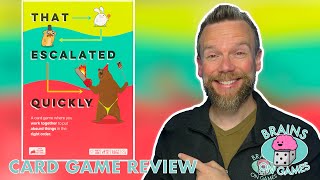
At its heart, That Escalated Quickly is a ranking game from Exploding Kittens. Each round, one player serves as the organizer and reads aloud a question with a spectrum defined by a scale from 1 to 10. Examples from the deck include scenarios like: "I'm on a road trip and drive by a roadside attraction. What is it?" (1: least likely to make a stop; 10: most likely to make a stop) or "My favorite theme park just got a new mascot. What is it?" (1: least disturbing; 10: most disturbing). The organizer shuffles and deals one numbered card face-down to each player, including themselves. Players then must come up with answers that align with their secret number on that spectrum.
Cooperative Ordering
After all players have given their answers, the organizer attempts to place the cards in numerical order from 1 to 10 based solely on what each player said. If the organizer correctly sequences the cards, the table scores a good card. Mistakes result in a bad card. The game ends when the group accumulates three good cards (winning) or three bad cards (losing). With larger player counts, the organizer is allowed one mistake before a card becomes bad, making the game slightly more forgiving. This cooperative structure means every player wins or loses as a unified team, eliminating the competitive tension of traditional party games.
The That Escalated Quickly Experience
Creative Collaboration in Action
Players describe That Escalated Quickly as a game that unleashes collaborative creativity. Because players are not limited to cards in hand, they must generate answers on the spot, and reviewers note that this freedom produces unexpected and often hilarious results. One reviewer playing with professional comedians commented that the game became a storytelling experience where participants were "making things up and getting to be creative." The spectrum mechanic creates a unique challenge: players with numbers near the extremes (1 or 10) have an easier task describing the most absurd or least appealing scenario. But those stuck in the middle must thread a needle, describing something that feels distinctly different from both the extreme and the middle ground. This tension produces moments of insight as players realize how their peers perceive the same spectrum differently.
Hilarious Absurdity
The emotional core of the experience is laughter. Reviewers consistently report playing the game and "laughing the entire time," with answers ranging from the ridiculous to the unexpectedly clever. A reviewer who tested the game with both children and adults noted that with kids, answers stayed "safe for work," but with adults, the game produced responses that were decidedly not. The absurdity comes not from judge-driven humor (as in Cards Against Humanity) but from watching your teammates struggle to describe increasingly weird scenarios and seeing how differently everyone interprets what "disturbing" or "useful" or "cozy" actually means.
What Makes That Escalated Quickly Stand Out
Universal Participation Without Judging
Unlike games that rely on a central judge or voting mechanic, That Escalated Quickly gives every single player agency every round. Nobody is waiting for a turn or watching others play; everyone simultaneously thinks through the spectrum, articulates an answer, and waits for the organizer to reveal whether they understood what each person was conveying. Reviewers emphasize that the lack of judgment is liberating for newer gamers. The organizer is not critiquing answers for cleverness or appropriateness; they are purely attempting to decode the numerical intent. This design means players feel safe being creative without fear of social stakes, making the game welcoming even for people who normally avoid party games.
Everyone Comes Up with Answers, Not Just One Player
A key distinction reviewers draw is between That Escalated Quickly and Wavelength, a game they consider mechanically similar but experientially different. In Wavelength, one team of clue-givers controls the round while the rest play a more passive role. That Escalated Quickly inverts this: every player must come up with an answer every single turn. Reviewers noted this continuous participation means the game maintains energy throughout, and each person gets to contribute their unique perspective and humor. This mechanic also teaches a subtle skill: understanding how to communicate your position on a spectrum through creative description, a form of verbal reasoning and vocabulary development that reviewers acknowledged even casual play reinforces.
Potential Drawbacks
Group Size Requirements
While the game officially supports 2-8 players, reviewers note that the sweet spot is 4 or more. With two or three players, each person must hold two numbered cards simultaneously and provide two separate answers, then remember which answer corresponded to which number. This cognitive load diminishes the enjoyment and flow. The organizer faces similar memory challenges. Reviewers strongly recommend the game for larger gatherings where each player holds a single card, simplifying both the answering and ordering phases.
Potential Question Repetition
The game includes 150 double-sided question cards, totaling 300 unique prompts. While reviewers have not yet encountered repetition in their play sessions, they acknowledge that heavy play with the same group could eventually exhaust the deck. However, reviewers also note that the game's strength lies in how different players and different numbers reveal different answers each time, and with fresh players, the same question can feel entirely new. Still, for groups that play This Escalated Quickly regularly, the finite deck is something to keep in mind.
If You Enjoy That Escalated Quickly
Players who appreciate the creative, cooperative gameplay of That Escalated Quickly will find similar satisfaction in Wavelength, which uses a different spectrum mechanic (guessing where on a spectrum a clue lands) but shares the collaborative energy and the need to think creatively about how to communicate meaning. Top 10, a European ranking game, uses nearly identical mechanics and offers a true alternative if you exhaust This Escalated Quickly's question deck. Players drawn to the light, social, non-judgmental party atmosphere might also enjoy Apples to Apples or Cards Against Humanity, though neither enforces the strict cooperation or requires the same level of continuous participation from all players. For those seeking a game that works across age groups and gaming experience levels, just as This Escalated Quickly does, consider Priorities, which offers a cooperative party experience with a different flavor.
What Reviewers Are Saying
"This works really, really well if you have people who are willing to be a little bit creative and play along with the silliness. It does have the benefit that everyone gets to participate and come up with these answers rather than just one player. So yeah, I highly recommend this one."
— Totally Tabled
"I loved realizing how you can lean into that and be like, let me show that if I take my foot off the gas a tiny bit, let me try to make it obvious that I'm one below this. I loved it. I had a great time."
— Grant Lyon
"What a fun, silly game, and every time I've played this game it was just laughing, laughing, laughing the entire time, so I think, like I said, a perfect game for non-gamers, a great palate cleanser in between heavier games if you need a break."
— Brains On Games