


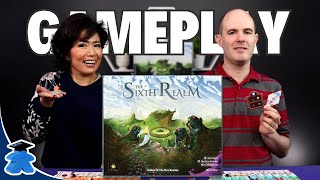


The Sixth Realm Deep Dive
What the Community Thinks About The Sixth Realm
The Sixth Realm arrives with a rare consensus among experienced board gamers: it is a carefully crafted, visually stunning Euro that delivers on the ambition of its design pedigree. Reviewers from Meeple University to The Board Game Garden to Tabled consistently praise it as a standout entry in Final Frontier Games' Five Realms series, with particular respect for the trio of veteran designers behind it (Matthew Dunston, Seth Jaffey, and Drake Veland). What excites the community most is not novelty for its own sake, but thoughtful design that makes every turn matter. Tabled's solo reviewer, a self-described lover of heavy Euros, ranked it as the second-most anticipated game for 2025, noting that it represents exactly the kind of mechanically rich, colorfully presented strategy game that feels increasingly rare in modern board gaming. The few reviewers who have played it highlight its accessibility within its complexity, suggesting that despite being a 4-out-of-5 weight game, it communicates its rules and decisions surprisingly clearly once you understand what each guild offers.
Core Mechanics That Define The Sixth Realm
Engine Building
The Sixth Realm rewards forward planning and incremental investment in a way that defines the entire experience. Throughout three years of play (split into seven rounds each), you build permanent upgrades: resources that unlock faster actions, Scrolls that open new strategic paths, Seals that multiply in value as the game progresses, and buildings that anchor your scoring. Reviewers describe a game where early turns feel constrained: you have few action points and must choose carefully between gaining resources versus spending them immediately. But this creates the classic engine-building payoff: by mid-game, your investments pay dividends. You flip resources to gain action points, use those points to advance on tracks, collect bonuses that unlock yet more actions. The satisfaction lies in watching your incremental choices compound into the power to execute elaborate turn sequences by year three. Designer Matthew Dunston's fingerprints are visible here; Meeple University's reviewers, who have played many Dunston games, note that The Sixth Realm follows the designer's proven formula of making every resource matter and every building block feel essential.
Mini-Games
Each of the six guilds on the board functions as its own mini-game, each with distinct rules and objectives. The Brown Council lets you place Historians and collect Traditions; the Blue Explorers build Bridges and Towers across the realm; the Green builders construct Foundations and Houses with their own row-and-column scoring bonuses. Rather than presenting players with one unified engine, The Sixth Realm divides the board into six distinct areas of mechanical focus. This means each turn, based on which guilds are available (only three of six are active in any round, and only one is primary), you are essentially choosing which mini-game to engage with. The rotating availability forces you to at least dabble in every guild's system, even if you specialize heavily in a few. Reviewers describe this as a brilliant constraint: it prevents any single strategy from completely dominating and guarantees that every player will experience the breadth of The Sixth Realm's mechanical palette, not just the two or three systems they find most comfortable.
The Sixth Realm Experience
Beautiful Constraint and Strategic Depth
Playing The Sixth Realm feels like navigating a puzzle where every piece matters. The action selection mechanism, where only one guild is primary (costing normal action points) and two are secondary (costing extra), creates constant tension between what you want to do and what you can afford to do. Reviewers emphasize that this is not punitive design; rather, it is elegant. You know the cost structure upfront. Choosing to use a secondary guild because it accelerates your strategy is a real decision, not a penalty. This creates a satisfying loop: you spend resources to unlock more actions, which lets you take more turns, which accelerates your engine. But the real question is always whether this is the right time to invest, or whether playing lean this round and power-spiking next round, when this guild is primary, pays off better. Meeple University reviewers describe the back-and-forth between specialization and generalization as the heart of the game's depth.
Colorful and Inviting Aesthetic
The Sixth Realm stands apart visually from much of modern board gaming's trend toward darker, moodier themes. Illustrated by Miio and featuring bright, cheery colors throughout, the game radiates invitation rather than intimidation. Tabled's reviewer, who confesses to loving the game's aesthetic, notes that the dual-layer player boards with custom meeples and the overall visual presentation carry "eye candy" that does not feel superfluous: every component fits a purpose. This matters because The Sixth Realm is, undeniably, heavy. Having a game this complex presented in warm, welcoming colors makes it more approachable. Reviewers describe the first time they see the board and components as a moment of excitement rather than overwhelm, which seems to carry through into the learning and teaching process.
What Makes The Sixth Realm Stand Out
The Rotating Guild Selection Mechanism
The core innovation is deceptively simple: only three of six guilds are available each round, and only one is primary. This single rule cascades into profound consequences. It forces every player to engage with every system (you cannot ignore a guild you dislike), while also rewarding specialization through action economy. If you do not have enough action points to take a secondary guild, you will have to wait for it to rotate back to primary. This creates a natural pacing where players naturally specialize in certain systems but cannot obsess over one strategy to the exclusion of all others. Reviewers consistently praise this mechanism as the backbone of the game's elegance, and it explains why The Sixth Realm feels neither overwhelmingly open-ended nor oppressively linear.
Multiple, Interlocking Paths to Victory
The Sixth Realm eschews a single scoring track. Instead, you earn victory points through Relics (majority-based bonuses), Seals (colored gems that score based on how many you collect and your track advancement), Traditions paired with Guild Upgrades, Objectives you unlock on the shared board (which other players can also score), Envoys placed in the Plaza, and Houses built across the board. This abundance of scoring routes means the optimal strategy is never obvious. The game rewards players who commit to a path but allows flexibility; if one route is contested, you can pivot to another. Meeple University reviewers note that one of the game's great strengths is placing tiles and locking in early scoring opportunities that others can build on, creating shared incentives that make the game feel collaborative even during competition.
Potential Drawbacks
Significant Complexity and Learning Curve
The Sixth Realm is a heavy game, rated 4 out of 5 in complexity. The rules are not difficult in isolation, each guild's mini-game is straightforward, but the sheer number of interlocking systems can overwhelm new players. Teaching The Sixth Realm requires patience and clear demonstration; it is not a game you can hand someone a rulebook for. Reviewers recommend learning by doing, playing through at least one full round slowly before accelerating the pace. The good news is that reviewers report the game is worth the effort to learn, and that once you understand the action economy, the rest clicks into place. Tabled's reviewer, who is selective about which games occupy table space, clearly considers the investment worthwhile, but acknowledges it is not for players seeking a quick or light experience.
Length and Table Footprint
At approximately 120 minutes for a full three-year game (shorter for experienced players), The Sixth Realm demands a committed session. The dual-layer boards and numerous components also require significant table space. This is not a flaw in design; it is a consequence of the ambition, but it does mean The Sixth Realm is a destination game, not something you pull out on a Tuesday night. Reviewers note that this is particularly relevant for solo players, since you will need to manage all three guild systems across three years by yourself. The payoff, however, is a rich, escalating experience where your choices across a full campaign compound into meaningful arc; the time investment matches the depth of decision-making.
If You Enjoy The Sixth Realm
Players drawn to The Sixth Realm will find natural homes in other Final Frontier Games titles, particularly Merchants Cove (which shares the same publisher and collaborative spirit despite competitive scoring). Matthew Dunston's earlier designs, Merchant Explorer and the various Escape Room titles in The Box series, offer similar resource-management satisfaction at lighter weights. Seth Jaffey's Eminent Domain and Drake Veland's portfolio of work with Final Frontier Games provide comparable design pedigree. For those seeking heavy Euros with engine-building bones, Trone (mentioned by Tabled as offering similar vibes) and Gloomhaven-style campaign experiences deliver similar epic scope. The most useful comparison for potential players is to games that reward long-term planning and specialization while maintaining strategic flexibility: if you loved the arc of Terraforming Mars or the decision density of Food Chain Magnate, The Sixth Realm's three-year campaign structure and multiple victory paths will resonate. Players who appreciate visual presentation and component quality, think Calico or Cascadia enthusiasts, will find The Sixth Realm's aesthetic a refreshing break from grim modern Euro design.
What Reviewers Are Saying
So it forces generalization because there's only three of the six actions available each round, and there's only one primary one, it's going to cost you extra action points, you're going to lose action points if you're going to take one of the secondary things. So at its core it kind of looks like it forces you into taking each action once, which may not sound great on the surface, but then you've got other ways you can do, you can build up your actions to focus on doing the one that benefits you the most a couple of extra times.
— Meeple University
I just love how bright and cheery and colorful this game is. It doesn't have that dark and depressing look that so many games have nowadays. I'm so over that.
— Tabled
This is coming from a trio of established designers that I trust, and it's got the artwork of the Miio, one of my favorite artists, in fact you can go check out my top 10 board game artists video to see where that falls. But just from a component standpoint, I'm all in. We have all these custom meeples, we've got the dual layer boards with all the meeples sort of fitting into the spots, you take them out moving up tracks. It's got all the eye candy that, you know, horrifies some people but really gets me excited.
— Tabled