










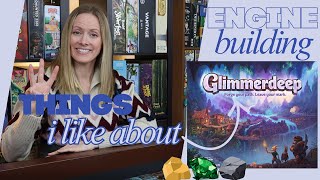




Glimmerdeep Deep Dive
What the Community Thinks About Glimmerdeep
Reviewers consistently praise Glimmerdeep as an engaging engine-building experience that offers asymmetry, replayability, and genuine strategic depth. The consensus leans strongly positive, with channels like Tabletop Tolson describing it as a solid engine-builder with accessible rules and rapid play. BoardGameCo's Alex, who covered it in a sponsored preview, later said he really enjoyed it but put it in the range where adding it to his collection would mean taking something else out. Reviewers appreciate the balance between simultaneous play that keeps everyone engaged and meaningful player choices that matter. Some hesitation centers on whether the prototype rules are final and whether the steep learning curve might limit casual appeal, but the underlying design philosophy resonates across the coverage.
Core Mechanics That Define Glimmerdeep
Simultaneous Excavation and Reveal-and-Write Gameplay
Glimmerdeep uses a unique blend of simultaneous play and reveal-and-write mechanics that keep the table moving without sacrificing individual agency. During the excavation phase, all players flip cards from their personal decks and mark polyomino shapes onto their dry erase maps at the same time. Each player holds their own deck, meaning the shapes everyone draws differ from round to round, creating divergent board states despite using identical maps. Reviewers from Tabletop Tolson emphasized how this mechanic eliminates downtime and creates a fast-paced rhythm, with players capping their dry erase pens to signal completion rather than waiting for turn order. The simultaneous flow only pauses during the construction phase, when players take turns selecting buildings from a shared market, then returns to parallel play during production when everyone activates their engine simultaneously.
Engine Building Through Workshops, Forges, and Asymmetric Traits
The heart of Glimmerdeep lies in players building production engines from purchased buildings and unlocked faction abilities. Workshops are compact 2x2 structures that convert resources into other resources or victory points, while forges occupy larger 2x3 footprints and typically yield powerful endgame scoring. Each faction possesses a unique calling that scores based on specific board patterns or thematic goals. Reviewers noted that players also unlock traits across three levels in rounds two through four, allowing them to customize their faction's capabilities and synergies. Tabletop Tolson highlighted how these trait selections compound with building choices, creating a second layer of engine building distinct from the card market itself. The mechanical progression ensures that early rounds feel tight and constrained, but later rounds explode into cascading resource conversions as more buildings and abilities unlock.
The Glimmerdeep Experience
Satisfying Resource Cascades and Combo Chains
Reviewers consistently describe the moment when an engine "turns on" as deeply satisfying. Kovray captured this feeling with the observation that late-game play feels like "rolling in treasure," as resources flow from one building to the next in increasingly powerful waves. That rush of abundance contrasts sharply with the early game's scarcity, where every decision about excavation placement carries weight because space is limited. One video reviewer described tracking through a specific sequence: converting iron to gold, gold to excavations, excavations to gems, and gems to points, underscoring how the game rewards forward planning and understanding card interactions. This escalation of power and complexity creates a satisfying arc across five rounds, where simpler round-one decisions bloom into elaborate production chains by round five.
Personal Strategic Puzzles Within a Shared World
Despite all players working on maps from the same set of locations and encountering the same shared market, reviewers emphasized the isolation of individual strategic puzzles. BoardGameCo's preview noted that asymmetric factions combined with unique excavation decks ensure every player builds a genuinely different board. No two Glimmerdeep games unfold the same way, not because of randomness, but because of asymmetric starting conditions, divergent card draws, and faction-specific win conditions. This means players rarely directly block one another; instead, the game delivers simultaneous puzzles where the optimal path for one faction differs dramatically from another. Tabletop Tolson reflected that players must decide whether to prioritize workshops for steady resource generation or forge for endgame points, and those decisions cascade across every turn.
What Makes Glimmerdeep Stand Out
Asymmetric Factions With Genuine Strategic Diversity
Reviewers highlighted the exceptional asymmetry as a defining strength. Each faction plays according to a unique calling and chooses from distinct trait progression trees. The Dust Whiskers, for example, score points for continuous clusters of unexcavated dirt, which inverts the usual logic of resource-hungry play. Deep Divers cannot construct buildings in the normal way but instead fill a scoring grid through excavations and production decisions, creating an entirely different puzzle. This design ensures that players exploring different factions experience materially different games, not simply cosmetic variation. Kovray emphasized that the asymmetry feeds directly into replay value; players return specifically to try different characters and discover how faction abilities reshape strategic priorities.
Dry Erase Components and Tactile Production
The physical handling of the game earned praise across reviews. Tabletop Tolson specifically called out the dry erase board and polyomino flipping as satisfying tactile experiences. Players draw shapes on their boards with dry erase markers, creating a permanent visual record of their excavations that supports planning. The polyominoes themselves come from personal decks, and the act of flipping and rotating them to fit available spaces grounds the excavation mechanic in physical puzzle-solving. Kovray noted that the overall table presence of the game possesses a quality they described as "magic," suggesting that the combination of simultaneous play, dry erase boards, and resource management creates a holistic experience that feels good to play beyond the point values alone.
Potential Drawbacks
Limited Polyomino Variety and Rule Interpretation Complexity
Tabletop Tolson raised concerns about excavation tile variety, noting that the game uses only four polyomino shapes across all player decks. While reviewers understood the design reasoning, the limitation creates a sense of repetition after multiple plays. Tolson also wished for a square (2x2) tile to match the common workshop footprint, observing that the design avoids it precisely because it would be too efficient. Beyond tile variety, Tabletop Tolson flagged that asymmetric faction rules can be easy to misinterpret during early play, particularly the complex mini-games embedded in each faction's calling. Misunderstandings detected mid-game proved hard to correct, suggesting that learning the full ruleset requires careful attention and possibly a practice round.
Prototype Status
BoardGameCo's preview was sponsored and played on a prototype copy, and it stated plainly that rules and components were still subject to change. Several of the other videos also covered prototype or convention copies, so buyers should expect the finished game to differ in places. The version the reviewers played shipped with four asymmetric characters and two map boards, which Kovray noted will be expanded in the full game.
If You Enjoy Glimmerdeep
One reviewer introduced Glimmerdeep by pointing to Splendor, probably the most famous engine builder, as the model for what makes the genre satisfying: a few small actions at the start that grow into a turn where you do everything at once. Anyone who loves that arc in Splendor will find Glimmerdeep pushes it further, with personal maps, asymmetric factions and multi-step resource conversions in place of Splendor's single gem market.
What Reviewers Are Saying
"I will say a strategy tip is that when excavating, make sure you have spaces for your buildings cuz your workshops and your forges just feel so good, especially later in the game when your rounds three to five. Like sometimes you'll only have four or five resources and then bam, you input them into this building, five resources come out, then you put those somewhere else, more come out and it just feels like you're rolling in treasure."
— Kovray
"Glimmer Deep, really, really nice, light, hour-long engine building game with a pretty straightforward, simple flip and right into your map. It's all about the choices you make with your workshops, your forges, where you're placing them, and then of course what you're activating with your special traits and your character faction abilities."
— Tabletop Tolson
"Glimmer Deep is one that I really enjoyed. I am not 100% certain if I'll add it or not. That one goes into that range where I like it enough that I do, but I have to find something else to take out."
— Alex, BoardGameCo