











Mercurial: Alchemia Deep Dive
What the Community Thinks About Mercurial: Alchemia
Mercurial: Alchemia stands as a nearly universal favorite among reviewers, with praise centering on its elegant design refinement over the original Mercurial and its intricate blend of mechanics. Reviewers describe it as a masterclass in improving a predecessor, removing tedium while preserving what worked. The game strikes a balance between strategic depth and engaging player interaction that reviewers across platforms consistently celebrate. While a few concerns arise around complexity and luck elements, they feel minor against the broader accomplishment of the design.
Core Mechanics That Define Mercurial: Alchemia
Interactive Worker Placement
Worker placement is the skeleton of Mercurial: Alchemia, but David Goh, working with publisher Hyperlixir and Good Games Publishing, designed it with a crucial twist: players can join actions taken by opponents by paying a resource cost. This mechanic generates the kind of interactivity reviewers typically associate with negotiation games, yet it happens entirely through economic incentives. When a player places their worker at a location, others can follow by spending dice, reagents, or catalysts. The first player to a location triggers additional bonuses for whoever was already there, creating a handshake moment that benefits both parties. Reviewers emphasize that this breaks the typical downtime that plagues worker placement games, since your opponent's turn becomes an opportunity to advance your strategy rather than a moment to wait. The system rewards attention to what other players are building toward and creates genuine tactical puzzles around sequencing your actions to set up profitable joins.
Multi-Use Deck Building
Rather than accumulating cards that merely draw more cards, Mercurial: Alchemia uses cards as Swiss Army knives. Each card serves a dual purpose: during the day phase, it has an immediate effect (rolling dice, drawing a card, generating resources), and during the night phase when you brew your potion, the same card contributes its ingredient symbol to shift the tracks on your potion board. This architecture means every card in your deck matters across multiple dimensions. Reviewers highlight that buying a card is not simply a matter of power level but opportunity cost; a catalyst you spend on a join action is one less catalyst you can use to modify your potion. The interaction between cards in your hand and cards you've already committed to your deck creates a layered puzzle throughout the game.
The Mercurial: Alchemia Experience
Tension and Press Your Luck
The blight mechanic introduces a lurking pressure. Every time you brew a potion, your blight tracker advances. Brewing early means a lower blight penalty but potentially a weaker potion; waiting risks blight penalties that skyrocket in severity as the game progresses. This creates a perpetual decision about timing. Reviewers note that the game forces you into moments where you've drawn a hand of cards you love but cannot brew twice in a row, creating deliberate moments of frustration that add edge to the experience. The design turns the satisfaction of building a potion into a real constraint.
Flow and Simultaneous Resolution
Once the day phase ends and workers are placed, much of the night phase resolves simultaneously. This design choice keeps tables engaged. Rather than watching others brew for minutes at a time, all players are executing their brewing actions in parallel, then advancing to the next round. Reviewers consistently note this saves what could have been a grueling experience, especially in higher player counts. The game accelerates once players understand the systems, allowing the depth of decision-making to shine without the burden of table downtime.
What Makes Mercurial: Alchemia Stand Out
A Masterclass in Design Iteration
David Goh's evolution of Mercurial stands out to reviewers as a textbook case of design refinement. The original relied on fiddly dice manipulation that felt thematic but tedious in practice. Alchemia solves this by integrating both deck building and dice into the core system, giving players multiple viable strategies. If you enjoyed the original's elemental interplay, you can pursue a dice-heavy approach. If you found the original frustrating, you have the option to lean into cards and ignore dice entirely. Reviewers describe this flexibility as profound; the same game accommodates different play philosophies without feeling arbitrary.
Production and Component Design
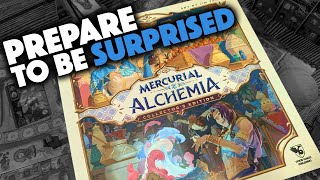
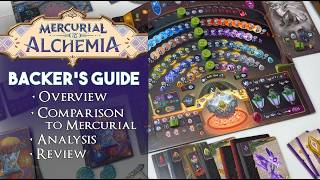
The deluxe edition's presentation appears to have captivated everyone who touched it. Reviewers praise the beautiful art on cards and the bazaar board, the tactile shells that serve as currency, and a organizational system that uses custom trays to store components. The arcana (animal familiars) feature evolution when flipped to their second side, adding personality to what might otherwise be mere tokens. Even the cardboard components garner specific praise for clarity and function. One reviewer noted the iconography is consistent across cards, player boards, and objectives, making learning intuitive.
Potential Drawbacks
High Complexity and Learning Curve
Mercurial: Alchemia demands multiple plays to fully internalize. The rules are approachable, but the interlock between deck building, track management, worker placement, joining, and blight creates a heavy decision space. New players can play the base game and scale into advanced modules (asymmetric player boards, the philosopher stone equilibrium mode, rune structures), but the depth of optimization available means each outing reveals new layers. Reviewers caution that this is not a light game, despite its art and theme suggesting otherwise. The simultaneous play helps, but mental overhead during the day phase can still stall turns for players still learning.
Luck Elements and Constraints
Objectives are drawn mid-game and can swing fortunes. A player who draws three valuable objectives by luck can surge ahead, while another draws nothing useful. Similarly, the cards you draw into your hand each round introduce variance. You cannot brew twice in a row, which reviewers note can create moments of frustration when you draw the perfect hand on the turn immediately after brewing. Blight progression involves some randomness. While these elements are not game-breaking and the strategic play more than compensates, reviewers acknowledge that a lucky draw can move outcomes in ways pure skill cannot overcome. This is less a flaw and more a design choice that lowers the skill ceiling just enough to keep games accessible.
If You Enjoy Mercurial: Alchemia
Players captivated by Mercurial: Alchemia's worker placement and deck-building combination will find satisfaction in other titles that marry the two systems. Dune Imperium similarly pairs worker placement with card-driven resources and a potion-like system of building power. Endless Winter combines worker placement with deck building in a civilization engine context. Lost Ruins of Arnac melds deck construction with expedition mechanics and interactive placement. Seas of Havoc uses the same designer and offers a naval variant on the combination. The original Mercurial remains an option for those who enjoy dice manipulation and simpler rules, though reviewers generally recommend Alchemia as the superior expression of the core ideas.
What Reviewers Are Saying
"Mercurial Alchemia is an example of design brilliance because what David Goh the designer has done is he has taken everything that's good about the original Mercurial and preserved it while taking everything that was tedious or annoying and changed it to make it better."
— Board Game Dad
"What I like the most about it is the positive player interaction in the worker placement space. So if you go to a space where there's someone else, you get something, they get something. So everyone's happy."
— Meeple University
"You're going around, you're placing your workers and getting these cards. You're trying to build a deck of cards that you will eventually take and put inside of your potion. And that potion will move things around your board so that you can get more points and more money and other things."
— Man vs Meeple