



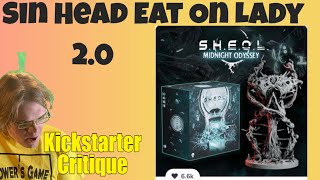

Sheol 2.0 - Midnight Odyssey Deep Dive
What the Community Thinks About Sheol 2.0 - Midnight Odyssey
Reviewers covering Sheol 2.0 - Midnight Odyssey, a project from Lunar Oak Studio, agree on the core pitch. It is a sci-fi campaign set in an eternal night, playable solo or cooperatively by one to four players, in which a small group of scouts defends the Citadel, the last city on Earth, against the shadows. Where they split is on the campaign page itself, which reviewers felt sold the theme better than it sold the game.
Bower's Game Corner offers the most detailed take. The channel awarded the campaign a B+ and said it wanted the game, yet much of the review focuses on the campaign video. Bower argued that the opening spends about 90 seconds on theme while components, dimensions and gameplay footage go unshown. Bower called the writing "insanely good" and the mission manual outstanding, so the objection is mostly about pacing and presentation rather than the content itself.
The Dice Tower's Crowd Surfing segment and a second episode, also from The Dice Tower, take a more cautious view. The hosts described the project as a mega game with a big, involved story, and they read the pitch's eight boards, four miniatures, 83 cards and 100,000 words of story aloud. They were drawn to the premise of shadows falling from the moon, but one host said the project was intriguing enough to watch without being enough to back, and that the problem was the page rather than the game.
The pitch itself places the game alongside Death Stranding and Expedition 33 and mentions a King of Tokyo style mechanism. Bower said neither video game had been played, but the King of Tokyo reference was the detail that stood out, since Bower loves that board game.
Core Mechanics That Define Sheol 2.0 - Midnight Odyssey
Cooperative Game
The central structure is a shared defense. Players work together to hold the Citadel while the shadows advance, and the design supports both solo and group play. Bower read aloud a line about managing powerful enemies with artificial intelligence and wanted to play the game solo after hearing it. The Dice Tower's read of the pitch frames the game the same way, as a group effort to "work together to fight off these shadows," which fits the cooperative emphasis reviewers kept returning to.
Branching Mission Campaigns
Beyond the shared fight, the game is organized as a campaign of missions. Bower singled out the branching mission cards, which use arrows to show how one mission leads to the next, and noted that scouts evolve between missions and that new Citadel boards are discovered along the way. The mission manual carries much of that structure, and Bower found its story good enough to support the campaign.
The Sheol 2.0 - Midnight Odyssey Experience
Eternal Night Dread
Reviewers describe the game as bleak in a way that suits its theme. The pitch Bower read describes a sunless wasteland haunted by ghosts, where liquid light is the substance that can destroy the shadows. Bower singled out the passive light mechanic, saying the brightness levels of enemies and corruption are unique and blend into the atmosphere of the game. The Dice Tower's hosts reacted to the same premise, calling the idea of evil darkness coming from space and destroying the moon a cataclysmic one.
Epic Campaign Scale
The second feeling is scale. The material Bower read promises 100,000 words of story, 450 illustrations and 60 plus hours of play, and Bower found it useful to translate those hours into the equivalent of repeated trips to the movies. The Dice Tower's hosts were less certain about the same size. One host was unsure whether their brain and time could handle a game this gigantic, and another called it a big lifestyle game. For these reviewers the epic scope is the draw, and the time commitment is the hurdle.
What Makes Sheol 2.0 - Midnight Odyssey Stand Out
Theme and Mechanics That Support Each Other
Bower's most enthusiastic point is that the theme and mechanics reinforce one another. In that reading, a rule that makes thematic sense is easier to teach, because a player can reason from the story to the rule rather than memorizing it. Bower gave the design credit on that basis, describing it as a game where theme and mechanics merge.
A Pledge Structure Reviewers Found Clear
Both channels singled out the upgrade and pledge structure. Bower said the campaign handled a large number of pledge levels cleanly and clearly, giving it extra credit for that. The Dice Tower's hosts noted that the campaign leads with an upgrade pledge for people who already own the game, so existing owners can jump in without repurchasing everything. Bower also called the stretch goals bangers, while wishing them featured higher on the page.
Potential Drawbacks
Price and Commitment
Price is the most direct objection. Bower reacted to the headline box at $358 with "Man, that price sucks," and although still committed, described it as a big, heavy investment in a large box. Bower wanted the campaign to justify that cost earlier, with more tangible footage of the components shown up front.
A Presentation That Buries the Gameplay
The most consistent complaint is that the campaign video and page are hard to use as a guide to the game. Bower did not realize the game contained cubes, complained that the components were zoomed out, and wanted to see the board setup rather than another theme sequence. The Dice Tower's hosts were intrigued by the premise but felt the page made the game hard to judge, and one host said the board's squared layout looked mathy and not very free form.
If You Enjoy Sheol 2.0 - Midnight Odyssey
Players who enjoy the cooperative defense of a fortress will recognize the structure of Castle Defense. Bower said that when someone described the project as castle defense, it matched the vibe being conveyed by the defense of the Citadel.
Players who enjoy the King of Tokyo mechanism described in the pitch will find a related pleasure in King of Tokyo, a game Bower loves.
Players who respond to the dark palette, heavy miniatures and sci-fi tone will find a similar atmosphere in Deep Madness. The Dice Tower compared the two for their look, describing Deep Madness as very dark, with lots of minis and a sci-fi bend.
What Reviewers Are Saying
"Merging together. The theme and the mechanics that is fantastic and it makes the game so much easier to teach in my opinion because then it's like oh that makes sense that that's why the rule works that way because it thematically makes sense"
— Bower's Game Corner
"That's what I was talking about when you're just shooting me full of 90 seconds of theme. It doesn't work anymore for most people because like we've all been burnt."
— Bower's Game Corner
"The board being a little squareish and by that I mean sort of like it looks mathy. I don't know if I like that. It doesn't look very free form."
— The Dice Tower