


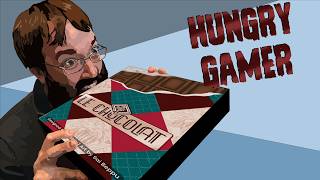









Le Chocolat Deep Dive
What the Community Thinks About Le Chocolat
Le Chocolat divides reviewers along a clear line. Dice Tower and Before You Play frame it as a clever, enjoyable filler that scratches a particular itch, quick, thematically satisfying, and full of surprising tactical choices for such a small box. BoardGameCo, by contrast, finds the core appeal limited; after a few plays, the novelty of breaking chocolate wears thin. The consensus emerges not around universal praise but around what Le Chocolat actually is: a travel-friendly, 10-minute puzzle for two players that punches above its weight in strategic thought, yet doesn't pretend to be more than a lightweight diversion.
Core Mechanics That Define Le Chocolat
Split and Choose
Le Chocolat inverts the classic split-and-choose dynamic by making splitting the core act. Players take turns drawing a single straight line across the chocolate bar, any direction, any position. The spatial tension comes not from dividing first but from controlling what your opponent will be forced to claim. The game mimics the tactile experience of breaking a real Hershey bar; cardboard tiles sit in a grid, and each split generates groups. When a split isolates three or fewer pieces, the player who just split does not claim them, the opponent or the player facing the resulting group has to. This inversion transforms the feel from "I'm trying to grab what I want" into "I'm trying to make you take what you don't."
Variable Scoring and Hidden Values
Each game flips a single scoring card that defines point values. One card might make almonds worth a majority bonus while raspberries become minus ten. The next game, the math flips. Some tiles face down, hiding their fruit or nut beneath cardboard until claimed; some tiles are blank and score zero. This hidden information layer means the chocolate bar holds secrets. Reading the setup, seeing which nuts are visible, calculating supply and demand, estimating risk, becomes the real puzzle. Reviewers noted that the scoring cards include helpful quantity indicators, showing exactly how many of each nut exist in play, making the decision space transparent even when the board is not.
The Le Chocolat Experience
Deceptive Simplicity with Hidden Depth
Breaking chocolate sounds trivial until you realize your opponent is setting traps. The rules take two minutes to explain; the first game moves fast. But moments arrive where the board offers cruel choices: claim something bad now or hope for something worse later. Reviewers described experiencing turns that sometimes play themselves, where no good move exists, yet also moments requiring "mental gymnastics" to calculate how to force your opponent into the worst outcome. The game occupies a strange middle ground, light enough to play twice in succession, yet heavy enough to reward reading ahead.
Satisfying Quick Ritual
Players reported reaching for Le Chocolat as an interstitial game, something to fill a 15-minute gap or warm up before heavier fare. The fact that you can play multiple rounds back-to-back without setup friction strengthens this role. Reviewers called it a "travel game, extremely light, very casual," where conversation continues around the table while the chocolate gets destroyed. The thematic production, actual foil wrapper details on the box, tiles that look and break like a chocolate bar, layers satisfaction onto mechanical simplicity. There's a reason chocolate was chosen as the theme instead of generic tiles: it justifies the splitting action and makes the act of claiming feel personal.
What Makes Le Chocolat Stand Out
Thematic Coherence Between Mechanic and Feel
Le Chocolat's designer Mashu achieved what many abstract games attempt and fail: making the theme inseparable from the system. The chocolate bar is not a reskin. Breaking chocolate in half, watching pieces cleave off when you cut too close to the edge, and claiming chunks that contain the varieties you need, these actions all map directly to the fantasy. Reviewers praised how the production reinforces this. The box mimics a chocolate bar's wrapper. The tiles are sized to suggest actual chocolate squares. The game doesn't ask you to imagine chocolate; it lets you enact breaking it, with all the satisfying spatial reasoning that implies. This coherence elevates what could be a dry grid puzzle into something tactile and memorable.
Scoring Variety That Shifts Strategy Across Plays
Ten scoring cards mean ten different games. One card values almonds and cashews as sets worth points; another makes having the majority of orange slices worth six, but the player with zero gets a bonus. Negative points trap unwary players into claiming tiles they actively want to avoid. This variety solves the replayability problem that plagues many lightweight games. You cannot master Le Chocolat by memorizing positions; each game rewrites the valuations, forcing you to re-read the board. Reviewers noted this shift kept them engaged across multiple plays, not forever, but long enough that the game justified shelf space for a two-player collection.
Potential Drawbacks
Limited Longevity and Scope
BoardGameCo concluded the game "felt played out after 2-3 plays," and this critique rings loud precisely because it describes real mechanical limits. The grid size never changes. The rule set never expands. You are always just cutting and claiming. Even with ten scoring cards, the core loop becomes routine. Unlike games with escalating complexity or hidden information that unfolds, Le Chocolat does not build toward a climax; it reaches a conclusion. For players seeking depth that rewards mastery across dozens of plays, the game simply does not sustain interest. It is a capable filler, not a collection cornerstone.
Predetermined Turns and Tactical Flatness
What feels like a fun occasional puzzle in an early play can turn repetitive across many sessions: reviewers described moments where "the turns play themselves," where the board state leaves so few viable moves that strategy collapses into determinism. In heavier games, this triggers decision compression, players think faster, accept tough trades, push forward. In a 10-minute puzzle, it just stalls momentum. The other critique: forcing your opponent to take bad tiles is satisfying exactly once. After that, the psychological layer thins. You know they know you are setting a trap. Sometimes no escape exists, and you just both accept that you are administering a punishment disguised as a choice. Not every filler needs to feel like a moral quandary, but reviewers suggested Le Chocolat occasionally strains to make the core tension feel fresh across multiple rounds.
If You Enjoy Le Chocolat
Dice Tower explicitly compared Le Chocolat to Dots and Boxes, the pen-and-paper game where players draw lines and claim boxes. If you loved that childhood game and want it in a modern, thematic package, Le Chocolat delivers exactly that energy. Before You Play mentioned affinity with New York Slice and Animals on Board, both split-and-choose designs that also reward spatial reasoning and forcing bad choices on opponents. Players seeking quick two-player puzzles with hidden information and area control might also explore Diced Veggies, which BoardGameCo suggested as a game that captures similar mechanics in a "more vibrant and better game experience," if you want to branch out from chocolate. For those who tire of Le Chocolat's particular grid quickly, Pacts and New York Slice offer similar tension with fresh aesthetics and slightly more strategic granularity.
What Reviewers Are Saying
"Hey everyone, welcome back to Chris Time. This week I took a look at a few games here. Le Chocolat, I gave a six. This is an interesting game where you break a bar of chocolate made of little cardboard pieces into half and eventually start collecting the pieces off of it. Some for good, some for negative points. I think it's clever. I think it's a very small form factor game and it feels like a small game. So, it's a six. Enjoyable."
— Chris, Dice Tower
"I split, I choose. I keep on splitting until I have to choose. And you basically start out with one big bar of chocolate. And on your turn, you have to split just something into two sides. And if ever you end up on the table with a piece of chocolate that is three or fewer actual pieces, you have to take them all."
— Naveen, Before You Play
"The production of this is super cool. The it looks like chocolate bar, and we've all done the thing where you break the chocolate bar."
— Dice Tower