







Cats Vs Cucumbers Deep Dive
What the Community Thinks About Cats Vs Cucumbers
Cats Vs Cucumbers occupies an interesting middle ground in the board gaming landscape. The game draws praise for its charming theme, cute components, and accessibility as a quick family filler. However, opinions diverge sharply on the core dice mechanism. Some reviewers find the push-your-luck engine satisfying and engaging, while others find the Yahtzee-style constraint, limited to three rolls per turn, undermines the build-and-risk tension that defines true push-your-luck games. The consensus is clear on one point: the theme sells itself. Whether the game underneath lives up to its adorable facade depends entirely on what you expect from a dice-rolling experience.
Core Mechanics That Define Cats Vs Cucumbers
Dice Rolling and Set Collection
The game uses a Yahtzee-inspired mechanic where players roll six dice up to three times per turn, saving dice between rolls. The goal is to match three-of-a-kind (or more) of specific symbols: cats (which let you place or advance cat tokens on scoring boxes), treats and toys (set-collection elements that provide points), or cucumbers (the penalty die). This structure creates a familiar framework for casual players while establishing the tension between locking in what you have and pursuing a stronger combination. Designers Ammon Anderson and Melanie Anderson, publishing through Levity Games Studios and Envy Born Games, built the game around this straightforward core. The scaling is clever: three of a kind provides one benefit, four of a kind provides two, and so on, which encourages players to push further even after securing a workable result.
Push-Your-Luck with the Bust Mechanic
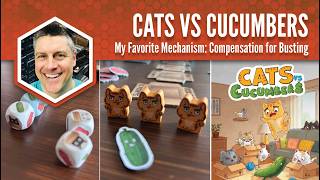
Rolling three cucumbers ends your turn immediately (a "bust"), but the game gives you something for the failure: you receive a cucumber token. On any future turn where you bust, you can spend a cucumber token to ignore the bust, gain three new rerolls, and keep going. This elegant recovery system ensures that even failed turns contribute to your overall strategy. The push-your-luck element centers on deciding when to reroll versus banking your gains. Some reviewers praise this mechanic for rewarding aggressive play without completely punishing failure, while others note that the three-roll limit constrains the escalation of tension. Unlike games where you can keep rolling indefinitely and feel the mounting pressure with each new die, Cats Vs Cucumbers imposes a hard ceiling. You know by turn one that you have exactly three chances, which changes the psychological weight of the decision.
The Cats Vs Cucumbers Experience
Whimsical and Forgiving
Reviewers consistently highlight the game's charm and approachability. The theme, rooted in the internet meme that cats panic around cucumbers, gives everything a playful tone. The cat meeples are cute, the box art is adorable, and the inclusion of sticker sheets so players can name their cats adds an interactive charm that extends beyond the mechanical experience. The game scales for 2 to 6 players and plays in about 25 minutes, making it the kind of title you can teach quickly and deploy in a casual game night without extensive rulebook diving.
Light Strategy with Modest Depth
While the dice are random, meaningful decisions emerge from risk assessment and resource management. Do you have enough cucumber tokens to absorb a potential bust? Are you close to unlocking a special roll bonus (the "Perfect" roll (one of each symbol) or the "Meowza" (three pairs), both grant bonus actions)? Can you afford to be conservative when the timer is running down? The "nine lives" game timer creates interesting end-game dynamics: players track shared lives that decrease each time anyone busts, eventually ending the game. This mechanic means individual incentives shift as the game progresses. Early on, you want the game to last; late in the session, a player behind might push recklessly to force a bust and trigger game end.
What Makes Cats Vs Cucumbers Stand Out
Set Collection Over Pure Yahtzee
Unlike traditional roll-and-write games, Cats Vs Cucumbers layers set collection alongside the dice rolling. Accumulating fish tokens (treats) and yarn tokens (toys) scales your score: one treat is worth one point, two treats are worth three points, and three treats are worth six points. This compounding scoring encourages players to specialize and pursue particular strategies rather than just chasing whatever dice appear. Reviewers note this depth distinguishes the game from simpler dice games and gives repeated plays distinct feel depending on what symbols come up early.
The Copper Token Redemption System
The cucumber token mechanic, converting failure into a tool, is a standout design choice. Most dice-rolling games punish a bust by simply ending your turn. Cats Vs Cucumbers transforms every bust into a strategic resource. You gain a token, and spending it later grants three free rerolls. This creates a risk-reward loop where even bad rolls contribute to future plays. Reviewers praise this as one of the game's most clever moments: a mechanism that makes defeat feel like progress.
Potential Drawbacks
The Three-Roll Constraint Limits Escalation
The primary tension in push-your-luck games comes from mounting pressure: each additional roll carries exponential risk, and the possibility of pushing indefinitely creates drama. Cats Vs Cucumbers caps this at three rolls, which means the tension arc is compressed. You know from the start that you cannot exceed three chances, which flattens the "will I? won't I?" moment that defines true push-your-luck experiences like King of Tokyo or Zombie Dice. One reviewer noted disappointment that the Yahtzee structure undercut the push-your-luck fantasy. The game becomes a tighter exercise in probability judgment rather than an emotional roller coaster.
Turn Outcomes Can Feel Empty
The dice can produce a roll where you have no three-of-a-kind of any symbol: not enough cucumbers to bust, but nothing to claim either. In these cases, you gain nothing and pass the turn. A reviewer noted the odd design quirk that busting (gaining a cucumber token) can be more rewarding than rolling nothing, which creates a strange incentive structure where failure has tangible value but pure whiffs do not. This is a minor friction point, but it suggests the probability math works differently than classic Yahtzee variants.
If You Enjoy Cats Vs Cucumbers
The comparison games mentioned by reviewers offer relevant alternatives. If you love the push-your-luck element and the simplified dice system, King of Tokyo delivers a larger escalation arc with more player powers and theme integration. Zombie Dice captures the same quick-play spirit with a tighter theme (zombie dice determine how many humans you can eat). For the set-collection layer, Farle (which shares the Yahtzee-meets-push-your-luck DNA) offers deeper strategic variety. If your draw is purely the adorable theme and family-weight accessibility, search for other animal-themed fillers or quick dexterity games that foreground charm over mechanical complexity.
What Reviewers Are Saying
"This game is really fun because you're pushing your luck cuz if you bust, you don't get to do anything besides gain the cucumber token and you lose a life for the game. This one, it's cute, it's fun, it's great for all ages. I highly recommend it."
— Watch Review
"It says ignore the bust and keep on going. I really like that. It is a way to feel good in a game where when you bust, nothing has happened on your turn, but at least it gives you a way to get out of a future bust."
— Jamie, Stillmmy Games
"You can't push your luck after that. And is that really push your luck? It doesn't bring that excitement. Comes a point where you're like, ‘Oh, I'm almost there. Can I make it happen?’ No, I can't because I only had three rolls. Sorry. So, I just think this combination is greatly disappointing. So, I'm going to give this one a five."
— Wendy, The Dice Tower