



Concrete Canvas Deep Dive
What the Community Thinks About Concrete Canvas
Concrete Canvas is a one to four player game of New York street art, designed by David Abson and published by Intersection Games, according to the kovray teaching video. The three channels that covered it arrive at a broadly favorable first impression, though each approaches the game from a different angle. Grant Lyon says the game is hard to describe, calls it a good game, and singles out its structure as "cool and different." The Dice Tower named it a pick of the week, and one host called it among their most anticipated projects, mostly on the strength of the art and the theme.
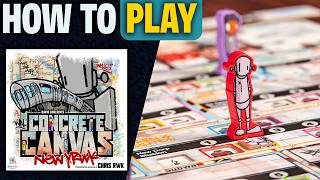
Kovray takes the instructional route. Ilia and Tyler teach the rules from a prototype and walk through setup, movement, painting, and endgame scoring in detail. Their video is the only one in the group that explains the scoring in full, which makes it the most useful reference for anyone deciding whether the rules suit them.
The reviewers agree that the presentation is strong and that there is more under the surface than the box art suggests. Where they differ is in emphasis. Grant Lyon is most interested in the puzzle that develops during play. The Dice Tower is most struck by the look and the theme, and says it looks like there is a game underneath as well.
Core Mechanics That Define Concrete Canvas
Movement Through the Five Boroughs
Grant Lyon describes the movement as worker movement: a player moves one of their pawns to an adjacent board, and the destination must sit exactly one value higher or lower than the current space. Kovray adds that the destination must be unoccupied and cannot already carry a sticker, because the mover places one of their own there. Each move also collects the spray can matching that sticker spot. Kovray notes a one-time metro card that lets a character travel to any tile on the board, and a player who never uses it scores four street credit at the end. The metro card turns movement into a scoring decision as well as a route decision.
Recipe Fulfillment and Spray Can Paintings
The second mechanic is the recipe. Paintings sit in a shared row, and each one requires a specific combination of spray can tokens. A player returns those tokens to the supply and adds the painting to their portfolio, where it earns street credit at game end and contributes icons that score against collection cards. Kovray explains that spray cans can be traded, two of one color for another or three for one, which lets a player adjust a recipe at a cost. Grant Lyon's phrase "recipe fulfillment" captures the same pattern: the target is named, and the decision is which completion to chase and when to commit scarce tokens to it.
The Concrete Canvas Experience
A Tightening Puzzle
Grant Lyon describes a clear arc. Early on, players move around the city collecting colors, but as the board fills, the walls close in because movement is limited to adjacent spaces at a higher or lower value. The late game becomes a puzzle about where to move without getting caught, since the game ends when a pawn can no longer move. That shift from freedom to constraint is what Grant Lyon finds most engaging, and it gives the game a tension that a flat set collection game would not have.
Playful Urban Creativity
The Dice Tower describes a lighter feeling built around the graffiti theme. The reviewers connect the game to the experience of seeing well done street art in a city, and they describe the theme as nostalgic in a way that appeals to them personally. The tone is less tense than Grant Lyon's, and closer to building a mural out of cards, tokens, and tiny spray cans.
What Makes Concrete Canvas Stand Out
Art and Upgraded Components
The Dice Tower reviewers praised the art and the components in detail. They singled out the 3D spray can tops, which work as tokens while still evoking the medium, and the miniatures that look like graffiti art. The art is built around the work of Chris RWK, a New York street artist who narrates the campaign video, according to the Dice Tower. One reviewer said the upgrades are a reason to back a project and that they wanted the spray can minis and painted minis in particular.
A Theme and Rules That Line Up
Reviewers also noticed that the theme and the complexity match. The Dice Tower said the game looks not complex, a sensible choice for a theme about street art that could attract people outside of board gaming altogether. Kovray's teaching video supports that impression in the early game, where players choose a character, place pawns from two collection cards, and start moving. The scoring adds layers later, which gives the game a low barrier to entry with more depth underneath.
Potential Drawbacks
Still a Prototype
Kovray is explicit that the footage shows a prototype that may change before release. Grant Lyon had played the game, but the Dice Tower segment focused on presentation rather than play, so the balance of the scoring and the final rules remain untested in these videos. Reviewers are enthusiastic, but their enthusiasm rests on the look, the theme, and an early version of the rules.
Fiddly Tall Components
The Dice Tower's most specific concern is the height of the 3D spray can tokens. One host said they were a little nervous about how tall the pieces are and that they might look fiddly on the table. The concern is about physical presentation rather than design, and the same reviewers still described the pieces as charming. The reviewers' interest in the upgraded version suggests that the physical edition will matter to buyers.
If You Enjoy Concrete Canvas
Players who enjoy Concrete Canvas's shrinking movement space will find similar satisfaction in Tokaido, where routing through a path is central to every decision. Players who are drawn to the recipe-style paintings, and to the idea of committing scarce tokens to a named target, may appreciate Namiji, which sits in the same comparison group as Concrete Canvas.
What Reviewers Are Saying
"It's a very interesting arc because at the start of the game, you're just popping around, getting the colors that you need, but then the walls start closing in because you can only move to a higher or a lower spot on an adjacent board. But what if all those spots are taken?"
— Grant Lyon
"I'm one of those people that actually likes the look of well done graffiti. I mean, if you're just going to scroll your name and it's, you know, but growing up in and around a lot of cities, I mean, it does add a particular appeal."
— The Dice Tower
"Now, as a note, what you see here in this video is a prototype of the game, and it may be subject to change. With that said, let's go to the table and let's start how to play."
— kovray