






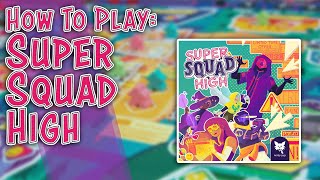

Super Squad High Deep Dive
What the Community Thinks About Super Squad High
Super Squad High has impressed reviewers with its vibrant presentation and distinctive theme, but opinion splits sharply around its social gameplay elements. The CA Couple celebrates the game's tight balance between competing demands, calling it a refreshing take on the cooperative genre. The Cardboard Herald, by contrast, finds the friendship system fundamentally at odds with the strategic core, describing it as awkward and pace-breaking. Meanwhile, the One Stop Co-op Shop and Foster the Mele channels praise the colorful, accessible design and excellent solo mode. What unites these perspectives is admiration for what Super Squad High attempts: a cooperative game where players juggle schoolwork, relationships, and crime-fighting without sacrificing coherence. Where reviewers diverge is whether that ambition succeeds.
Core Mechanics That Define Super Squad High
Time-Restricted Worker Placement
Super Squad High uses worker placement, but with an innovative constraint: the spaces you can access depend on the time of day. Players divide their six daily actions across three phases (morning, afternoon, and evening) with two workers per phase. This design by Michael Addison forces players to commit actions early, knowing they will not have access to all spaces until later in the day. The CA Couple emphasizes how this restriction creates a constant balancing act: do you complete schoolwork now to refresh cards later, or do you fight crime immediately to prevent damage tokens from accumulating? The limitation also ensures that players cannot simply optimize toward a single goal, keeping the game from becoming formulaic.
Dice Rolling Combat with Card Mitigation
When players engage crime, they roll a number of dice and use costume cards from their hand to cancel specific damage results. The Cardboard Herald highlights the elegance of this system: players see the consequences of their rolls immediately and must decide whether to mitigate with limited cards or accept damage. Successful crime-fighting yields rewards and moves tokens to the rooftops, allowing teamwork where players can assist one another. The dice resolution keeps combat feeling tense and high-stakes, which one reviewer notes mirrors the "crisis management" of games like Pandemic, though with tighter constraints.
The Super Squad High Experience
Vibrant, Approachable Presentation
Multiple reviewers praise the game's visual appeal and accessibility. Foster the Mele calls it "super vibrant and colorful and fun," while the CA Couple found it engaging enough to produce a full playthrough. The art by Tan Ganguli and the design from Nerdy Pup Games create a world that feels inviting rather than intimidating. Solo players report that the game flows smoothly and presents no overwhelming board state, despite managing student abilities, power cards, costume decks, and threat tokens simultaneously. The accessible presentation belies a system with real friction between competing priorities.
Tight, Demanding Tension
Reviewers consistently describe the game as constraining. The CA Couple notes the core tension: "because this game is so tight you've got to like make that balance," referring to the choice between fighting crime and investing in preparation. The Cardboard Herald observes that undefeated crimes guarantee damage tokens on the villain scheme, which escalates threat and shrinks the decision space further. Players must juggle five damage tokens in the supply before they lose; failing grades mean instant defeat; crime card exhaustion means time runs out. This density of losing conditions creates a game that demands attention and punishes hesitation.
What Makes Super Squad High Stand Out
Thematic Integration of Student and Hero Powers
The character creation system stands out across reviews. Players draft a student identity (geeky, artsy, trendy, etc.) and a superpower, then combine them with costume cards. The CA Couple and the One Stop Co-op Shop highlight how this feels like real character customization: your identity shapes which classmates you can befriend and which powers you unlock. The One Stop Co-op Shop calls it "a really interesting take on sort of the superhero genre, one you don't really see as much," anchoring the appeal in the mundane reality of high school layered over saving the city. This lens is what Nerdy Pup designed into the core, and it resonates.
Solo Mode That Delivers Challenge Without Excessive Bookkeeping
The Cardboard Herald specifically praises the solo mode as "really fluid," and the One Stop Co-op Shop confirms it works without devolving into tedious automation. Solo players face the same core decisions as multiplayer, with threat scaled to player count. Foster the Mele notes the game supports one to four players and solo play equally, which is rare for worker placement games. This accessibility opens the game to players without a regular group, broadening its appeal significantly.
Potential Drawbacks
The Friendship System Derails Game Flow
The Cardboard Herald's sharpest criticism targets the social element directly: "The whole social element just feels awkward and has no real game impact other than derailing the entire pace. And the need to remember secret information feels incongruent with the rest of the systems." The friendship system asks players to peek at hidden trait tokens, remember them face-down, and later answer creative prompts to forge relationships. Reviewers find this memory game jars against the precise, dice-driven crime-fighting. The switch from strategic calculation to creative roleplay, and back again, disrupts momentum. While some players enjoy this tonal whiplash, others experience it as a broken pacing mechanic.
Limited Strategic Latitude and Reactive Gameplay
The Cardboard Herald notes that the game becomes "very reactive and demanding" because most actions must be dedicated to fighting crime or preventing failure. "You're putting damn near everything into these fights determined by a heck of a lot of dice rolls and you're left with very little room for creative decisions." Unlike Spirit Island or Pandemic, where players can strategize about which threats to address, Super Squad High leaves almost no room to let problems slide. Undefeated crimes damage the villain scheme automatically, forcing engagement. This eliminates slack in the system and makes the game feel overly prescriptive in what players must do each turn.
If You Enjoy Super Squad High
If the tight, colorful chaos appeals to you, explore Spirit Island for deeper strategic decision-making in a cooperative context. Pandemic offers similar crisis management but a grittier theme. For the theme of teen heroes in peril, Small World captures that sense of asymmetry and meaningful powers applied to a contained board. For pure solo playability with excellent presentation, King of Tokyo delivers dice rolling, player powers, and a more forgiving mechanical space, though without the school-life flavor.
What Reviewers Are Saying
"The one thing I've been enjoying about this game is like the balance of whether or not you actually have to successfully do the crimes or you can leave them for later. Because this game is so tight, you've got to like make that balance and I find it interesting."
— CA Couple
"The whole social element just feels awkward and has no real game impact other than derailing the entire pace. And the need to remember secret information feels incongruent with the rest of the systems and weirdly reliant on cognitive capabilities."
— The Cardboard Herald
"This is a solo cooperative game where you are high school students who are also superheroes by day and night. It's kind of crisis management like Pandemic, but then you also go on dates and have friendships with some of the characters. So, I love the theme of this one. I think it's a really interesting take on the superhero genre, one you don't really see as much."
— One Stop Co-op Shop