





Thieves of Eldris Deep Dive
What the Community Thinks About Thieves of Eldris
Thieves of Eldris has captured reviewers' imaginations as a fresh take on hidden movement games. What makes this game distinctive is that it flips the traditional formula: rather than one player hiding while everyone else hunts, every player is simultaneously trying to conceal their identity while hunting everyone else. This twist generates a deduction game where the mystery works in all directions at once. Reviewers from Board Gaming Ramblings to Board Game Dad emphasize that the game creates either compelling strategic depth or controlled chaos, depending on player count and table comfort with asymmetric information. Inside Up Games' designer Conor McGoey has crafted something that plays differently at two players than at three or four, with the hidden movement mechanics pushing players to balance aggressive stealing with careful identity management. Consensus among reviewers: Thieves of Eldris offers a tense, rewarding puzzle that keeps everyone engaged from start to finish.
Core Mechanics That Define Thieves of Eldris
Hidden Movement
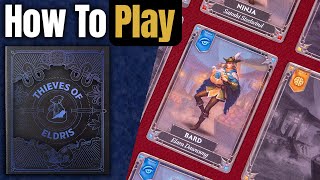
Hidden movement in Thieves of Eldris works by making every player simultaneously a thief with a secret identity (called a cut purse) that opponents must deduce. Each player secretly chooses one townsperson card from their hand to be their identity, and the other cards become targets they pursue. Players roll three dice each turn, using the symbols on them to swap adjacent townspeople cards on a six-by-four grid. The tension arises because every move is information: the more aggressively you manipulate the board, the more you reveal about which identity you might be. Players must juggle two contradictory goals: making the moves they need to steal coins without exposing their position. Reviewers note this creates a cat-and-mouse dynamic that operates in multiple directions simultaneously, unlike traditional hidden movement games where one player flees and others pursue.
Closed Economy
Thieves of Eldris uses a fixed pool of eight coins that players race to accumulate. Every coin stolen from a target is one fewer coin in the general pool, and every coin extracted from a defeated player is a direct loss for that opponent. The value of targets varies by position on the grid: corner positions yield two coins, edge positions yield one and a half coins, and central squares yield just one coin. This positional economy means players must weigh the risk of being obvious as they hunt high-value targets. The first player to collect eight coins wins instantly, which creates urgency but also strategic decisions about whether to pursue safe, low-value steals or risky, high-value scores. Reviewers highlight that the closed economy keeps tension high because every successful theft brings someone closer to victory while everyone else falls further behind.
The Thieves of Eldris Experience
Relentless Tension
The constant threat of exposure defines the emotional core of Thieves of Eldris. Players cannot simply steal and accumulate points openly because revealing their identity makes them vulnerable to retaliation and accusation. At three or four players, reviewers describe a game where long stretches of turns yield no steals, only misdirection and position jockeying as players try to protect their identities. A wrong guess about an opponent's identity exposes your own cut purse with no reward, a painful swing that keeps players cautious and calculating. The asymmetric knowledge of who is who creates sustained uncertainty, forcing players to make strategic bluffs by moving townspeople they do not care about to confuse the table about their true identity. This tension is broken only when someone collects eight coins and wins instantly, ending the game with no final scoring round to temper the victory.
Mental Demand
Tracking all the information in Thieves of Eldris requires constant focus. The board state changes with every turn as cards swap positions, identities shift due to dice rolls, and the set of possible targets shrinks. Reviewers candidly acknowledge that the game is cognitively challenging, particularly during playthrough scenarios where they must narrate actions for an audience and simultaneously track five or six moving targets and shifting identities. Players must remember where high-value targets are positioned, which targets they have already stolen from, which of their own targets remain in hand, and which opponents might be which identities based on previous moves and theft patterns. This mental load makes the game less of a casual experience and more of a puzzle to solve in real time, rewarding players who cultivate systematic memory practices and forcing inattentive players to rely on luck and intuition.
What Makes Thieves of Eldris Stand Out
Everyone Hides, Everyone Hunts
The reversal of the hidden movement convention creates immediate freshness. Traditional hidden movement games assign one player to hide and the others to hunt cooperatively or semi-cooperatively. Thieves of Eldris dissolves that asymmetry by making every player simultaneously a moving target and a detective. Reviewers note that this mechanic prevents the typical alpha-player problem where one hidden player becomes the center of attention and enjoy a dramatic arc, while others execute supporting roles. Instead, every player owns their moment of mystery and their moment of investigation. The shared vulnerability and shared agency keep the table engaged and create more opportunities for clever bluffing, misdirection, and social deduction at player counts of three and higher.
Elegant Dice-and-Position Synergy
The dice rolling mechanic elegantly ties movement to the board position of targets. Players do not roll generic action points; they roll symbols that force them to move specific types of townspeople on the grid. This constraint makes pure optimization difficult: you cannot always move exactly the piece you want, which invites opportunities for opponents to misread your intent. The special abilities granted by rolling doubles or triples add another layer of meaningful decisions without overwhelming the ruleset. Reviewers appreciate that the dice rolls feel thematic and random in a controlled way, preventing the game from becoming a pure deduction exercise and keeping luck as a legitimate force in the outcome. The position-based payout system (corner, edge, middle) further rewards careful planning of which targets to pursue relative to their grid location, encouraging a puzzle-like quality to the game's strategic layer.
Potential Drawbacks
Hard to Track, Especially When Cards Move Frequently
Multiple reviewers candidly report that following the game state during play is exhausting. The constant card swaps on the grid mean that even players with strong memory struggle to maintain a reliable mental model of which townspeople are where and which are still in play. Reviewers explicitly note that this cognitive load makes the game harder to follow as a playthrough for an audience, but also makes it harder to play socially because players must devote sustained mental effort just to understand the board state, let alone make strategic decisions. Players who enjoy fast, intuitive games may find themselves frustrated by the constant mental recalculation that follows each turn. This is particularly acute in four-player games, where four different people are each moving cards and it becomes genuinely difficult to remember what just happened or why a specific card was moved.
High Risk of Incorrect Guesses and Significant Penalties
Revealing an opponent's cut purse requires the accuser to be orthogonally adjacent to the target and to name the player correctly. A wrong guess immediately exposes your own cut purse to the table with no monetary reward, a brutal swing that can end your competitive viability in a short game. Reviewers note that this creates a chilling effect on guessing: players become very conservative about accusations, preferring to steal coins quietly rather than risk the three-coin swing from failed revelation. This dynamic means games can feature long stretches where players passively maneuver and only rarely venture an accusation. For players who enjoy aggressive social deduction and constant reveals, the conservative equilibrium might feel cautious and slow. The risk-reward calculus also heavily favors players with good memory, potentially alienating players who struggle with sustained recall and creating a wider gulf between different player skill levels than reviewers expect in a family-weight game.
If You Enjoy Thieves of Eldris
Thieves of Eldris shares the deduction and bluffing DNA of games like Shot and Totton and AirLand and Sea, where information management and positioning decisions drive gameplay. Its dice-driven movement recalls the strategic randomness of Earth, another Inside Up Games title that combines spatial control with hidden goals. For players drawn to trick-taking mechanics with surprising twists, Crits and Tricks (the other game in the Twisted Realms trilogy) offers a dice-based trick game with special character powers. Draft and Write Records and Block and Key, both from the same publisher, share the same design DNA of elegant constraints and surprising emergent gameplay. Fans of asymmetric deduction games will also find kinship with hidden movement designs that reward memory, careful observation, and the willingness to gamble on incomplete information.
What Reviewers Are Saying
"In Thieves of Eldris, everyone is trying to hide from everyone else. The deduction is going every direction. It sounds like it could either be completely chaotic or one of the most compelling challenges."
— Board Game Dad
"That hiding out becomes a lot more important because someone is always going to be able to get you, so you've really got to be a lot more secretive, and there's a lot more turns where you're not actually robbing anybody, cuz you're trying to keep your identity a little bit secret, whereas if you rob it, you're signaling, hey, it's me."
— Allies or Enemies
"This game is all about understanding what is going on. I'm going been hard playing this one so far because it's so hard to follow along with everything."
— Board Gaming Ramblings