














Quagmire Deep Dive
What the Community Thinks About Quagmire
Quagmire commands genuine enthusiasm from reviewers, who consistently praise its elegant design and surprising depth. Reviewers agree the game succeeds as a strategic puzzle wrapped in an accessible package, though opinions diverge sharply on how well it scales beyond two players. The community consensus leans toward celebration: a clever re-implementation that improves on its predecessor, Bog, with elegant mechanics and thoughtful production design.
Core Mechanics That Define Quagmire
Predetermined Movement Paths
Every frog in Quagmire moves along a fixed four-step route printed on its tile. When players advance a frog, it hops to the next lily pad according to this predetermined sequence. This design removes randomness from pathfinding and places the entire game state in plain view, allowing players to anticipate where frogs will move several turns ahead. Because routes are known to everyone at the table, timing becomes the critical strategic element: knowing you can see where an opponent's frog is headed forces careful positioning and forces players to either move out of danger or set a trap.
Fly-Driven Hand Management
Players begin with only three or four frog tiles in hand, depending on player count. The only way to draw new tiles is to land on flies scattered across the bog, making fly capture the core resource management challenge. Placing each fly becomes a mini-game: you decide where to position it, knowing that if you land on it, you must move it again, and your opponent might capture it before you do. The tightness of hand management directly creates tension: run out of frogs without landing on a fly, and you lose three points while drawing a desperate replacement.
The Quagmire Experience
Strategic Tension Through Open Information
What makes Quagmire tense is that nothing is hidden. Every frog's route is visible. Reviewers describe the experience as a psychological war where players constantly weigh risk against reward. Do you complete a frog's journey now, or wait and try to score through formations? Do you capture an opponent's frog even though it leaves your own exposed? The game forces players into uncomfortable decisions where safety and opportunity pull in opposite directions, creating a pressure that intensifies as resources dwindle.
Multiplayer Chaos at Higher Player Counts
Two-player Quagmire unfolds as a deliberate dance: you can study your single opponent's options and respond tactically. At three or four players, the game becomes overwhelming for many reviewers. With frogs oriented in multiple directions across the board, tracking everyone's paths becomes a cognitive burden. Reviewers call this state a "high search abstract" where paying attention to every possible threat becomes exhausting rather than fun. The game transforms from elegant puzzle to mental gauntlet, and whether that's appealing depends entirely on your tolerance for analysis.
What Makes Quagmire Stand Out
A Clever Blend of Cute Theme and Cutthroat Mechanics
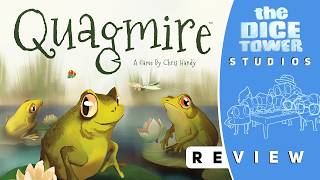
The disconnect between Quagmire's appearance and its gameplay creates much of its charm. The frogs are drawn with personality and humor; they wear different expressions and have distinct visual character. Yet the game itself is decidedly un-cute: reviewers consistently note that despite the adorable artwork, this is a ruthless game about squashing opponents' frogs, managing scarcity, and outthinking rivals. That juxtaposition delights players who enjoy games with teeth hidden beneath a friendly exterior.
Formation Scoring Creates a Parallel Strategy
Beyond completing routes, players can discard frogs from hand to score points for formations: specific patterns of lily pads they've highlighted. Scoring a formation immediately gives you points but costs you a frog tile, and it can potentially give opponents points as well if their frogs happen to occupy those spaces. This parallel path creates genuine strategic tension: do you focus on getting your frogs home safely, or sacrifice tiles to claim quick formation points and hope the board state works in your favor? Reviewers note this mechanic elevates the game beyond a simple race to complete routes.
Potential Drawbacks
Visualization Becomes Difficult at Four Players
Reviewers consistently flag the same problem: tracking everyone's movement paths becomes painful at higher player counts. With four players facing different directions around the board, determining where each frog will move next requires sustained mental effort. One reviewer describes having to look carefully at each frog, determine that player's orientation, then mentally trace the path to its next stop. This cognitive load makes four-player games feel slower and more frustrating than two-player games, where tracking is straightforward.
The Penalty for Being Unable to Move Can Feel Harsh
When a player runs out of frogs or cannot make a legal move, they lose three points then draw two replacement frogs. Reviewers note this penalty is severe but sometimes necessary; without it, a player could become trapped with no legal actions. The harsher original rule from Bog (losing immediately instead of just three points) created different tension, and whether Quagmire's modification feels right depends on which kind of pressure you prefer. Some reviewers miss the finality of Bog's rule; others appreciate that Quagmire allows comebacks.
If You Enjoy Quagmire
Players who love Quagmire's puzzle-like positioning and careful planning will find similar satisfaction in Checkers, though Quagmire offers far more theme and discovery. Blokus</strong shares the abstract spatial reasoning but with different mechanics. Onyitama</strong also places movement rules on the pieces themselves and rewards tactical positioning. Those drawn to Quagmire's two-player experience should try the original Bog, a tiny card game that fits in a pocket and delivers the same elegant puzzle in a travel-friendly form.
What Reviewers Are Saying
"This is sort of a route-building game of sorts. Well, the route's already built. These frogs are basically just trying to complete their routes while not getting squashed by other frogs."
— Before You Play
"This game is going to blow people's minds who love checkers, cuz it kind of has some of those things, but so much more theme and cute artwork and interesting things to discover."
— Zee Garcia, The Dice Tower
"You're trying to figure out the timing of when to move where cuz most everything's open, right? Cuz as soon as someone plays something to a shore, you can see where that frog is going to go for the life of the frog."
— Game Boy Geek