
Game Info
Year
2017
Players
2-4
Age
6+
Playtime
15 min
Complexity
1/5
Collection
Ratings
Creator Score
Mechanic profile
Not enough video data yet
Vibe profile
Not enough video data yet
Description
Players race to find matching pairs of marine animals visible on a busy shared board before other players spot them
Featured Videos
Review

Ecosystem: Coral Reef
Ask a Rules Question
Images
GID0453391.jpg

GID0453391_thumb.jpg
All mentions
Browse transcript mentions, sentiments, pros/cons, mechanics, topics, quotes, and references.
Total mentions: 2
This page: 2
Sentiment:
pos 2 ·
mix 0 ·
neu 0 ·
neg 0
Showing 1–2 of 2
Video nzI4w3dhYh8
Review at 0:06 sentiment: positive
video_pk 78452 · mention_pk 191051
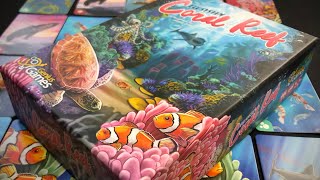
Click to watch at 0:06 · YouTube ↗
Overall sentiment (raw)
positive
Pros
- Wonderful artwork adds to the experience.
- Adds new layers of depth and challenge compared to the original.
- Strategic placement is key due to scoring mechanics.
- Solo game against 'Moka' provides a good challenge.
- Straightforward rules, making it a swift game.
Cons
- Did not manage to achieve the normal victory target (70 points), only the easy victory (55 points), scoring 64 points difference.
- Felt short of a normal victory, possibly due to not getting certain cards like whales or octopuses.
- The host felt they didn't get enough diversity, specifically in the predator category.
Thematic elements
- Building a diverse ecosystem with producers, prey, and predators.
- Coral reef ecosystem
Comparison games
- Ecosystem
Mechanics (from transcript analysis)
- action selection — On a turn, players play one card into their ecosystem, play one card into the opponent's (Moka) ecosystem, and draw a card. Completing a row of five cards triggers drawing five cards instead of one.
- Area Majority — Plankton scores points based on majority among all players. Coral scores based on being in the bottom row.
- Grid Building — Players build a grid representing their ecosystem, with limits on width (five cards) and depth (four cards).
- Pattern Building — Krill scores for orthogonally adjacent groups. Grouper scores for adjacent Krill. Clownfish score for adjacent Coral and Plankton. Eel score for adjacent prey if also adjacent to Coral. Shark scores for prey in the same row or column.
- row/column scoring — Crab scores for Plankton in the same row. Turtle scores for each row and column containing at least one turtle.
- Set Collection — The game involves collecting species to form food webs (producers, prey, predators) for scoring.
- special actions — Octopus allows moving a card or swapping two cards. Whale flips an adjacent card face down before scoring.
- Take That (indirect) — When playing into Moka's ecosystem, the goal is to minimize their score by playing cards that score them few or no points, or conversely, to 'deprive Moka of any Plankton'.
Video topics + discussion points
No key topics recorded for this video.
Quotes (from this video)
- this is a game of mindfulness and having wonderful artwork really adds to that experience
- in the solo we're going to be playing against mocha mocha named after the giant white whale that was an inspiration for Herman Melville's Moby Dick
- your end score is the difference between your score and markers score and we've got a beat marker by 55 points we want a 55 Point margin for easy Victory 70 for normal 80 for difficulty
- we haven't managed that our total score is 85 minus 21. which equals 64.
References (from this video)
No references stored for this video.
Video G5A7SG0f5V4
Meeple University Review at 1:04 sentiment: positive
video_pk 69950 · mention_pk 235558
Click to watch at 1:04 · YouTube ↗
Overall sentiment (raw)
positive
Pros
- easy entry point with simple rules
- thematic sea-life theme and visuals
- positive reinforcement scoring with a food web bonus
- reference cards are useful
- good two-player and six-player scalability
- two-player draft variant helps low-player-count games
Cons
none
Thematic elements
- balance of producers, prey, and predators in a coral reef
- marine coral reef ecosystem
- tile-drafting with a 4x5 grid and scoring
Comparison games
- Ecosystem
Mechanics (from transcript analysis)
- adjacency_scoring — Certain animals score by adjacency to other types (e.g., clownfish to plankton, groupers to krill).
- card_types — Cards fall into producers, prey, and predators, each scoring differently.
- Compound Scoring — Turtles score if they are spread across every row and column.
- Drafting — Players draft one card from a hand of ten, pass to the next player, then draw a new ten and draft in the opposite direction.
- food_web_bonus — End scoring doubles the lowest-scoring category among producers, prey, and predators.
- grid_placement — Drafted cards are placed on a 4x5 grid with placement-specific rules.
- Multi-Use Cards — Cards fall into producers, prey, and predators, each scoring differently.
- special_abilities — Octopus allows card swapping after placement, adding strategic flexibility.
- turtle_scoring — Turtles score if they are spread across every row and column.
- two_player_draft_variant — Two-player mode uses a 'fake third player' to ensure enough drafting content.
- two_stage_draft — First draft, then a second draft in the opposite direction.
Video topics + discussion points
No key topics recorded for this video.
Quotes (from this video)
- "It's a stand-alone sequel. They're not combinable. It is a separate game."
- "The game itself is very simple and the game itself plays the same way as the original Ecosystem. It's a draft."
- "This one has an easier entry point... it has these categorizations that make it easier to organize your thoughts"
- "I like the Coral Reef newer version better while Tarrant like the older version better."
- "It's an easy one to get to the table with really simple rules."
- "Quite um quite a good getaway game."
References (from this video)
No references stored for this video.
Transcript Navigation
Showing 1–2 of 2