



Cataclysm Arcade Deep Dive
What the Community Thinks About Cataclysm Arcade
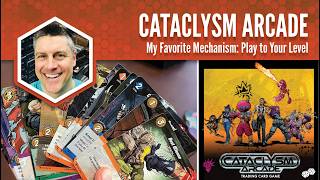
Cataclysm Arcade has captured the enthusiasm of tabletop reviewers for its bold approach to a fundamental problem in trading card games. Designer Brian David Marshall set out to create a complete TCG that works straight out of a single booster pack, and the community response has been remarkably positive. From established channels like Good Time Society and Stonemaier Games to coverage at conventions, reviewers consistently praise the game's accessibility without sacrificing depth. Where opinions diverge slightly is in emphasis: some reviewers are most excited about the novel format and innovative mechanics, while others highlight the richly imagined world and thematic coherence. But there is consensus that Cataclysm Arcade represents thoughtful design solving a real problem in the hobby.
Core Mechanics That Define Cataclysm Arcade
Single Booster Pack Playability
The defining innovation of Cataclysm Arcade is that everything you need to play a complete game comes in one 15-card booster pack per player. Brian David Marshall was frustrated throughout a career in trading card games by a simple question from customers: after opening a pack, can you actually play? The answer was always no. You needed to build a deck, find more cards, or commit to constructed formats. Cataclysm Arcade eliminates that friction. Open a pack, arrange your cards into a deck, and you are ready to play immediately. This innovation matters most for younger players and casual gatherings where constructing a deck or learning drafting feels like too much friction. As reviewers noted, the psychological impact is substantial: you can offer a friend a pack and they can play within minutes, not after hours of preparation.
Level-Based Progression and Token Economy
Rather than using traditional mana costs, Cataclysm Arcade uses a level system where each round (called a level) increases in number. The key mechanic is that most fighters and weapons are free to play as long as their level is equal to or lower than the current game level. This removes a constant friction point in TCGs where you manage both hand size and resource generation. Instead, Cataclysm Arcade uses tokens as a much narrower resource: tokens pay for attacks and ability activations. Each level, players gain tokens equal to the level number, so turns naturally escalate in power. Reviewers found this structure reminiscent of Hearthstone in its elegance: you have a clear resource curve, cards become progressively available, and resource management becomes about committing to offense rather than choosing between playing cards or passing. The system is forgiving enough for newcomers but offers strategic depth through timing and sequencing decisions.
The Cataclysm Arcade Experience
Tense, Aggressive Multiplayer Combat
The moment-to-moment feel of Cataclysm Arcade is defined by rapid-fire turns and constant threats. The game employs a unique rule that damage is non-reciprocal: when you attack an opponent, they do not immediately hit back. This breaks the pattern of most multiplayer games where attacking invites retaliation, so it encourages aggressive play throughout. Instead of players dancing around each other tentatively, Cataclysm Arcade players are constantly sending waves of fighters at their opponents, managing board presence and deciding when to swing at the boss directly. The turn structure enforces this pace: on your turn, you take one action. That action might be playing a card, activating an ability, or attacking. Then it passes. This keeps turns snappy and means a four-player game moves quickly despite the multiplayer format. Reviewers noted that you can play through an entire game in 30 to 45 minutes, which is remarkable for a TCG.
Post-Apocalyptic Spectacle with Personality
The world of Cataclysm Arcade is set 40 years after a cataclysm that destroyed civilization. Humanity survives in underground pockets, specifically in the tunnels of the New York City subway system, now called Suburbia. The core conceit is that all combat is broadcast as entertainment: a gladiatorial blood sport called the Cataclysm Arcade, complete with play-by-play commentators named Hot Mike and Tube Steak calling the action on closed-circuit TV and ham radios. This narrative wrapper gives each card a character and a story beat. Boss cards have personalities and lore tied to the collapse of the multiverse. Fighters have names and subtypes like gangs and specialties that suggest a living world. Some bosses have voice acting attached to their cards, adding an extra layer of personality. The theme is inspired by 80s action cinema, with influences from John Carpenter, Ridley Scott, and James Cameron. This isn't just flavor text layered onto rules; reviewers felt the world genuinely enriches the experience of playing with the cards.
What Makes Cataclysm Arcade Stand Out
Accessibility Without Sacrifice
Most TCGs force a choice between accessibility and depth. Cataclysm Arcade seems to have cracked that code. The genius is that the level system makes the early game completely forgiving: with no token cost to play fighters, new players can field units immediately and feel like they are doing something. But the token economy and ability interactions create a skill ceiling that allows experienced players to dominate through sequencing, resource management, and understanding which fights to engage. Reviewers emphasized that you can teach this game to someone in minutes and they will have fun, but there is enough decision space that competitive play and repeated plays still reward mastery. Jamie from Stonemaier Games remarked that the mechanism of paying tokens to attack with fighters, rather than paying to play them, was innovative: it reframes the entire economy around aggression.
Modern Game Design Applied to TCGs
Cataclysm Arcade borrows heavily from successful modern board games and TCGs. The one-action-per-turn structure is borrowed from games like Star Wars Unlimited and Flesh and Blood, ensuring that turns stay tight and players are not sidelined for long stretches. The boss-as-character conceit comes from Magic Commander and Flesh and Blood, grounding the game in avatar gameplay where your character's health is the central goal. The reshuffle-discard-to-deck mechanic is a modern deckbuilding staple borrowed from roguelike games, ensuring games never mill out and shorter decks remain viable. The companion app tracks boss health, tokens, and level automatically, removing bookkeeping friction. Reviewers saw Cataclysm Arcade as a game that absorbed lessons from two decades of TCG and modern board game design and synthesized them into something new.
Potential Drawbacks
Booster Pack Variance
Playing out of a single booster pack means your deck's power level and synergy are entirely up to luck. Reviewers noted that some packs will have strong mechanical synergies and powerful cards, while others will be less cohesive. This is not a surprise to TCG players, but it means a newcomer opening their first pack might get a weak deck through no fault of their own. Some players might open multiple packs and find one stronger than another, which could feel unfair in casual play. The designers have mitigated this with multiple formats: sealed deck, booster draft, and constructed, where deck building choices matter. But for the advertised experience of cracking a pack and playing, variance is baked in.
Tightly Bound to the Companion App
Reviewers noted that while the companion app is well-designed, tracking health, tokens, and levels becomes difficult without it. The app is not strictly optional; it is the preferred way to play because manual tracking with dice and counters is cumbersome and error-prone. This creates a dependency on a digital product that may not be maintained forever or may require internet access in some contexts. In-person play at conventions or game stores is fine, but home play without a smartphone or tablet for each player is less seamless. This is not a fatal flaw, as many modern games integrate digital companions, but it is worth noting for players who prefer completely analog gaming.
If You Enjoy Cataclysm Arcade
Players who enjoy Cataclysm Arcade's single-booster format and quick multiplayer gameplay will find similar satisfaction in Star Wars Unlimited and Flesh and Blood, which both offer rapid-fire, aggressive card play and boss-based health tracking. The level-based system and token economy will appeal to fans of Hearthstone, which uses a similar escalating resource curve. For players who want more strategic depth and multiple viable formats, Magic: The Gathering and its Commander variant offer larger card pools and constructed metagames, though with much higher investment barriers than Cataclysm Arcade requires.
What Reviewers Are Saying
"I love trading card games. I've been working in trading card games for most of my professional career. And the one thing that's always sort of frustrated me about trading card games, was the lack of a first-time user experience out of a booster pack."
— Brian David Marshall, Good Time Society
"If you want to attack with these cards, you can see the coin is down here. If you want to attack with them, you need to spend the coins, spend the coins for their attack cost. It's like you're paying this fighter to go into a battle, and you have them go do an attack. So, I thought that was really cool. You can get cards into play really easily as long as they are equal to or less than the current level, but you have to pay them to actually attack."
— Jamie, Stonemaier Games
"Your turn isn't a long sequence of different things that you can do. Rather, your turn in this game is to do one thing. It's often a playing a card or attacking or passing. You're doing one thing on your turn. And so, it means that turns are really snappy back and forth."
— Jamie, Stonemaier Games