








Six-Sided Seas Deep Dive
What the Community Thinks About Six-Sided Seas
Reviewers and video creators agree on the core appeal of Six-Sided Seas, the two-player pirate battle published by Solis Game Studio. It is a compact dice game that fits into roughly 15 to 20 minutes, and reviewers consistently describe it as a fast, tense head-to-head contest. The strongest praise comes from Grant Lyon, who has played it at several conventions and treats it as a dependable filler game, and from Rob's Tabletop World, who calls it highly underrated and compares its beautiful neoprene playmat favorably to bigger, pricier pirate games.
Opinions diverge mainly on how much the game depends on luck and whether it works beyond two players. The Dice Tower reviewers describe it as a dice game where luck is unavoidable, but they argue that the short runtime makes that trade-off easy to accept. They also note that they have only played it with two players, and that the game is at its best in that format. The Dice Tower how-to-play video frames it explicitly as a two-player push-your-luck game, and Grant Lyon goes further, saying that the game should be treated as a two-player only experience. Board Gaymes James presents it as a quick skirmish game that moves briskly once the rules are understood.
Core Mechanics That Define Six-Sided Seas
Six-Sided Seas combines two mechanisms that reviewers repeatedly single out as the reason the game works. Its dice pool, its three victory conditions, and its ship-based combat all grow out of these two systems, and Solis Game Studio built the entire experience around them on a single playmat.
Push Your Luck
Each turn begins with a roll phase. Players draw dice one at a time from their personal supply and add them to a shared pool, and the running total must stay at or below the player's coin limit, which starts around 12 or 13. Reviewers describe the choice to stop or roll again as the game's central tension. The Dice Tower explains that a player who busts must place up to three dice with different values into evade spaces, which softens the penalty but still ends the turn. Rolling exactly the coin limit is a reward, granting either a permanent limit increase or an extra die that does not count toward the limit. Grant Lyon summarizes the feeling simply: "Do I roll another dice right now? If I roll four or lower, I'm going to be safe, but if I roll a five or a six, I'm going to bust."
Dice Placement
Once a player stops rolling, the dice become workers that are placed onto the ship's action spaces. Each space demands a specific pip value or combination. The four cannon fires with a three or four, the aft cannon with a five or six, and the main cannon requires a four, five, or six plus a second die of any value. Other spaces let players plunder three matching dice for gold, send a run of three consecutive numbers to claim an island, or ram an opponent with a six and three evade dice. The Dice Tower notes that partially filled spaces keep their dice between turns, which lets a player prepare an action now and finish it later. Rob's Tabletop World describes this as the point where strategy takes over from the roll.
The Six-Sided Seas Experience
Nervous Tension at Every Roll
Reviewers describe the moment before each roll as the heart of the game. Because the coin limit is visible and the dice total is always public, every additional die becomes a calculated gamble. Grant Lyon says the game creates a real tension where a player might want to roll a die but knows that certain faces will end the turn. The result is a fast cycle of bold rolls, sudden busts, and relieved stops that keeps both players focused on the table.
Swashbuckling Pirate Fun
The second dominant feeling is lighthearted, almost comical pirate play. Rob's Tabletop World calls it "dice-chucking pirate fun" and describes their grandchildren fighting over the game. The Dice Tower adds that the sea rewards reckless rolls with a bonus, which feels appropriately piratey. The theme is simple, but the flavor text on cannons, ramming, and plundering gives each action a memorable identity.
What Makes Six-Sided Seas Stand Out
Three Paths to Victory
Reviewers repeatedly highlight the game's three ways to win: raising the coin limit above 21, controlling four islands at the start of a turn, or reducing the rival's hit points to zero. Grant Lyon says these paths keep matches interesting because a player can start out pursuing an attack and then pivot toward islands or coins based on what the dice allow. The Dice Tower compares the coin track to King of Tokyo, but argues that winning through islands is a more satisfying victory than simply accumulating points.
Quick, Portable, and Easy to Teach
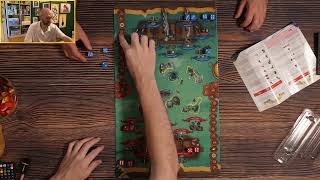
Many reviewers praise how little the game asks of players before play begins. Rob's Tabletop World highlights the neoprene playmat and dice as the entire footprint of the game. Grant Lyon notes that Six-Sided Seas uses almost no reading, which makes it useful for mixed-language groups. Grant Lyon makes the same point about its iconography. Its 15 to 20 minute runtime and minimal rules overhead make it an easy choice for convention downtime.
Potential Drawbacks
Heavy Dependence on Luck
Reviewers who are less enthusiastic about the game point to randomness as its main limitation. The Dice Tower acknowledges that every added die carries an element of chance, and one reviewer jokingly concludes that the game is luck-driven. The same reviewers, however, argue that the short playtime and the presence of meaningful decisions in placement keep this from becoming a serious problem for most players.
Packaging and Rulebook Clarity
The physical presentation draws mixed reactions. The Dice Tower reviewers dislike the tube packaging, which makes the playmat and dice difficult to store on a shelf or in a library. They also say that the rulebook is very short and leaves timing questions unanswered, and one reviewer notes that they only discovered a useful rule interaction after several turns. Both reviewers still described the game as fun, and they suggested that a standard board in a regular box would have been a better fit for the design.
If You Enjoy Six-Sided Seas
Players who enjoy Six-Sided Seas will find a similar appeal in King of Tokyo. The Dice Tower draws the comparison directly, saying that the game carries a King of Tokyo feel while playing differently. Both titles use dice rolled in turns with a push-your-luck rhythm and several ways to win. Six-Sided Seas is the leaner choice, offering a head-to-head match in 15 to 20 minutes with a single playmat. Players who want a quick dice battle with a stronger sense of chaos and table presence may prefer King of Tokyo, while those who want a compact, two-player duel with more strategic positioning will find Six-Sided Seas a natural next step.
What Reviewers Are Saying
"This is fantastic. This is a wonderful, wonderful game. Beautiful map, beautiful art, and just dice-chucking pirate fun."
— Rob's Tabletop World
"It has a King of Tokyo feel, but totally different. I love the different avenues of victory is big on this. And all of them are fun, by the way."
— The Dice Tower
"But there are also three paths to victory and I think that keeps the game interesting. You could win by raising your coin level. You could win by controlling these islands. You can win by attacking your opponent."
— Grant Lyon