

























Duel of Meloch Deep Dive
What the Community Thinks About Duel of Meloch
The board game community's response to Duel of Meloch has been enthusiastically positive. Reviewers across multiple channels celebrate this as a bold and successful mashup that does far more than simply combine two games. Several describe it as their favorite Stonemaier game to date. One Stop Co-op Shop found it works beautifully as a mashup that offers very different head-to-head experiences compared to the base games. The game appeals to both Scythe veterans and Expeditions enthusiasts, though reviewers note that enthusiasm varies depending on which side of the duel you prefer to play. While some players appreciate the Expeditions experience, Scythe appears to hold a slight edge in player satisfaction, particularly for those already comfortable with the system.
Core Mechanics That Define Duel of Meloch
Asymmetric Action Systems
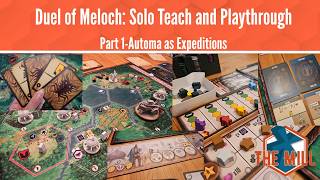
At the heart of Duel of Meloch lies a fundamental design: one player executes actions through the column-based pawn system of Scythe, while the other uses the cube-movement and card-play mechanics of Expeditions. The Scythe player selects a column on their board and performs either the top action, bottom action, or both, cycling through different columns each turn. The Expeditions player moves a cube through three available actions (move, play, gather), covering one action per turn until they refresh and reset the cycle. This asymmetry creates genuinely different play patterns within the same game space. Reviewers note that this design means you are truly playing Scythe when you play that side and truly playing Expeditions when you play that side. The compact board forces interaction between these fundamentally different systems in ways the base games never attempt.
The Race to Four Stars
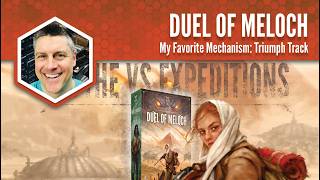
Rather than accumulating victory points, players race to place four stars on a shared triumph track. Each star placement blocks that achievement space for the opponent, meaning players compete not just for speed but for control of specific victory conditions. The Scythe player places stars immediately upon meeting achievement thresholds, while the Expeditions player must take a boast action, adding tactical depth to what might otherwise feel like a simple race. This mechanic keeps the game tight and tense, with players watching each other's progress toward easy-to-reach stars like money or workers, then making strategic decisions about whether to pursue contested spaces or pivot to alternative goals.
The Duel of Meloch Experience
Intense, Compact Gameplay
Reviewers frequently highlight how much tighter Duel of Meloch feels compared to the base games. One Stop Co-op Shop emphasizes that the game is tight, tense, and exciting, with meaningful combat encounters that occupy far more of the 45-minute playtime than combat typically does in Scythe. The small map forces interaction and raises tension throughout. Shelfside praises significantly less downtime than regular Scythe due to being two-player only, noting that combat occupies a much larger proportion of this shorter game. The condensed scope transforms what could feel like a sluggish experience into one where momentum matters and every turn contributes meaningfully to the outcome.
Strategic Tension and Meaningful Decisions
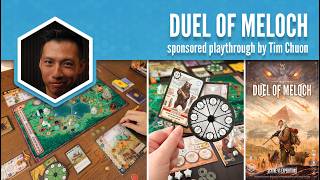
Beyond the mechanical systems, reviewers describe a game that demands constant tactical thinking. Bonsenator and Tim Chuan note that the Expeditions side offers tons of decision-making, from choosing whether to chase combat or normal cards to deciding when to refresh workers and cards. The Scythe side offers different pressures. Shelfside found that with one-on-one play, Scythe feels less like a tight, predetermined set of correct plays and more about counter-play and positioning. Players must consider not just their own path to victory but whether they can afford to let an opponent take an uncontested star. This creates a satisfying push-and-pull dynamic where early decisions ripple throughout the game.
What Makes Duel of Meloch Stand Out
A Genuine Mashup That Works
Many reviewers grapple with how Stonemaier Games pulled off what seemed impossible: seamlessly combining two full games into a cohesive package. One Stop Co-op Shop opens with amazement at the very concept, noting they had never heard of anyone attempting something like this. Shelfside calls it their favorite Stonemaier game ever, and Tantrum House remarks on the nearly endless variability of faction combinations available. The game succeeds because the designers did not merely layer one system atop the other but created genuine interaction between them. Combat works differently, the map serves dual purposes, and both sides have real tools to interact with each other's positions. This is not a mod or a variant; it is a complete game where Scythe and Expeditions genuinely enhance rather than diminish each other.
Combat That Matters
Combat in the base games often feels optional or marginal, but Duel of Meloch places it at the center of the experience. Shelfside notes that combat can lead to immediate game-ending stars and occupies a much larger proportion of playtime. One Stop Co-op Shop found the combat system engaging, with intentional and strategic play rather than automatic resolution. Both players now have meaningful reasons to fight: there are one to two combat stars available depending on the triumph track side, earning half or more of the stars needed to win. The new combat cards introduced for this game have multi-use properties, allowing players to discard them for resources even when not fighting. Bonsenator and Tim Chuan described combat as genuinely exciting, with outcomes that swing games. Combat occupies a central place in the narrative and the strategy, transforming it from a sideshow into a major decision point.
Potential Drawbacks
Rulebook Gaps and Learning Curve
Multiple reviewers flag the rulebook as a significant weakness. Shelfside describes it as confusing and minimal, barely explaining each game and often referring to summaries or external resources. Tantrum House notes that the rules are not quite as robust as the rulebooks for Expeditions and Scythe standalone, requiring familiarity with those base games to play confidently. This creates a barrier for newcomers: Shelfside speculates that the game is meant for everyone, as it was playtested with people unfamiliar with both base games, yet the sparse rules suggest otherwise. Reviewers found themselves reaching for online tutorials and videos to clarify mechanics. The jungle side of the map lacks a printed blue worker for the Expeditions player, requiring workarounds that go unexplained in the manual. This is not a game you can teach from the included rules alone.
Potential Asymmetry Concerns
Despite overwhelming praise, some reviewers express uncertainty about balance, particularly on the Expeditions side. Shelfside plays six games and finds the Expeditions player feels potentially underpowered, though acknowledges that stronger play might reveal different truths. The Scythe player can place stars immediately while the Expeditions player must take a boast action, creating a timing disadvantage. The newer factions included with the game, while interesting, seem to favor the Scythe side slightly. One specific concern: the Expeditions player's seven-corruption objective feels nearly impossible, as it requires seven separate vanquish actions plus spending corruption for other abilities, while the Expeditions player's own faction ability encourages discarding corruption. Tantrum House found that certain map and triumph track combinations might lend themselves more toward the Scythe player winning. Some of these concerns may reflect a skill gap rather than true imbalance, but they deserve attention as the game finds its competitive community.
If You Enjoy Duel of Meloch
Players drawn to Duel of Meloch's tight two-player design and combined mechanics will find natural homes in both Scythe and Expeditions. Duel of Meloch accelerates what makes Scythe work best: the efficiency puzzle and territorial tension, while stripping away downtime through its two-player focus. Similarly, it preserves Expeditions' card-play depth and worker-placement decisions while introducing combat stakes the base game lacks. For those who already own both games, Duel of Meloch offers a faster, tighter experience that plays these systems against each other. For those new to both, the solo experiences with base Scythe or base Expeditions offer the foundation needed to appreciate the duel version's design choices. Players who enjoy asymmetric games or competitive two-player experiences will find the head-to-head dynamic compelling, with each round presenting new strategic puzzles as players race toward four stars.
What Reviewers Are Saying
"If you own even one of the games already, I think this one is a lot easier of a pill to swallow. And if you own both games, I think this thing is awesome because it gives you a very, very different way to play, a much more interesting head-to-head experience than I think either game offers, and solid solo play as well."
— Mike, One Stop Co-op Shop
"The map is small, so it forces combat and raises tension. And most of the time the Expeditions player can threaten resources. Combat itself occupies a large proportion of this now 45-minute game. Scythe didn't have that much combat."
— Shelfside
"Yeah, for me being able to get that feel of playing Scythe or the feel of playing Expeditions in that shorter time frame was a plus for me. And I think we will continue to play this one."
— Tantrum House