







Everdell Journeys Deep Dive
What the Community Thinks About Everdell Journeys
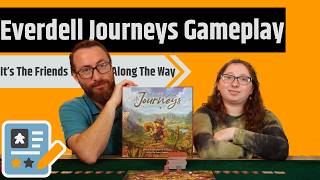
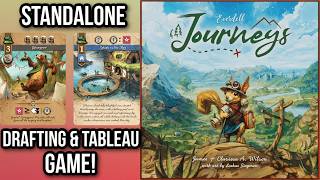
Everdell Journeys is a standalone drafting game set in the Everdell world, designed by James and Clarissa Wilson and published by Tycoon Games for one to six players. Every video covering it shows a prototype ahead of a crowdfunding campaign, and several were sponsored: Tantrum House notes its crowdfunding videos are sponsored in part by the game's creators, Tycoon Games helped sponsor the Man vs Meeple teach and the Before You Play playthrough, and BoardGameCo's channel is sponsored by All Play. Within those limits, early impressions are warm. BoardGameCo gives it four out of five, calling it easy to teach, easy to table and satisfying, while still preferring the original Everdell. Tantrum House sees it as the series' first departure from worker placement that still feels familiar, and The Dice Tower's livestream crew played it for the first time on camera. The main reservations are the randomness of song cards and whether the puzzle stays fresh over many plays.
Core Mechanics That Define Everdell Journeys
Drafting a Path of Cards
The game runs over three rounds. Each round players receive eight journey cards and draft five of them into a row in front of them, ending with a 15-card path. There are two ways to draft. In closed drafting, players pick a card from a hand and pass the rest; in open drafting, cards sit face up in a shared display and players take turns choosing. Man vs Meeple explains that the game recommends closed drafting for a lighter, faster experience and at higher player counts. Tantrum House points out that the open market feels more like the original Everdell and slows the game down, but lets players see what their neighbors might take. Cards placed but not yet visited can still be rearranged, which Tantrum House and TheGameBoyGeek both highlight as a source of planning.
Journeying, Resting and Scoring
After playing a card, a player either journeys or rests. Journeying means extinguishing campfires equal to a card's cost, plus one extra when moving into a different terrain type, then collecting the reward on that card. A player can travel across several cards in one turn if they have the fires. Resting relights three campfires and draws a new journal token, a personal goal such as visiting a certain number of patches, and only three active journals can be held at once. Caravan cards have no terrain and let players slip between regions cheaply. BoardGameCo's Alex Radcliffe finds the pacing works well: because a journey turn can cover several cards, resting rarely costs the chance to reach the end, and in their plays about half the time every card was covered, usually with 13 or 14 reached otherwise.
Round goals award cheers, and each lap of the cheers track earns a song card worth points that often grants a permanent symbol. At the end of each round, players compare cheers with the player to their left: having more earns five points, while having fewer relights a campfire. Legend cards also compare a symbol count with the left-hand neighbor and are worth 10 points if the requirement is met.
The Everdell Journeys Experience
Scoring That Builds as the Path Grows
BoardGameCo says the game escalates nicely. Early cards score only a few points, but later cards look back across everything already visited, so a card placed late in a tableau full of matching patches pays far more. Alex describes a trade-off between chasing the round goals everyone else wants and building a personal tableau, and names copying cards as a favorite trick: invest in an expensive high-scoring card, then copy it more cheaply later. On The Dice Tower's stream, Zee Garcia speculates that pushing a strong scoring card further down the line might be a big part of the strategy.
A Surprise at the End
Tantrum House enjoys that everyone hops along the score track fairly evenly until journals, songs and legend cards are revealed, which can swing results by a wide margin and keep the winner uncertain. They also note that new players sometimes feel behind, not realizing they can journey as far as they like on a single turn.
What Makes Everdell Journeys Stand Out
New Within the Everdell System
BoardGameCo, a self-described huge fan of the series, calls Journeys more accessible and easier to table than Everdell, and is glad it is something new rather than another version of the same game. Tantrum House agrees that it departs from worker placement yet feels consistent with the family, helped by art from Lucas Sigman, whom they identify as the illustrator of Silverfrost. TheGameBoyGeek stresses that no experience with earlier Everdell games is needed.
Flexible Setup and Striking Components
TheGameBoyGeek praises the sculpted, painted critter miniatures and the illustrated journey cards, and notes that open drafting makes the game a bit more thinky and crunchy. Solo and cooperative modes are also mentioned by Man vs Meeple and TheGameBoyGeek, and Before You Play describes a two-player cooperative mode. On The Dice Tower's stream the hosts judged the prototype box as bigger than Everdell Duo but smaller than the original, while cautioning that the final size may differ.
Potential Drawbacks
Song Card Randomness
BoardGameCo's main complaint is the song cards. The value of a song depends heavily on when it arrives: a wild patch is excellent early and nearly useless late, while a high-point song is the reverse. Alex says the cards carry the largest amount of randomness in the game with little mitigation to get the ones a player wants, and compares them to Far Away, which builds its extra cards around player selection. Before You Play adds that in a two-player closed draft a lot more comes down to the luck of the draw, and suggests the open draft for a more strategic game, at the cost of a lengthier session.
Replayability Questions
BoardGameCo is not confident about long-term variety. After several plays, chasing yellow patches or green, mountains or forest has not felt meaningfully different, and the overall strategy of combining cards does not significantly change. Alex wonders whether it holds up for five, ten or fifteen plays. They also flag two points others may dislike: comparisons with only the left-hand neighbor can let one player block another without being blocked in turn, and big copy combos can look like luck to the rest of the table.
If You Enjoy Everdell Journeys
BoardGameCo recommends Far Away for a similar but much shorter journey puzzle, and Let's Go to France, which Alex rates as excellent, for another game about scoring and synergizing along a route. BoardGameCo also suggests On Tour for players who want a pure point-to-point journey without the symbols, though that pick comes from All Play, the channel's sponsor. Alex still ranks the original Everdell higher, and Tantrum House notes the open-market mode feels closest to it, so fans of the original may want to start there.
What Reviewers Are Saying
"And this is different and new within the Everdell system, and I'm happy that they are experimenting with different things because they have more of a reason to stick around as opposed to just trying to figure out which version of Everdell I want."
— BoardGameCo
"Yeah, this is the type of game where everybody is scoring points along the way, but it is still a surprise who wins at the end because of those journals and the song cards."
— Tantrum House
"You don't need any experience with previous Everdell games to play it or enjoy it. And you can customize the experience to your group's needs and player count with either open or closed drafting."
— TheGameBoyGeek