













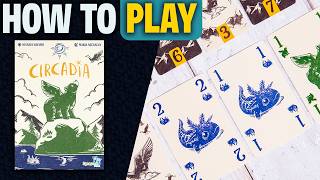
Circadia Deep Dive
What the Community Thinks About Circadia
The board game community's response to Circadia has been largely enthusiastic, with reviewers drawn to its elegant simplicity and clever puzzle-like gameplay. Going Analog, Cardboard East, and Board Stupid all expressed genuine delight with the game, each adding it to their collections during their hands-on experience. However, the consensus carries an important caveat: this game truly shines at lower player counts. The Broken Meeple, while not dismissive, raised a significant concern about player scaling, noting that the game's display of available cards doesn't scale with player count, leading to excessive card churn at four or more players. Where reviewers agree most strongly is on the ingenuity of the core design, the beauty of the presentation, and the satisfying puzzle created by managing your hand and timing your plays.
Core Mechanics That Define Circadia
Set Collection Through Creature Stacks
At its heart, Circadia challenges players to build ascending stacks of spirit creature cards. Players play cards from their hand into sets limited to three active stacks per player. Each new card added to an existing stack must match the creature type and have a value equal to or greater than the card already there. These stacks represent habitats that, once they reach a qualifying value, can be discarded to claim habitat scoring cards. It is a deceptively simple constraint that creates meaningful decisions about which creatures to pursue and when to cash in your stacks. The genius lies in how the play-cost affects your hand replenishment: playing a single card of value one draws only one card, while playing four cards all of value three draws three cards. This asymmetry forces constant evaluation of long-term hand health versus short-term stack advancement.
Day and Night Alternation
Circadia's signature twist emerges through its scoring cards, each marked as either day or night. Once a player claims a scoring card, they must alternate between day and night for all subsequent claims in that game. This simple rule creates a web of strategic constraints. A player racing to build their second scoring stack might discover they need a night card to continue the sequence, but the display offers only day cards. Do they wait for a night card to appear, risk drawing from the blind deck, or accept a lower-scoring alternative? The circadian rhythm theme, which names the game, becomes mechanical: players must synchronize their habitat collection to the cosmic cycle, occasionally forcing difficult choices. If they cannot claim the card type they need, they must accept a five-point card instead, breaking their streak and opening new pathways forward.
The Circadia Experience
Puzzle Satisfaction
Playing Circadia feels like solving a cascade of small, interconnected puzzles. Every turn presents a problem: Which number should you play from your hand, knowing that lower numbers draw fewer cards and preserve your options, while higher numbers risk emptying your hand but grant access to better draws? The decision tree multiplies when you factor in the day/night constraint and the value thresholds for claiming habitats. Reviewers consistently describe a satisfying "click" when a plan comes together, when the cards in hand align perfectly to advance multiple stacks or claim a perfectly-timed scoring card. This is not a game of luck or chaos; it is a game of deliberate choices with immediate, visible consequences.
Planning Tension
The pressure of the day/night alternation creates ongoing tension. Players must look ahead to the scoring cards available in the display and plan not just one stack, but the entire sequence of day and night claims they will need. At the moment you claim a day card, you are implicitly committing to finding a night card for your next claim. This forward-planning creates a delicious uncertainty: you can see some of your future constraints, but not all of them. Will the cards you need appear in the display before your turn circles around again? The game becomes one of calculated risk where the best-laid plans may collide with the limited options at hand, forcing elegant compromises.
What Makes Circadia Stand Out
Evocative Artistic Vision
Reviewers consistently return to Circadia's visual presentation as a standout quality. Hisashi Hayashi's design for Synapses Games features three spirit creatures representing different habitats: the rooted axolotl of troubled waters, the winged bear of wild forest, and the cloud goose of high mists. The art is rendered in a minimalist, abstract style that is sketchy and expressive rather than ornate. Going Analog praised it as "beautiful, beautiful art" that is "really really evocative" and "sketched" in a way that feels alive and evocative. This is not art that overwhelms the player with detail; it whispers, it suggests, and it invites the imagination to complete the picture. The card design elegantly communicates the day and night divide through clear, contrasting visual treatment, ensuring clarity without sacrificing beauty.
Elegant Simplicity With Surprising Depth
Circadia wears its complexity lightly. The rules are few, the components are straightforward, and a new player can grasp the basic flow within minutes. Yet reviewers repeatedly describe discovering surprising strategic layers the more they play. Going Analog noted that despite its simplicity, "there's a really interesting balance there" and that mastery is elusive. Cardboard East called it "very simple but it has a lot of interesting strategy and feel to it" and praised the game's "really clever" design. The hand management system, in particular, reveals itself as deceptively deep: the interplay between drawing one card or drawing four based on your play decisions creates a puzzle that remains fresh across multiple plays. This is a game designed with restraint, where every rule serves a purpose and every decision matters without the need for excessive chrome or components.
Potential Drawbacks
Player Count Scaling Issues
The Broken Meeple identified a genuine concern that merits serious consideration for groups that regularly play at higher player counts. The game's display of five available creature cards does not scale based on the number of players. At two or three players, this works beautifully; the display refreshes at a pace that allows players to plan and anticipate. At four players, and especially at five, the display turns over rapidly as each player pulls cards, making it difficult to evaluate what cards might be available when your next turn arrives. The reviewer described the experience at four players as chaotic and at five players as "ridiculous." Players with turn one finding that most cards they planned to draw have been snatched away. This does not break the game entirely, but it does fundamentally alter its puzzle nature, shifting it from strategic planning to reactive scrambling.
Limited Variety and Replayability Concerns
The Broken Meeple also observed that Circadia lacks significant game-to-game variation. The creature types, their values, and the scoring card mechanics remain constant each game. There are no hidden modular elements, no variable player powers, and no randomized objectives beyond which cards appear in the display order. This is not inherently a flaw; many excellent games follow similar patterns. However, it means that once a player has internalized the optimal strategies, the puzzle may feel more familiar and less surprising. For players who crave variety and novelty, this could limit the game's long-term appeal. For those who prefer mastering a single, well-crafted system, it is a non-issue.
If You Enjoy Circadia
Players drawn to Circadia's puzzle-like set-collection design and elegant hand management might find kindred spirits in related games. Cascadia shares Circadia's focus on spatial collection and ecosystem building, though with a tile-placement mechanic. Yokohama, also designed by Hayashi, offers more complex strategic decision-making within a cargo-trading framework that similarly rewards planning across multiple turns. Trains appeals to players who enjoy deck-building engines and the tension of managing limited resources. For those captivated by the day/night rhythm and circadian themes, Bomb Busters (another Hayashi design and an award winner) provides collaborative puzzle-solving with a similar sense of elegant, constrained decision-making. Arctic offers comparable hand and set management with its ice-floe card mechanics. All of these games share Circadia's core philosophy: simple rules, surprising strategy, and the satisfaction of solving complex puzzles with limited resources.
What Reviewers Are Saying
The art's very beautiful sort of abstract drawn, but like really really evocative. I really like how this looks, um, really sort of sketched, you know? Beautiful game. So if you get a chance, go look at the game because it's just very evocative, cool, sketchy art style.
— Going Analog
"If I played four ones, I still only get to draw one card and now my hand is like empty. So, you have to balance through that. It was a cool little puzzle to figure out."
— Cardboard East
When you buy a day points card, you must then buy a night points card and that might conflict with the cards that you've collected. So that's some quite interesting stuff there. I thought it was pretty cool, and we immediately bought a copy.
— Board Stupid