









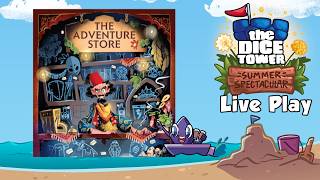

The Adventure Store Deep Dive
What the Community Thinks About The Adventure Store
The Adventure Store, a trick-taking and deck-building hybrid from designer Taylor Reiner and publisher Inside Up Games, has drawn an unusually warm early reception. Every video here covers the game around its Kickstarter campaign, and most of the coverage is publisher-supported: Before You Play and The Brothers Murph say Inside Up Games sponsored their playthroughs, Board Game Animal thanks the publisher for letting the channel take a look, and Amy and Maggie of Thinker Themer, guesting on Rahdo Runs Through, note they played a prototype. With that context in mind, the verdicts are strong. Justin of Board Game Animal says the game climbed into his top 25 trick-taking games of all time after only a short time with it, and predicts it will feel like a modern classic. Amy and Maggie call it really innovative and the best design they have played from Taylor Reiner. Their praise comes with caveats, though: they find it a little long, harder to teach than it needs to be, and noticeably better at three or four players than at two.
Core Mechanics That Define The Adventure Store
Trick-Taking
Each of the eight trials is a series of must-follow tricks, which the game calls fights. Cards come in three combat styles (brute strength, cunning wisdom and arcane magic), and a favorite style acts as trump once one is chosen. Winning a fight earns five crowns, and the crowns collected in a trial decide who earns the most renown, which is what actually wins the game. The rules also reward not winning. A sponsored teach video explains that the first fighter to empty their hand takes the initiative token and two renown, and that a fighter who finishes a trial with zero crowns while still in the final fight steals first place outright. As that teach puts it, this is not necessarily a game where players want to win every trick. Combo strikes add another layer: matching the exact combat value of the previous player lets a fighter play a second card of the same style, which helps shed cards quickly. On The Dice Tower, one host says they love a trick-taking game where players can chase zero, and the session ended with two first places stolen.
Deck Building
Every player starts with an identical 22-card deck. For the first five trials, crowns are spent at the store between rounds. Purchases go to the discard pile, or to the top of the draw pile for whoever holds initiative, and unspent crowns cannot be saved. Players can also pay five crowns to trash a card from the shop so nobody else can buy it. Trials six through eight form the showcase, when the store closes and the decks that have been built are tested. Deck thinning matters as much as buying. In the Before You Play session, Michael cut his deck from 22 cards to 11, which won the fewest-cards end-game challenge and helped him steal first place in the final trial.
The Adventure Store Experience
A Big Trick-Taker That Keeps Its Momentum
Board Game Animal describes a game that still feels like trick-taking at heart, just a big, involved version of it. Justin explains that a hand in most trick-taking games plays here like a couple of turns in a deck builder, and the fusion comes together in a really satisfying way: it feels grand, like building something substantial over time, without feeling like too much. He also finds that upgrading the deck feels like unlocking an achievement. Amy and Maggie's experience with skilled players is more social. At four experienced trick-takers, the game became very entertaining, with players at times cooperating so everyone wins five crowns and nobody steals the lead.
Strategy With Consequences
Reviewers keep returning to the tension between staying in a trial and getting out early. Amy and Maggie compare it to a trading card game like Pokemon: a player cannot just be aggressive without some way to answer what opponents might do. Shedding cards for initiative lets a player put new purchases straight onto the draw pile, which they describe as crafting the next trial. In their words, the design creates strands of strategy that cannot be fully exploited without consequences.
What Makes The Adventure Store Stand Out
Catch-Up Tools and Mitigation
The game builds in several ways back for a player who falls behind. A fighter who finishes alone in last place can accept the shopkeeper's helping hand: return all their crowns, take any card from either shelf for free, and choose the next favorite style. Anyone who ends a trial with zero crowns receives store credit equal to the richest fighter's crowns, and the steal-first rule gives a real underdog path. Justin credits the catch-up mechanisms and mitigation options, along with the variety of cards and the progressive scoring, for balancing a game that otherwise seems to break trick-taking fundamentals.
Variety From the Store and Shopkeeper Challenges
The store is stocked with 12 card types, taken from curated sets in the rulebook or chosen with randomizer cards, and each game also reveals shopkeeper challenges that can award renown during play and at the end. Amy and Maggie single out those end-game goals, worth eight renown to the winner, as a meaningful layer that shapes strategy, alongside a Dominion-style mix and match of items to buy. Before You Play notes that its randomized shop leaned heavily toward draw and trash cards, and that other setups would bring different combat cards to the fore. Justin also praises the art, calling it filled with cool characters and classic fantasy items.
Potential Drawbacks
Not an Easy Entry Point
Amy and Maggie say the web of shedding, initiative and card powers makes The Adventure Store probably not the most accessible game for players new to trick-taking; it suits people who are already familiar with the genre. The starter set of shop cards and the symmetric side of the character mats make it simpler. They also found the themed terminology hard to learn from the prototype, noting that broke does not necessarily mean shoot the moon, and they asked for a player reference card. They also want the reminder steps on the board color-coded, because shopping no longer applies in the final three trials.
Length and Player Count
The same reviewers felt the game ran a little too long and suggested that dropping one trial, or making the points escalate faster, would still give the full experience. Their biggest reservation concerns player count. The game supports two to four players, but after starting at two they much preferred three or four, saying two players miss many of the dynamics built into the design. They would like a dedicated two-player variant.
If You Enjoy The Adventure Store
Board Game Animal calls The Adventure Store a kitchen sink trick-taker in the same category as Rebel Princess, Trick Takers and Origin Story, games full of asymmetry, surprises, power-ups and twists on the genre, and calls it the standout example in that space right now. Players who enjoy those games should look here next. Amy and Maggie's comparison of the shop to Dominion's mix-and-match card supply points deck-building fans toward a familiar kind of variety, now attached to a trick-taking core.
What Reviewers Are Saying
"It seems like something that would be counterintuitive to some of the fundamentals that makes trick taking enjoyable. But here, the variety of cards and upgrades, the catch-up mechanisms and mitigation options, the deck makeup in and of itself, the cumulative and progressive scoring and rewards, it all balances the game out and both rewards and offers consequences for risky decisions."
— Board Game Animal
"But overall, this is just really innovative. I think a lot of people who have played deck building games, trick taking games are going to love this blend of mechanics."
— Rahdo Runs Through
"Now, in this game, players are taking on the roles of fighters who are fighting with each other over a series of eight trials to ultimately score the most amount of renown. We're going to improve our fighting style by buying equipment from the adventure store and ultimately try to be the champion."
— Before You Play