



Early Threatens Washington Deep Dive
What the Community Thinks About Early Threatens Washington
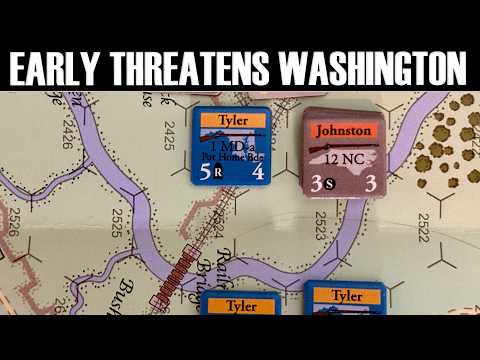
Zilla Blitz has returned to Early Threatens Washington repeatedly, in a monthly update, in an upcoming wargames roundup, and in a dedicated walkthrough of the July 9th, 1864 afternoon scenario. The verdict is positive but early: Zilla Blitz describes first impressions as "very positive" and says the game looks like a good addition to the Blind Swords series, while noting that it was still working through the learning game in its later videos.
The channel's perspective is most distinctive on solitaire play. Although Early Threatens Washington is a two-player design, Zilla Blitz rates its solo potential at 7 out of 10 and argues that the chit pull system carries the solo experience. The channel also treats the game as an accessible entry point into the series. Its rules are described as mature and compact, and the complexity is rated about 4 out of 10, which the channel considers average for the Blind Swords series.
Core Mechanics That Define Early Threatens Washington
Chit Pull Activation
Activation is the centerpiece of the design. At the start of each turn, leader chits and event chits are placed into a cup, and then they are drawn one at a time. Whichever chit comes out determines which division or brigade group acts at that moment. Zilla Blitz explains that a chit may carry a number, and the activating player must roll that number or less for the group to act with more than a basic order. Scenario rules shape the cup. In the afternoon battle, Gordon's reinforcements are pulled first for the Confederates and activate without a roll, while Union division leaders and the Confederate commander Early also enter the cup.
Event chits add a second layer. Each scenario lists which events enter the pool, and in the afternoon battle the Confederate player chooses two events to include, such as brigade reserve movement and rally, and then adds two random chits drawn blind. Fortunes of War introduces random events, while Fog of War stops a later chit from activating. Event chits such as Heroic Stand and Rebel Yell give each play a distinct flavor. The game is published by Revolution Games, and no designer credit is attached to this release yet.
Close Combat and Cohesion Tests
Combat moves through movement, defensive fire, and then close assault. Zilla Blitz walks through a Confederate attack in which three units from Cook's brigade converge on a Union unit at P. Reich's farm. Flanking attacks gain a two column shift, an attacking force that outnumbers the defender two to one gains another, and a defender with higher cohesion shifts the result back toward the defender. Close combat draws on a separate cohesion test table from fire combat. The results can include a break test, a retreat of every unit in the defending hex, and a panic check on adjacent units whose cohesion is two or less. The result is a combat outcome that can reshape a whole flank in a single activation.
The Early Threatens Washington Experience
Unpredictable Solo Pressure
Playing both sides can feel like a string of small emergencies. Zilla Blitz says the chit pull keeps producing challenges that cannot be anticipated, regardless of which army the player commands. Each activation becomes its own decision, and the order in which Cook's and Cox's brigades activate can determine whether Tyler's Ohio brigade has time to reorganize or is pushed back toward the stone bridge. The channel describes this as forcing the solitaire player to react to what is in front of them rather than execute a fixed plan.
A Holding Action Full of Choices
The Union side in the afternoon scenario is outnumbered and fights a defensive battle, yet the channel finds the position rich in options. The Union player must decide whether to hold the eastern bank, concede a channel of ground, or pull back behind the hill. The Confederate player faces a parallel question of where to force a crossing among the ford, the railroad bridge, and the stone bridge. Zilla Blitz frames the battle around the Georgetown Pike and a deadline of roughly three and a half hours, so the pressure to commit comes from both the clock and the geography of the Monocacy River.
What Makes Early Threatens Washington Stand Out
A Solo Experience Without a Bot
The game has no solo bot, so one person runs both armies. Zilla Blitz nonetheless praises the solo system and says the activation cup keeps the player engaged on either side. The channel explains that the chit pull makes every turn unpredictable enough to hold interest, which is why the solo rating is strong despite the two-player design.
Compact, Mature Rules Within the Series
The Blind Swords series rules are at version 1.5, and Zilla Blitz calls them mature, with many earlier questions and ambiguities resolved. The general rulebook runs 16 pages. The channel notes that a player who knows one Blind Swords game is most of the way to learning the next, because the counters, maps, and rule framework stay consistent across titles. The river crossing rules, covering burning wooden bridges, fords, and railroad bridges, are described as unique to this battle without being overbearing.
Potential Drawbacks
A Dense Combat Modifier Chart
The combat shift chart looks intimidating on first use because of the long list of modifiers. Zilla Blitz notes that most of the shifts do not apply in a typical fire or close combat, and that the chart becomes manageable after a few combats. The channel still acknowledges that the disruption, movement, and close combat rules have "a little bit of heft," which is part of why the complexity sits at that average mark rather than lower.
Two Sides and a Long Commitment
Without a bot, the solo player must track decisions and priorities for both armies at once, switching mental sides every time the cup produces the opposing force's chit. The full day scenario compounds that load: Zilla Blitz estimates roughly 17 turns of 30 minutes each, or six hours or more of play, so sustaining two independent plans across a session that long asks more of a solo player than the shorter introductory scenario does.
If You Enjoy Early Threatens Washington
The clearest comparison is Gettysburg: The First Day, another Blind Swords title that Zilla Blitz covered in an overview video. The channel explains that a player who has learned one Blind Swords game can move into the next with little effort, so readers who enjoy the chit pull activation and compact combat of Early Threatens Washington may find the rest of the series a natural follow-up.
What Reviewers Are Saying
"It's a two-player game, but the nature of gameplay makes this a very strong recommendation for solo play. The way the chit pull system works is just I found it really fun and engaging to play these solo."
— Zilla Blitz
"It's got some unique rules for the whole river crossing and fords and bridges and stuff like that, but they're not overbearing. And so, I think this one actually might be a good introduction to the Blind Sword series as well."
— Zilla Blitz
"I really like the Blind Sword system and it is so good for soliter too. This one has three scenarios in it. There's a learning scenario and then the battle was one day."
— Zilla Blitz