



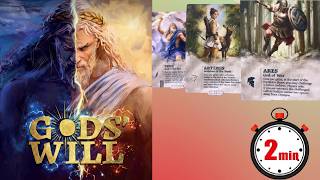




Gods' Will Deep Dive
What the Community Thinks About Gods' Will
Reviewers are exceptionally enthusiastic about Gods' Will. Multiple reviewers who are deeply familiar with the social deduction genre praise it as a meaningful evolution of the formula established by games like Resistance and Avalon. The game's greatest strength appears to be its ability to strip away the mechanical friction of older social deduction games while adding thematic depth and strategic nuance. Meeple University frames it as having its own style while maintaining the core appeal of the genre. BoardGameCo emphasizes that Gods' Will succeeds as a game fundamentally about reading people and navigating table talk. TheGameBoyGeek highlights the clean round structure and engagement across all player counts. Most tellingly, a BoardGameCo reviewer states there is no reason to return to Resistance or Avalon after experiencing Gods' Will in prototype form, a strong endorsement from someone immersed in social deduction games.
Core Mechanics That Define Gods' Will
Streamlined Leader Election and Team Selection
Gods' Will diverges from the Resistance formula by consolidating the voting process. Instead of repeatedly rejecting team compositions, players vote once to elect a leader, who then selects team members without further voting. This single structural change eliminates the repetitive rejection cycles that can bog down earlier social deduction games. The result is what reviewers consistently describe as cleaner, faster rounds that keep everyone engaged. Each venture moves the game forward without stalling on team selection disputes, allowing social deduction and player reading to remain the focal point. The streamlining is complemented by the mythic ventures variant, which constrains leader choices by tying eligible leaders and team compositions to thematic Greek mythology scenarios illustrated with Renaissance and Baroque paintings.
Destiny Cards and the Fate Mechanic
Team members play one of three destiny cards per venture: light, darkness, or fate. All light cards mean the light team advances toward victory; any darkness card (with no fate) means darkness advances. But fate cards introduce nuance, allowing darkness to advance only one space instead of three. This mechanic creates genuine strategic depth because players must decide which card to play regardless of their secret alignment. A light team member might play a fate card to hide their loyalty, while a darkness servant might play fate to avoid revealing their ambition. Reviewers emphasize that this decision space is central to the game's replayability. The cards are shuffled after selection, so claiming what you played becomes part of the social deduction puzzle, where truth and deception intertwine.
The Gods' Will Experience
Divine Drama and Mythological Betrayal
Reviewers consistently describe Gods' Will as feeling like a mythological soap opera unfolding on Olympus. TheGameBoyGeek opens by describing it as divine destiny meeting human deception, capturing the game's emotional tenor. The dual-sided god cards (light side and dark side) create immediate visual feedback when a venture goes against a player's alignment; their card flips to signal their corruption, turning suspicion into physical evidence on the table. The game's aesthetic amplifies this drama: the classical artwork woven into the mythic ventures variant, drawn from real Renaissance and Baroque paintings depicting famous mythology, elevates every venture beyond abstraction. Players are not just manipulating generic teams; they are orchestrating events within a narrative world of gods, and the gallery-like presentation of these mythological moments makes betrayal feel operatic rather than purely mechanical.
Intense Social Deduction Through Careful Observation
At its core, Gods' Will is a game about reading people and defending your reputation under suspicion. BoardGameCo emphasizes that this is a game all about the table talk and what players are able to convince others of. Players must piece together which gods are secretly serving light, darkness, or themselves as loners. The expulsion phase, where every player votes to push one god away from Olympus, becomes a referendum on trust. If a venture reveals a darkness card played by Athena, Poseidon, and Hera, suspicion falls on all three, and the expelled player must later play destiny cards face-up, eliminating deception from their future actions. This creates rising tension as the game progresses and the deduction puzzle sharpens. Reviewers note that at higher player counts, the complexity of tracking roles increases, but so does the number of teammates who can provide information and support, maintaining balance while deepening the social challenge.
What Makes Gods' Will Stand Out
A Mythic Twist on a Proven Genre
Several reviewers highlight that Gods' Will succeeds by respecting the foundations of social deduction while adding meaningful differentiation. TheGameBoyGeek notes the game features variable powers for each god and ventures stemming from real mythology, giving every game a unique narrative arc. Rather than playing as unnamed roles with generic abilities, players become specific deities: Hades can drag another god down if expelled, Artemis votes to expel a failed venture member, Athena can appoint a venture leader without voting. These powers are tightly linked to each god's mythological identity. The mythic ventures variant reinforces this thematic integration by replacing generic team-building cards with mythological scenarios depicted in classical artwork. This marriage of mechanics and theme distinguishes Gods' Will from games that treat theme as window dressing.
Streamlined Pacing Without Sacrificing Depth
Reviewers are notably vocal about Gods' Will solving a real problem in social deduction games: endless voting spirals. TheGameBoyGeek repeatedly praises the game's ability to provide cleaner, faster rounds while maintaining strategic depth, with the light players facing tough decisions to make. By eliminating repetitive team rejections, rounds resolve quickly, keeping energy high and engagement consistent. Yet the game is not simplified; players face genuine strategic dilemmas about which destiny card to play, whom to elect as leader, and whom to expel. The presence of loner roles, such as the Hermit, the Anarchist, and the Narcissist, adds unpredictability that forces players to reconsider standard deduction patterns. Meeple University notes the presence of one-per-game effects that accumulate in the final rounds, creating potential for a domino chain of chaos in the big climax, suggesting the game builds toward memorable, climactic moments rather than fizzling.
Potential Drawbacks
Complexity Scaling at Higher Player Counts
As the game scales from five to fourteen players, the deduction challenge compounds. Additional gods, roles, and loners enter play, expanding the information space each player must track. BoardGameCo acknowledges this explicitly, noting that it becomes more complicated because there is a whole lot more to figure out, though players have more teammates helping them as well. While reviewers frame this as a balancing feature rather than a flaw, players sensitive to cognitive load may find large tables overwhelming. The game assumes a table willing to engage actively in deduction and discussion; passive or distracted players can disrupt the social machinery that drives the experience.
Group Dependent and Table Talk Intensive
Gods' Will lives or dies by table talk. BoardGameCo emphasizes this centrality: the game is about the table talk and what players are able to convince others of. Players who struggle with social pressure, prefer quieter experiences, or play with groups prone to analysis paralysis may find Gods' Will exhausting. The public voting and expulsion phase mean that accusations and defenses happen aloud, creating moments of genuine discomfort for some players. Additionally, if one player dominates conversation or if the table cannot self-regulate discussion length, rounds can drag. The streamlined mechanics solve voting bottlenecks, but they do not solve interpersonal bottlenecks, which remain a constant in social deduction.
If You Enjoy Gods' Will
Gods' Will is explicitly positioned as an evolution of Resistance and Avalon. If you love Avalon's hidden role deduction with a magical twist, Gods' Will offers a similar structure with faster pacing and mythological theming. One Night Ultimate Werewolf fans will appreciate the quick rounds and hidden role tension, though Gods' Will adds more explicit social deduction and voting strategy than Werewolf's elimination model. For those seeking direct predecessors, The Resistance remains the spiritual parent, but reviewers suggest Gods' Will surpasses it mechanically. Beyond these close cousins, fans of deeply thematic social deduction and anyone drawn to Greek mythology presented through classical artwork will find Gods' Will rich territory. The game appeals to players who enjoy reading their opponents, managing information, and orchestrating group decisions under uncertainty, making it a natural fit for anyone who treasures table talk and social pressure as core gameplay.
What Reviewers Are Saying
"God's Will improves upon the social deduction genre with streamlined team selection, removing repetitive rejections, providing cleaner, faster rounds that keep everyone engaged."
— TheGameBoyGeek
"God's Will feels a bit like Resistance or Avalon, but has its own style to it. It has the team-building tension of who do we elect mixed with secret card play, public voting, player powers, and shifting suspicion."
— Meeple University
"If you like the Resistance Avalon with fun twists then you'll have to try God's will. After playing this prototype I don't see any real reason to play Resistance Avalon ever again."
— BoardGameCo