



GrimBrew: A Battle of Flame and Potioncraft Deep Dive
What the Community Thinks About GrimBrew: A Battle of Flame and Potioncraft
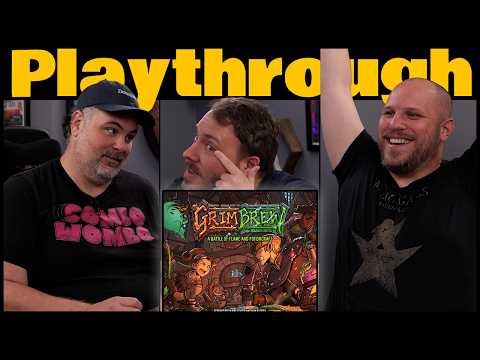
GrimBrew is an engine-building game from Lucky Omen Studios in which players gather ingredients, brew potions, and race to claim points from a shared supply. Reviewers covered it from several angles: a full playthrough by The Brothers Murph, a critical overview by The Cardboard Herald, and a sponsored preview by Board Game Co. that was based on a prototype copy from the game's crowdfunding campaign. The overall response is positive but measured. Reviewers describe the game as quick to learn, tidy in its decision space, and satisfying as an engine comes together, while also questioning whether its ingredients and theme go far enough to give it a strong identity.
Core Mechanics That Define GrimBrew: A Battle of Flame and Potioncraft
Ingredients, Symbols, and Potion Brewing
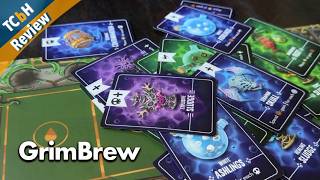
On each turn a player takes one action: take an ingredient from the central display, spend flames to rekindle, or brew a face-up potion. Ingredient cards show one or more symbols along the top, and most also count as one or more colors. Many carry a one-time effect that triggers when the card is collected, such as gaining flames, spending flames for points, or placing and removing maulings. The Cardboard Herald points out that a single ingredient can supply several symbols at once, but each symbol a potion requires must come from a separate symbol, so one card cannot satisfy two requirements. The Brothers Murph explain that a potion's requirements are read from left to right, that players can fulfill as many of them as they can, and that the highest level reached sets the points gained from the supply. Board Game Co. adds that the Ouroboros symbol functions as a wild.
Brewing a potion costs a flame, and the finished potion is tucked beneath the player's board. Its symbols then serve as permanent icons that help satisfy future potions, and some potions also score at the end of the game. The Brothers Murph describe this as the core engine: each completed brew adds to a player's pool of symbols, which makes the next brew easier.
Maulings and Player Interaction
Maulings are the game's player-versus-player tool. Certain ingredients let a player place up to three of their colored maulings on another player's board, never on their own. When the affected player brews a potion and scores from the shared supply, the mauling's owner takes the first point, and the mauling returns to its owner. Board Game Co. describes this as a way to steal a victory point when an opponent brews. The Cardboard Herald sees the same mechanism as a clever way to slow down the leader, and notes that some ingredient actions can also remove maulings from a player's board.
The GrimBrew: A Battle of Flame and Potioncraft Experience
Pacing and Turn Structure
Reviewers consistently describe the flow as brisk. The Cardboard Herald calls the game easy to teach and quick to play, and credits the single-action turn structure with keeping the pace moving. Board Game Co. explains that the game ends when the shared victory point pool is depleted, and that every other player then takes a final turn before endgame scoring is added. The Brothers Murph's three-player session is loaded with table talk, but turns move quickly, and a single brew can change the standings enough to shift the whole table's plans.
Escalation and Racing the Point Pool
Board Game Co. describes a clear sense of escalation. Players begin by taking ingredients and building their first potions, then gradually assemble labs that become more efficient, all while racing toward the same shared pool. The Brothers Murph show this tension in play, as players weigh whether to take a smaller payout early because it sets up stronger brews later. Their session also ended in a tie on points, which was settled by a tiebreaker on completed potions, remaining flames, and remaining ingredients. That result suggests the endgame can be decided by small margins in the engine rather than by one large swing.
What Makes GrimBrew: A Battle of Flame and Potioncraft Stand Out
An Accessible Decision Space
The Cardboard Herald praises the clarity of the design, calling the game neat and tidy. In its view, the drive for efficiency combined with a strict limit on actions produces decisions that are easy to understand but still satisfying. The shared display of three potions and three ingredients is central to this planning, because players must weigh whether a potion they want will remain available against the ingredients they hold. The Brothers Murph echo this, noting that many ingredients offer one-time effects that players can chain together with the potion they are aiming for.
Action Economy Around Potions
The Cardboard Herald identifies the potion crafting and ingredient ordering as the game's most distinctive feature. Players must decide whether to complete a potion early to bank points, or to hold off and reach a higher tier for a permanent bonus that will help later. The reviewer says this makes players think about how much to invest in each potion and when to take the efficiency bonus available right now. The Brothers Murph show the same tradeoff at the table, debating whether to spend a wild symbol for an extra requirement or keep it flexible because it can count toward many different symbols.
Potential Drawbacks
Ingredients That Feel Interchangeable
The Cardboard Herald's central criticism is that every type of ingredient feels roughly the same. The suits and symbols do not carry much thematic weight, so leaning into skulls does not make a player feel any more necromantic than any other alchemist. The reviewer notes this is not unusual for the genre, pointing to Splendor and Propolis and many games in between as examples where mechanics outpace the theme. Even so, the reviewer finds that the vibrant card illustrations, the evocative magical setting, and the subtitle hint at a richer experience than the symbols deliver.
Theme, Maulings, and Production Footprint
The same reviewer felt that maulings are flavorful but underpowered for the space they take up in the rulebook, and would have liked them to offer an extra hook, such as a way to commit them for other reasons or a guaranteed way to remove them. On production, the reviewer describes GrimBrew as a narrow game that takes up a large amount of space through its player boards and box size, and wished it had been trimmed to match the efficiency of its design. The reviewer acknowledges that this is partly a matter of preference and shelf space concerns. Board Game Co. also cautions that the prototype copy it previewed had components and rules that were subject to change, so some of these points may evolve before release.
If You Enjoy GrimBrew: A Battle of Flame and Potioncraft
The Cardboard Herald suggests that GrimBrew is a good fit for players who enjoy lighter games with a degree of engine building and resource management, along with evocative fantastical themes. The Brothers Murph frame the permanent-symbol system in terms of Splendor, so players comfortable with that style of engine will recognize the basic logic. GrimBrew is likely to appeal most to players who want a fast, tidy engine builder with ingredient-based interaction and a visible race for points. Players who want a strongly felt theme or heavier decisions may find it lighter than they hoped.
What Reviewers Are Saying
"Every type of ingredient feels roughly the same, essentially different suits and symbols that don't amount to actual vibes."
— The Cardboard Herald
"Players are going to have this sense of escalation where their labs are going to get more and more efficient, but they're all racing towards this victory point pool, which is ultimately being depleted."
— Board Game Co.
"They will take points from you first, and you only get the leftovers. This sends their maulings back to their owners."
— The Brothers Murph