




















Kalypso Deep Dive
What the Community Thinks About Kalypso
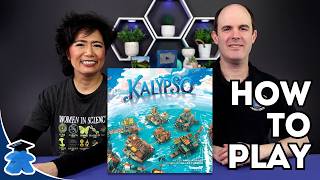
Reviewers approach Kalypso, the tile-placement survival game from Inside Up Games, with anticipation that has largely turned into enthusiasm among the people who have played it. Board Game Dad introduced the game around its Holdfast Coding, a soft coating that lets the tiles adhere to one another, and pointed to the objective drafting that happens every round as the feature that could make each session play out differently. Meeple University walked through the full rules and presented two ways to play: a competitive race to build the highest scoring settlement, or a four-round cooperative quest to keep survivors fed, housed, and happy.
The channels agree on the quality of the puzzle. BoardGameCo described the game as satisfying tableau building, and Board Gaming Ramblings called it one of the better spatial puzzle games it has played in a long time. The disagreement comes over which mode deserves the most attention. BoardGameCo argued that solo or cooperative play is the strongest way to experience the game and said competitive play is fine but less compelling than Planet Unknown. Board Gaming Ramblings split along the same line. One host said the cooperative version works perfectly but would not replay it, not being one to enjoy co-op games much, while the other praised the competitive version as fantastic.
Core Mechanics That Define Kalypso
Foundation Building and Construction Rules
Meeple University explained that every salvage or scrap tile must be placed orthogonally adjacent to the existing foundation, and that a building can be constructed when a placement completes a 2x2 section where at least three of the four squares share a building material. Plastic can form part of a foundation but is not a building material, and barrels act as wild. Because the building must be placed at the moment the completing tile goes down, the layout of the foundation determines which buildings a player can ever use. Meeple University also noted that a boat docked to the foundation becomes an extension of it, but that a boat is not wild, which makes placement planning a constant consideration.
Forecast Objectives and Drafted Goals
Each round, players choose a forecast card from their deck, pass it to a neighbor, and receive one in return to place as an objective for that round. Meeple University described these objectives as diverting resources that could otherwise go toward other purposes. Completing a forecast unlocks an end-game scoring bonus or an immediate benefit, while failing one costs points at the end of the game. Board Game Dad singled out this drafting as the source of variety, since the point-scoring routes stay the same from game to game while the objectives a player drafts can push each game in a different direction. In the cooperative mode, these objectives are shared, and the whole team's collective pool of resources must satisfy them.
The Kalypso Experience
Tense Survival on a Floating World
Meeple University framed the cooperative mode as a post-apocalyptic struggle in which the team must avoid many possible defeats at once. Survivors have to be housed by building houses, fed through a fish track that is consumed each round, and supplied with vegetables through a garden track that must keep pace with the population. The result is a steady squeeze rather than a single crisis, because a shortfall in any one of these tracks can end the run. That pressure is the part of the game that most clearly separates the cooperative experience from a relaxed building game.
Satisfying Spatial Puzzles
The other dominant feeling is the quiet satisfaction of fitting pieces into a constrained space. BoardGameCo compared the thinkiness of Kalypso to Cascadia, describing the same puzzle-like question of how to place pieces to maximize output while building a tableau in a satisfying way. Board Gaming Ramblings described the experience in similar terms, calling it one of the better spatial puzzle games its hosts have played. The satisfaction comes from placements that complete a building and open a new scoring route in the same move.
What Makes Kalypso Stand Out
Components That Hold Their Place
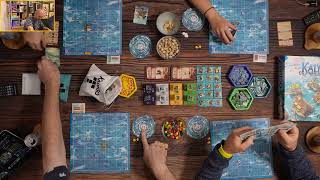
Board Gaymes James was most impressed by the component design, noting that the special tiles are designed so they do not fall off the plate when passed around, and that the board stays steady rather than jiggling. The surface uses a felt-like material that sticks to itself without relying on magnets. Board Gaymes James put it this way: "So, it's not using magnets. It's like a felt that sticks to each other which is really cool." Board Game Dad also pointed to Holdfast Coding, the soft coating that lets the tiles adhere to themselves, as one of the first things that makes the game stand out.
Two Modes With Real Depth
Meeple University presented the competitive and cooperative modes as complete games in their own right, with the cooperative mode adding specialist survivors who provide ongoing abilities. Board Gaming Ramblings also described the competitive version as fantastic and the cooperative version as working perfectly. BoardGameCo's praise centers on the cooperative mode, where all four player boards connect into one large shared board. Reviewers rarely treat the second mode as an afterthought, which gives the game more replay range than its single-mode competitors.
Potential Drawbacks
Buildings That Still Move
The strongest criticism comes from Board Gaymes James, who noted that while the board and special tiles stay put, the buildings themselves still jiggle around. The felt-like material is not as strong as Velcro or magnets, which means a player can still knock buildings loose while placing gardens between them. Board Gaymes James also described the surface as giving a very unusual sensory texture, and felt that the art appears slightly dull. These points do not stop Board Gaymes James from calling the game a really cool tile placement design, but they suggest the technology may not be the decisive advantage it first appears to be.
Cooperative Losing Conditions
Meeple University flagged the number of ways a cooperative game can end in defeat as a concern. A team can fail by missing either settlement goal, by leaving a survivor unhoused at the end of a round, by running out of fish, or by letting the settler population outpace the gardens. Players who enjoy a steady, forgiving cooperative pace may find this unforgiving. Board Gaming Ramblings shows the split in practice, since one host who does not enjoy co-op games still praised the competitive mode.
If You Enjoy Kalypso
Players who enjoy Kalypso's tableau building and spatial optimization will find a familiar pleasure in Cascadia, which BoardGameCo used as the reference point for Kalypso's thinkiness. Players who want a game that rewards careful planning around a shared board should also look at Planet Unknown, which BoardGameCo recommends over Kalypso's competitive mode. For a heavier take on the same building-and-placement instinct, Cascadia Alpine Lakes adds more layers of thinking and building upward, which BoardGameCo found satisfying in a different way.
What Reviewers Are Saying
"So, it's not using magnets. It's like a felt that sticks to each other which is really cool."
— Board Gaymes James
"And Calypso was one of the better spatial puzzle games I've played in a long time. I'm not gonna try to hype it too much for you."
— Board Gaming Ramblings
"For me, the cooperative way to play is the best way. The solo or cooperative is the best way to play the game."
— BoardGameCo