Game Info
Year
2026
Players
2
Age
14+
Playtime
45 min
Collection
Ratings
Creator Score
Mechanic profile
Not enough video data yet
Vibe profile
Not enough video data yet
Description
An asymmetric two-player card game set in a dystopian 1950s America where a productivity-obsessed supercomputer faces a struggling employee
Featured Videos

Rules Teach

The Idles - How To Play
Ask a Rules Question
All mentions
Browse transcript mentions, sentiments, pros/cons, mechanics, topics, quotes, and references.
Total mentions: 4
This page: 4
Sentiment:
pos 3 ·
mix 0 ·
neu 1 ·
neg 0
Showing 1–4 of 4
Video hmaqUmanqHo
BoardGameCo Rules Teach at 2:23 sentiment: neutral
video_pk 151389 · mention_pk 425069
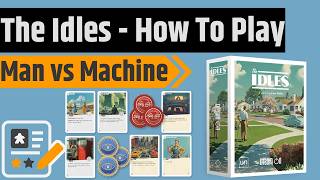
Click to watch at 2:23 · YouTube ↗
Overall sentiment (raw)
neutral
Pros
- Asymmetric gameplay
- Thematic depth with dystopian undertones
- Unique 'grind' mechanic for the employee
Cons
- Can seem complex initially
- Maxwell's turn structure with program activation before the initial phase might be confusing
Thematic elements
- A supercomputer obsessed with maximizing corporate productivity versus an employee struggling under its weight
- Nostalgic 1950s USA with dystopian undertones
Comparison games
none
Mechanics (from transcript analysis)
- Action Point Allowance — Players have a base number of actions per turn, which can be increased by card effects or energy expenditure.
- area control/influence — Maxwell plays program cards face down, and these cards need to be connected to the character card to be activated, implying a form of area or network building.
- Asymmetric gameplay — The two player sides, Maxwell and the employee, have distinct card types, abilities, and win conditions.
- Card Replacement — Players can play a new card of the same type to replace an existing one in play, often returning the old card to hand or discard and gaining resources.
- Deck construction — Players construct their decks according to specific rules, with recommended starting decks provided.
- Grind Action — A specific action for the employee to attack Maxwell's departments (discard pile, draw deck, character card, program cards), potentially revealing cards and earning rewards or productivity awards.
- Hand Management — Players draw cards and have a hand size limit, needing to discard excess cards during the cleanup phase.
- Resource conversion — Energy can be spent to gain additional actions, and actions can be boosted by spending energy.
- Set Collection — The employee needs to collect three productivity awards to win the game.
Video topics + discussion points
No key topics recorded for this video.
Quotes (from this video)
- The Idols is an asymmetric card game for two players. It is set in the nostalgic 1950s of the USA with some sort of dystopian undertone.
- The game pits a mysterious supercomputer obsessed with maximizing corporate productivity against a lowly employee struggling under that very weight.
- The employee's way of playing is going to be much more straightforward than Maxwell's because they're simply going to try and build their engine and then attack Maxwell by performing an action that is called to grind.
- When we're performing grind, we need to choose which department of Maxwell we're kind of going to attack.
References (from this video)
No references stored for this video.
Video hyqc-K9aeMI
Tabletop Tolson Review at 0:00 sentiment: positive
video_pk 151133 · mention_pk 424746
Click to watch at 0:00 · YouTube ↗
Overall sentiment (raw)
positive
Pros
- Interesting 30-45 minute dueling games
- Compelling satirical 1950s theme
- Economical use of components (bottle caps as currency/markers)
- Lots of combinations and replayability
- Smart and replayable game
- Beautiful artwork
- Seamless and easy system once understood
- Provides many plays
Cons
- Worker placement can be difficult to get through supervisors.
- AI can be protected by supervisors, making it hard to reach cards.
- Some cards can be removed and replaced, losing potential gains.
Thematic elements
- Satirical look at labor vs. corporations/broadcasting and AI
- 1950s
Comparison games
- Caper
- Caper Europe
- The Battle of Versailles
Mechanics (from transcript analysis)
- Area Control — Maxwell, the AI, places programs and supervisors to 'protect those programs' and score points.
- Card Drafting — Players can choose cards to add to their deck as they figure out the game and what cards are available.
- Deck Building — The game is explicitly called a 'deck builder' where players 'build' their deck and 'craft your strengths and weaknesses'.
- Resource Management — Players manage coins and energy to play cards and take actions.
- Set Collection — Players aim to collect 'productivity' points to win the game.
- Worker Placement — The employee side uses workers to 'prove their worth and productivity' and to 'grind' through operations.
Video topics + discussion points
No key topics recorded for this video.
Quotes (from this video)
- So I found myself absolutely compelled by the um satirical kind of 1950s nostalgia.
- This is a two-player dueling game by the same designer who brought us Caper and Caper Europe.
- The Idols. Um, very, very exciting. Again, with that kind of two-player, um, push and pull with a little bit of that dueling.
- But there are a ton of combinations here. And it's a pretty seamless, easy system once you've got everything all laid out.
- So, I'm excited to come back and revisit this with more of the deck building.
References (from this video)
No references stored for this video.
Video 4oh6Mcr0tgA
Board Of It Review at 0:04 sentiment: positive
video_pk 127711 · mention_pk 363554

Click to watch at 0:04 · YouTube ↗
Overall sentiment (raw)
positive
Pros
- The game blossoms into something interesting once the asymmetry is understood.
- Tensions build, and it becomes truly head-to-head.
- The hidden information creates uncertainty and makes it like a social deception or poker-like game.
- The face-down cards allow for misdirection and fake-outs.
- There's a lot of tension for both players, with Maxwell fearing discovery and the employee racing against the clock.
- The decks feel different and offer different strategies.
- Each play can be different even within the same deck.
- Players can lean into different strategies based on card draws, focusing on extra actions or generating more caps.
- The game feels like it has a lot of potential and is worth exploring further.
- The decisions are often hard and interesting.
- There's a balance of when to spend resources, adding strategic depth.
- The game is very good.
Cons
- The generative AI art is disappointing and will likely turn people away.
- It might take a play or two to get grips with the asymmetry.
Thematic elements
- Productivity in a corporate hellscape
- dystopian 1950s America
Comparison games
- Caper Europe
Mechanics (from transcript analysis)
- asymmetric factions — One player takes on the role of Maxwell, a supercomputer manager, while the other plays a lowly employee, each with unique abilities and playstyles.
- Deck Building — Both players start with large decks of action cards and character cards, and the game involves building and modifying these decks throughout play.
- Hidden Information — Maxwell plays all their cards face down, creating uncertainty and requiring players to deduce information about the opponent's state.
- Resource Management — Players manage 'energy' and 'caps' to perform actions, boost card effects, and activate abilities, with decisions on spending creating tough choices.
- Set Collection — The goal is to collect 'productivity awards', with each player trying to achieve this through their unique faction mechanics.
Video topics + discussion points
No key topics recorded for this video.
Quotes (from this video)
- The Idols is a strange, strange game, and it certainly takes a play or two to get to grips with the asymmetry. However, once you do, the game really blossoms into something rather interesting.
- But I think what changes this is the fact that there is hidden information.
- It creates a lot of tension for both players.
- It's disappointing with the whole generative AI thing, which I think for a lot of people is always going to put a black mark on the game and turn them away from it, no matter the purpose of that.
- And you know, it's almost a shame that this game is very good because if it was terrible, then everyone could just kind of forget about it, right?
References (from this video)
No references stored for this video.
Video 0YhbHNv9rZc
Board Of It Top List at 7:42 sentiment: positive
video_pk 123604 · mention_pk 354327

Click to watch at 7:42 · YouTube ↗
Overall sentiment (raw)
positive
Pros
- Very smart and thematic gameplay
- Tense and engaging
- Good production value
- Interesting decision space
Cons
- AI artwork might turn some people off
Thematic elements
- A supercomputer obsessed with productivity versus a lowly employee.
- Dystopian 1950s America
Comparison games
- Radlands
Mechanics (from transcript analysis)
- Asymmetric gameplay — One player is the supercomputer, the other is the employee, with distinct objectives and abilities.
- Deck Building — Players build their decks from a large stack of cards, using only 30 in a game.
- Hand Management — Players manage their hand of cards to play programs and supervisors effectively.
- Set Collection — The employee tries to collect specific cards or symbols to crack into programs or decks.
Video topics + discussion points
No key topics recorded for this video.
Quotes (from this video)
- But it's not really a game. Like I had a lot of fun playing it, but if I'm ranking the best games that we played in August, I don't really feel like it's so much of a game as a fun time activity where people yell.
- The gimmick is that you are on your left side kind of fighting your left player. So, your free peoples is fighting their shadow side. And on the right, your shadow is fighting the player on your right's free people side in like little kind of mini games.
- It's really really good and I actually had it as my my first and you had it as your second
- No, I think it's really amazing game. Incredibly well produced as well. I really like the components. They're nice and chunky and good artwork and yeah, it's really great.
References (from this video)
No references stored for this video.
Transcript Navigation
Showing 1–4 of 4