
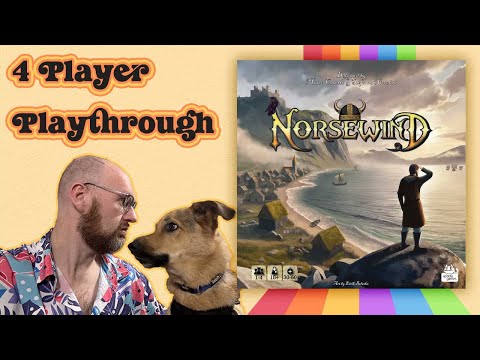



Norsewind Deep Dive
What the Community Thinks About Norsewind
Norsewind has struck a chord with reviewers who initially underestimated its depth. First impressions suggest a simple, elegant design, but multiple plays reveal satisfying strategic tension that grows more apparent each time. The consensus across board game channels is cautiously enthusiastic, with reviewers praising the game's balance between resource acquisition and defense management. While some were uncertain about the Viking attack theme initially, those who played repeatedly came away genuinely engaged. The game is not universally polarizing, but rather consistently appreciated as a well-executed design that rewards understanding its core trade-offs.
Core Mechanics That Define Norsewind
Card and Chit Market
The heart of Norsewind lies in its elegant market system. Players face a rotating display of cards representing buildings, ships, churches, and other structures for their Anglo-Saxon kingdoms. You must acquire these cards through a limited currency, money earned through income-generating buildings already in play. Aporta Games' design ensures that not every card is affordable on every turn, forcing meaningful choices. Players cannot simply sweep the market or cherry-pick the best options indefinitely. The market refreshes as cards are purchased, keeping the available options in constant flux. This creates a rhythm of decision-making: do you take a strong card now with limited funds, or wait and risk it being purchased by an opponent, or replaced by something less valuable?
Tableau Building
Each player constructs a personal village across four kingdom rows, placing cards face-up in front of themselves. These cards generate resources, points, and abilities. The placement matters significantly. When you add a building to a row, you immediately activate the income-generating effects in all other rows, not the row where you placed it. This creates interesting spatial puzzles: positioning buildings to maximize chain reactions and unlock abilities at the right moment. Over the course of the game, your tableau grows from an empty board into a functioning economy. Some buildings, like blacksmiths, can generate substantial money if positioned well, giving players a sense of building an engine, though this power must be balanced against the Viking threat that grows alongside your prosperity.
The Norsewind Experience
The Weight of Threat
Every card you acquire comes with a cost beyond its price: Vikings. Each building or ship brings attack strength to one of your four kingdoms. This creates the core tension of the game. You are constantly negotiating between acquiring powerful cards that generate points and prosperity, and the danger they represent. A card might give you space for three citizens and prestigious value, but six Vikings attack with it. Take it and risk being unable to defend; ignore it and miss the points. This threat is not theoretical or distant. At game's end, each kingdom's total Viking attack value is compared to your accumulated defense. If the Vikings outnumber your shields, that entire kingdom is lost, costing you seven points. The Vikings feel present from turn one, shaping every purchase decision.
Simple Rules, Layered Choices
Norsewind teaches quickly. Players begin with five starting money and take turns acquiring one card or building a castle, then placing pieces on their kingdom boards to unlock income. Yet beneath this straightforward framework lies surprising tactical depth. The game reveals itself through repeated plays. On a first play, players are simply learning what buildings do. By the second play, the economy comes into view. By the third, the tension between point-scoring potential and defensive necessity becomes clear. Reviewers consistently reported that the more they played, the more they appreciated the design. The game does not feel broken or overly fiddly, just genuinely smart in how it balances competing goals.
What Makes Norsewind Stand Out
The Income Engine That Cuts Both Ways
A blacksmith is one of only four building types available, and it can become the most profitable structure on the board. Place it in the right kingdom and position your placements carefully, and it can generate substantial money every round. However, that same blacksmith is a building taking up a kingdom row, space that could instead hold higher-prestige structures. And any blacksmith placed brings Vikings with it. Reviewers noted that this game rewards players who understand when to push an income strategy and when to pivot toward defense or point-scoring. The blacksmith is not overpowered; it is simply powerful if managed well, and dangerous if pursued too greedily.
Cards That Tell a Story Through Conflict
The design philosophy centers on a core question: can prosperity be built while fending off invasion? Churches generate points but attract Vikings. Ships provide money and defense but take valuable row space. Castles are the only explicit defense tool, but they cost money and take time to acquire. This is not a game about optimization puzzles or pure number-crunching. It is about making hard choices under incomplete information, knowing that every benefit carries a hidden cost. Reviewers appreciated this thematic coherence, where the mechanics reinforce the narrative of settling and defending Viking-threatened lands.
Potential Drawbacks
A Lighter Game Than Publisher Branding Suggests
Aporta Games is known for heavier Euros like Revive and The Magnificent, which may set expectations for Norsewind's weight. This game plays in 30 to 40 minutes and is decidedly medium-light. Reviewers familiar with the publisher's heavier fare noted this was a departure. Some may come seeking the chunky Euro experience and find instead a clever, faster-playing design. This is not a flaw, but it may disappoint players specifically seeking a weighty strategic challenge or a long campaign-style experience.
Artistic Direction That Not Everyone Will Embrace
One reviewer expressed concern that Norsewind's artwork might be AI-generated, citing a disconnect between the graphic design and illustration style. While others praised the visual presentation as beautiful and thematic, the art direction is polarizing enough that some players expressed reservations. This is a minority concern, but it is worth noting for players who prioritize hand-drawn or clearly human-created artwork in their games.
If You Enjoy Norsewind
Fans of Norsewind should explore Kingsburg, which shares the Viking attack theme and the experience of defending against escalating threats. Tax the Rich offers similar resource management depth in a lighter package. Revive appeals to players who want more economic complexity and a heavier tableau-building experience with greater player interaction. The Magnificent provides comparable visual polish and strategic weight from the same publisher, for those seeking a slightly heavier sibling to Norsewind.
What Reviewers Are Saying
"There's a really good card there with space for three citizens, and it's worth one prestige, but it's got six Vikings on it. Oh no, if I take that one, I'm not going to be able to defend myself in time. So yeah, we've found it really interesting and the more I've played it, the more I've enjoyed it."
— Paul, Gaming Rules!
"This game really is that simple. For some reason, my brain wants to overcome it. So I get a dollar. Right. And then we have to refill this."
— Board Gaymes James
"We were like, that's okay, it's all right. I can see that it's it's probably a clever, it's probably a well-designed game, but it didn't give us that same sort of hit as as the other games did when we first played them. And then I played it twice again, and all of a sudden, I'm not going to go out and say it's the best game ever, but we really enjoyed it."
— Paul, Gaming Rules!