



Fourth Wing: Rise of the Wingleader Deep Dive
What the Community Thinks About Fourth Wing: Rise of the Wingleader
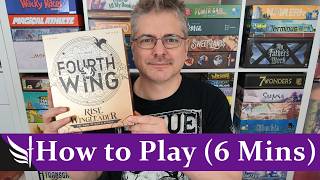
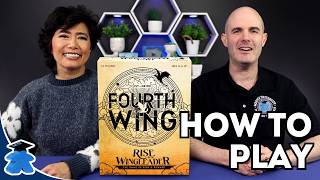
Rob of JestaThaRogue walks through Fourth Wing: Rise of the Wingleader as a tight, readable loop built around a single choice each turn: play, claim, or fold. Stella of Meeple University teaches the same loop in a classroom format alongside a co-host, but keeps circling back to how closely each round plays like a scene from Rebecca Yarros's Empyrean novels, the series this Goliath Games release is built from and set within at Basgiath War College. Bower's Game Corner takes the most skeptical line: unboxing rather than teaching, impressed by how the components look but unconvinced that the cards carry enough text to back that look up once the rule booklet closes.
All three reviewers single out the claim system as the game's center of gravity, the moment where a round's blazons get converted into glory. Where they split is over how much that system asks players to accept. Bower's Game Corner wants more substance on the cards themselves, while the Meeple University hosts are more focused on what claiming and folding cost in injury tokens than on the text that explains them.
Core Mechanics That Define Fourth Wing: Rise of the Wingleader
Hand Management
Each turn in Fourth Wing: Rise of the Wingleader requires one of three actions: play, claim, or fold, and a player cannot pass. Rob of JestaThaRogue explains that the play action lets a player put either one card with two blazons, two cards with two blazons each, or one card with three blazons face up in front of them, so a single turn adds between two and four blazons to the table. Those played cards stay in front of the player for the rest of the round, which means the hand is not simply emptied each turn. Players must decide which allies to commit now and which to hold back for later.
The Meeple University hosts highlight the decision that folding creates for the hand. When a player folds, they pick up every card they have played that round and return it to their hand, which leaves them with a bigger hand than if they had claimed and discarded. Claiming, by contrast, spends those cards for good. This makes the hand a resource that can be recycled through folding, and it is why the choice between claiming and folding feels meaningful rather than automatic.
Area Majority
The contest in Fourth Wing: Rise of the Wingleader is not fought over regions of the board. Instead, each of the four blazons (power, agility, cunning, and connection) is tied to one of four claim tokens, and the event card in play determines which blazon goes with which token that round. A player may claim a token only if they have strictly more of the relevant blazon in their played allies than every other player. Rob of JestaThaRogue stresses that a tie earns nothing, and the Meeple University hosts repeat that a player "must have strictly the most" to claim. Their example shows a first player who can claim two blazon types while being unable to claim a third because of a tie.
Claimed tokens score glory, typically two or three spaces on the glory track, while one special token also draws a bonus ally and unlocks that player's signet ability. Once a player claims, they discard their played allies and step aside for the rest of the round. This is majority contesting with a clear penalty for stepping in, and it rewards players who can read where the other players' blazons are concentrated.
The Fourth Wing: Rise of the Wingleader Experience
Tense Risk and Reward
Bower's Game Corner opens with the tagline "risk and rewards, fly or die," and that framing captures the tension the other reviewers describe as well. Every turn is a choice between pushing ahead and cutting losses. The Meeple University hosts note that folding is sometimes a tactical move to set up future rounds rather than a sign of failure, but a fold on a dangerous event still costs an injury token. The result is a steady background pressure in which each decision carries a cost that is easy to feel at the table.
A Story Told Through Its Scenes
The theme is not a thin coat of paint. The Meeple University hosts explain that the circular event cards depict events and scenes from the Fourth Wing book series, and that each round resolves a single scene. Signets, the hidden abilities that players unlock during play, echo the books as well: the Meeple University hosts point out that, as in the Fourth Wing world, players do not know what their signet will be until they have unlocked it. Rob of JestaThaRogue gives the example of an Illusionist signet that rotates the event card once per round, which shows how a book-derived power can change the flow of a round.
What Makes Fourth Wing: Rise of the Wingleader Stand Out
Theme Woven Into the Rules
Two of the three reviews point to the way the theme shapes the play itself rather than sitting on top of it. The Meeple University hosts frame the game as a classroom in which cadets compete to rise to wing leader, and they note that folding out of a round is "kind of a lot like in the book," so the choices players make feel familiar to fans. Rob of JestaThaRogue ties the event cards and signet abilities to the story as part of the setup and rules, so the book's scenes are present in the mechanics rather than only in the artwork.
A Solo Mode Built From the Same Rules
The game includes a solo mode in the standard box, and Rob of JestaThaRogue devotes a full section of their walkthrough to it. In that mode, the player uses a dragon score tracker as a rival, deals the rival ally cards, and resolves claims for the rival before claiming for themselves. The rival can be injured and can win by collecting three injuries, and a second dragon tracker can be added to raise the difficulty. Because the solo mode reuses the multiplayer claim system, it feels like a natural extension of the core game rather than a separate experience.
Potential Drawbacks
Thin Card Text and Reliance on the Rulebook
Bower's Game Corner offers the most pointed criticism. They describe the card components as high quality but note that the cards are an unusual size that will be difficult to sleeve, and they say they want more substance in the card text. Their concern is that players must rely on the rule booklet to understand what the cards do, which can make the first few games feel less self-explanatory. They are fair about this, acknowledging that players who value the look and feel of the components may not mind, and they suggest that the game's appeal will depend on how much a given player wants from the text.
Elimination and the Cost of Folding
The Meeple University hosts explain that a fold on a dangerous event costs an injury token, and that a third injury eliminates the player from the game. They present this as a manageable risk, since one or two injuries are fine, but it is a real source of tension in longer rounds. Rob of JestaThaRogue points out the same elimination rule in the solo mode, where a player who collects three injuries loses. For players who dislike elimination mechanics, this penalty structure may feel unforgiving even though it reinforces the game's risk-and-reward identity.
If You Enjoy Fourth Wing: Rise of the Wingleader
Players who enjoy Fourth Wing: Rise of the Wingleader's hand management will find similar satisfaction in Sushi Go!, where the decision of which cards to commit and which to keep back shapes every turn. Players who value the push-and-pull of stepping out at the right moment will find a related tension in Can't Stop, where the choice to keep going or lock in progress defines the game. Those who like the blazon majority system, in which the player with the most of a symbol wins the reward, will recognize a similar contest in Coloretto, where majorities in color rows decide the scoring. Fans of a licensed book series carried through event-driven play rather than flavor text may also want to look at Harry Potter: Hogwarts Battle, where each game adds new cards tied to specific moments from the books instead of narrating the story directly.
What Reviewers Are Saying
"Importantly, you have to have more of the relevant blazon than every other player. You don't get anything on a tie."
— Rob, JestaThaRogue
"Having one or two injuries is fine, but if you ever get a third injury, then your cadet is dead and you're eliminated from the game."
— Stella, Meeple University
"I want more meat on the text. That being said, that's a that is a that is a very nice looking game."
— Bower's Game Corner