


Gothic: A Shadow's Quest Deep Dive
What the Community Thinks About Gothic: A Shadow's Quest
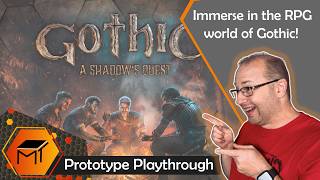
Reviewers largely agree on who this game is for. Gothic: A Shadow's Quest is a one to four player cooperative adventure published by THQ Nordic and set in the Valley of the Mines from the Gothic video game series. The reviewers who covered it see the strongest appeal among people who already know that world. Meet Me At The Table presents it as a campaign game with an optional game master, and its prototype playthrough focuses on how the components, encounter books, and combat flow fit together. That channel repeatedly stresses that the art, components, and rules were still prototype material when filmed.
BoardGameCo covers the game within a busy month of Gamefound crowdfunding. Its host describes it as a cooperative adventure RPG that brings the Gothic world to the tabletop, with an overarching adventure and individual campaign missions inside it. The host draws comparisons to Gloomhaven and points fans of the video game toward the campaign.
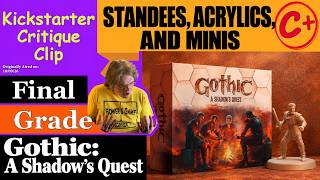
Bower's Game Corner reaches a more divided verdict. The reviewer believes fans will be well served because the rulebook and videos make the game sound engaging, but is not persuaded for non-fans. The main reservations concern the campaign page and pricing rather than the core gameplay. Taken together, the shared position is that the game is compelling for fans, while its prototype status and crowdfunding presentation leave open questions.
Core Mechanics That Define Gothic: A Shadow's Quest
Campaign
Reviewers describe the game less as a single session than as a story the group advances through a campaign book. Locations in the Valley of the Mines are represented by cards that change as quests are completed. When the party finishes an early mission, for example, the group swaps the old camp card for a numbered replacement that alters what can be done there. Side quests, reputation with non-player characters such as Fingers, and skills learned from those characters carry forward. Movement also has a cost. Each new location adds threat, and once the threat track fills, a token moves into a threat pool that raises the chance of an ambush later on. Meet Me At The Table identifies this interplay as the heart of the design, noting that the group can return to earlier locations and that outcomes recorded in one part of the book affect what is available in later sections.
Action Points
Combat runs on a budget of action points. At the start of each player phase, a character's pool resets to its full value minus any exhaustion the character has accumulated. Movement costs one point per field, and attacks cost points depending on the weapon skill, so a character who has trained with a sword strikes for less. Reviewers highlight the trade-offs built into the spending. Characters can concentrate for an extra die at the cost of an exhaustion point, catch their breath to remove exhaustion, disengage from enemies, block to make incoming attacks harder, or loot corpses and open chests. Enemies carry their own action point pools and activate in a set order, which means a player who spends everything on offense may have nothing left to block with. Meet Me At The Table shows how a round can turn on whether a character saved points for defense.
The Gothic: A Shadow's Quest Experience
Tense Cooperative Combat
Reviewers describe the fights as tense and swingy. Combat uses dice pools rolled against a success threshold, and the prototype playthrough shows how quickly a fight can tilt. A sword attack may roll poorly while a fireball spell lands, and an orc warrior can wound a party member in a single round. The host of Meet Me At The Table reacts to the dice in real time, which conveys the feeling of a group stretched thin and relying on each other to block, retreat, and finish off enemies. At one point the host reports, "Oh boy, we're in a world of hurt," after a round of enemy attacks.
Exploration of an Unknown Valley
The second feeling reviewers return to is discovery. Locations hide tokens that are revealed only when a character comes within range or line of sight, and the encounter books let a single hidden token change what waits nearby, whether that is a treasure chest, a fresh group of enemies, or a trap that forces a choice. Meet Me At The Table describes this as making the fights dynamic, because a fight can change shape once new tokens are revealed. Quests are not always resolved by defeating every enemy either. Puzzles that require placing cubes, destructible objects, and locks to pick all offer alternative paths to completing a mission. Bower's Game Corner says the game sounds fun to fans, while BoardGameCo frames the appeal as a way to dive into the world of Gothic.
What Makes Gothic: A Shadow's Quest Stand Out
Physical Components With Practical Value
Meet Me At The Table singles out the hit point trackers as a neat system. Each tracker is magnetic and carries numbers on both faces, so a foe with 20 hit points can be marked down one step at a time and then flipped over to continue counting. The host also highlights acrylic stands that keep enemy status visible during combat and a combat monitor card that gathers a character's stats from equipment in one place rather than requiring players to add them up mid-fight. Bower's Game Corner, while critical of the standee-heavy presentation, credits the publisher for offering backers a choice of editions, describing the range of tiers as consumer-friendly even though it complicates the campaign page.
An Integrated Map and Encounter Books
Meet Me At The Table gives its strongest praise to the way the world hangs together. The map, quest cards, location cards, and combat setup all reference the same campaign materials, so encounters are not standalone skirmishes. Each fight is laid out from a combat book that dictates which enemies appear, where characters start, and which tokens are placed on the board. Story results and hidden tokens then feed back into the wider campaign, so the group's choices matter beyond the current battle. The host sums up the appeal directly: "I love the fact that this all works together on this one map. And all of the encounters are inside encounter books."
Potential Drawbacks
A Prototype That Is Still Changing
Meet Me At The Table repeatedly cautions that everything shown is prototype material. The art is not final, components may change, and the rules may change before publication. The host appears to have misapplied at least one rule, using a spell's power-up ability on a spell that did not have it, and directs viewers to pinned comments and subtitles for corrections. Those caveats matter because the playthrough is partly a learning exercise, and reviewers are judging a game whose final state is still in flux. The dice-heavy tests also make outcomes sensitive to rolls that do not go the group's way, which the host describes in frustrated and humorous terms.
Campaign Page Presentation and Price
Bower's Game Corner is the most critical voice on the campaign page. The reviewer describes it as a rough draft of a strong campaign: stretch goals are stacked into one long scrolling section that is hard to navigate, a setup video and other helpful material appear to have been removed, and the layout does not clearly show what each box contains. Price is also treated as a mixed signal. The reviewer considers the cost reasonable for a committed fan across the available editions, but finds paying around $100 for the standee version harder to justify for people who are not already invested in the Gothic series. Bower's Game Corner awards the campaign a C plus, saying that a fan will be pleased while a non-fan needs more convincing.
If You Enjoy Gothic: A Shadow's Quest
Gloomhaven is the tabletop comparison that reviewers raise most directly. BoardGameCo suggests that players who enjoy games like Gloomhaven should look at this one, because both are framed around an overarching adventure with scenario-based missions that a group works through across sessions. BoardGameCo also notes that the two games are very different in their particulars, so Gloomhaven fans should not expect a copy of its system.
The Gothic video game is the source material rather than a tabletop recommendation. Reviewers present it as the main reason many players will be drawn to the board game, and Bower's Game Corner suggests that fans of the series will find the setting and campaign especially appealing.
What Reviewers Are Saying
"I love the fact that this all works together on this one map. And all of the encounters are inside encounter books. I think that is fantastic."
— Meet Me At The Table
"You have a giant overarching adventure you're going through. You have the individual campaign missions you're diving through as you take down various scenario objectives."
— BoardGameCo
"There's a lot of these little things that I feel like really could have used a level of polish here. I said it earlier, this feels like the rough draft of a really solid campaign page, but they just didn't update it."
— Bower's Game Corner