My TOP Thinky 2 PLAYER Board Games with a Twist! (No.10 - 6)

Transcript
Are you looking for a two-player board game to play with your significant other or even your bestie? Well, you've come to the right place, my friends, because in this video, we are going to be looking at my top 10 terrific two-player only board games with a twist that exist in my collection. Hi, my name's Danny. I'm an avid modern board gamer from Australia. I love sharing my passion for this hobby with you, my friends, and my family. Come and join me on this journey, and don't forget to subscribe for more wholesome board game content. There's one thing that I'm really fascinated by when I whenever I go traveling, especially when I go to the city or I go to a new metropolitan area.
My hubby's also the same. We're quite invested and interested in like network design and transport routes. So when you stand there and look at like how a metro network is kind of laid out or how train connections connect together, you can often go in a deep dive down some YouTube videos that kind of describe how better to transport people from point A to point B. So this game is one that sits pretty high in our two-player game collection, even though you can actually play it with three. We won't talk about that. But Past Tally is a brilliant two-player game from Asia and it's been republished u so that it's got a wider audience. But basically in this game it kind of reminds me of looking at one of those transport train or bus routes and trying to see how everything connects together. The game comes with these little um hexagonal pieces which kind of reminds me of the rubies from uh The Legend of Zelda. And what you're doing is you're drafting from three different tiles uh that are available on your turn and then you're placing them out on this little map. Now, the map itself already has a grid of white lines and each player has three little markers that are perimetered on this board. And the idea here is to try and get or create lines that connect your markers together to pass through as many tiles as you can and as high as you can. So, for example, a tile that is on the ground level is worth one pass. A tile that's worth on
the second level is worth two passes. A tile that's on the third level is worth three passes, and so forth. And so, you're trying to lay these tiles on this little shared map because both you and your opponent are playing on the same board to try and connect your uh pathways together. And basically on your turn, you're trying to create really two efficient pathways to try and convert or get as many passes you as you can because the number of passes that you get will be converted using this table and then it will convert into victory points which allow you to ascend the victory point track. Part of the puzzle of this game is going, "Okay, should I place a foundation tile and hopefully get some base points for two of my markers, or shall I kind of piggy back on what um I've built before, what the other players place down to then try and connect it to um other places?" You can also use your turn to move your markers around the perimeter of the board, too, to position them in a much better way.
So, you kind of in some ways either want to stretch your markers right across to create really lengthy routes cuz that'll get you a lot more passes and points or you want to move them close together to try and just continually use those points that are uh I guess geographically close together. This is one of those puzzles where a two-player level, it's all about kind of readjusting how things are configured andorked together. you've built this really great system in the corner, but then the opponent will place a tile there and reroute it to their cubes. And so it creates that really interesting uh indirect impact on what you're planning. So there's all these interruptions to the best laid plants, but also configuring the puzzle in a third dimension cuz as you the game progresses, you're going to run out of ground floor space here. And so the only space you can kind of take advantage of is the space that kind of ascends higher and higher up. And as you get further and further up, the higher the levels, the more passes you're going to be able to make in total on your turn. And so having those big passes means you're going to get way more victory points.
And so the game technically ends when someone gets to 50 or beyond all the tiles runs out. It is a beautiful puzzle game that has this really cool eclectic abstract visual design to it. I mean, they could easily use rectangles, but the fact that these little tiles are kind of simulate like a little mini Metro system. I've even thought about replacing these cubes with like little mini trains from like Ticket to Ride. So, they kind of have that little metallike feel to it. One of my life dreams is to be able to travel around the world and visit a lot of amazing locations. I guess it's kind of like bucket list item things to do. Uh, one of my favorite destinations was going from the north of Switzerland all the way down to the southern part of Switzerland, seeing Grindleald, Young Fra, and also going up to the Matter Horn and seeing all the wonderful mountainous scenery. Now, there's one game that I often see in a board game shop or I've seen online as well, and it was a game called Fjords. I just liked the I guess environmental mountainous glacial look to it and but I've never been able to kind of convince myself that you know what this is a game that I definitely need in my collection mainly because it seems like a quite relatively simple game in such a big box. However, they finally released a small version of the game which fits in this tiny box called Small Fjords. And there's a few little rule tweaks compared to the original game, but this was the time where I was like, "Yep, fjords, you're going right into my
collection because I'm all for condensing these big box games down into small packages." Players are going to be taking turns drawing a tile and placing it out onto the map, kind of carcassone style, where basically you're going to place the tile so that it continues the landscape as long as it's also touching two adjacent tiles. So, you can't kind of create like a single string of tiles coming out. And you'll see why in a few minutes. Uh, the other thing that you can do is that you can place one of your long houses onto a tile that you just placed out. These long houses are really important for the second half of the game cuz what you're going to be doing in the second half is you're going to be conquering the fjords by placing your little Viking cubes out, crafting little trails, and blocking out your opponent.
And so once all of the tiles are out on your fjord, you get to create this beautiful unique map and then you'll be taking turns placing a cube out. Now, when you're placing a cube out, you can only place a Viking cube next to one of your existing long houses or next to another Viking cube that you've already placed out, and you can only move along the planes. So sometimes when you're placing these tiles out, you can kind of create these little dead ends or culde-sacs where you know if you've kind of got advantage of that particular location by placing a Viking cube there, you can block out that peripheral location from the other player. And so you kind of start seeing how this game gets quite competitive, can't you? Where you'll create like a little path, you'll create a little blockage. You'll try and craft your way so you can place your cubes so they spread out or elongate. It definitely reminds me of another Rhino Canitzia game called Blue Lagoon where you're trying to spread out and gain majority, but this game just does it in such a compact uh manner. And the twist here is do I put my long house out now or do I wait till I see more of the map before deploying my long house? when you deploy your long house because it's the place where you've just placed your tile, is that place going to be most advantageous for allowing your fjord to grow? And so there is this very cool geographical puzzle about okay, where which position on the map is going to give me the most advantage, which position is going to allow me to kind of
block off the path for the other player, and when I'm placing my next tile, where do I want to position it so it helps me, but not the other player? And so there's this really intense kind of uh two and fro that happens as you watch this fjord evolve which you know plays in like 15 minutes. So it's short, sharp and really straight to the point and I love it. The next game that has recently gained my admiration is a game from South Korea and it's about managing the positions on a sporting team. And whilst I'm not a very sporty person myself, in fact I don't watch much sports at all, but I have coached like a soccer team for a couple of years. This game just had some interesting frills to it that I thought even if I don't like sport, this game has enough strategy in it to make me feel like I'm not really playing the game or playing the sport that it's kind of dressed around. In fact, I really enjoy the card play and the I guess you push your luck mechanism and tug-of-war mechanism that this game has to offer.
Magic number 11 is a g two-player game where you'll be placing cards out, joining little icons from your players, and then based on those icons, you'll be able to increase your defense. You'll be able to try and shoot for goals, and you'll be moving, I guess, this marker to and fro uh along this little, I guess, accuracy track where you push the soccer ball up the other end or the other players pushing the soccer ball towards you. And basically, you're playing these star cards that help build up, I guess, your value. And the push your luck element to this game is that you don't want to surpass a certain value. If you able to get 11 and nail exactly 11 stars, then you basically get a goal. There's an interesting thing here where is when a player plays a little penalty card, you get to go to a penalty kickoff. And that's kind of like a scissors, paper, rock style element.
And yes, we all don't like chance, but this is a game where if you're the defender, you choose a card and it's got two little glove positions. And if you're the uh penalty kicker and you're trying to kick the ball, you get one out of the five positions. And if they match up, then the ball is uh knocked away. And if they don't match up, the ball goes in the goal. So, there's really cool uh I guess amplifying of the game when you play. It's not just I'm playing a card, position here, shoot here, play this card. Everything has this tense buildup around it where you're trying to think about the configuration of where everyone goes on the field to match up the little cards. You're thinking about uh when you're gaining those accuracy cards. You're thinking about the tugof-war element about pushing the ball down towards the other end. You're thinking about, okay, if I'm going to defend, what sort of defense do I need to plan for now? In fact, whilst it has this soccer theme, it definitely has like a really cool like card battler effect where as you place all your little cards out, you know, you can even draft star players that give you like better abilities that change the way you play things. It just has this great level of underlying tension in the game that sometimes you forget you're playing like a soccer game. Uh but yeah, it's super fun, super thinky, and it's got some really fun um nuances about it that you don't really kind of experience until you've actually really deep into the game. You're like, "Oh, I see why
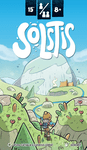
that happens. Oh, how exciting was that? Oh, I'm going to try and go for the goal." It it really has some fantastic fun cardplay strategies infused into it. Uh, spring is one of my favorite seasons of the year because everything around my house just blossoms and grows, including all of my green pot plants. The air is warming up. And basically, it's a great time to play board games, especially when the days are long. And you know what? There's nothing like getting a cold tea and drinking and playing some two-player games. The next two-player only game that I want to talk about is Solstice. And it's about um ascending a mountain. And if you see on the table here, you can see that I've created the full panorama, which is basically six rows in height, but the length of each row is going to be different. And so what you're trying to do is you're trying to build your panorama at the same time as the other player. But there's only one copy of each tile, and each tile has a special vertical and horizontal position in this panorama.
As you're building your uh panorama out, there are a couple of things that you're trying to do. There are these little fire icons at the top of the mountain that you're trying to connect so you can create a pathway down to the red tiles at the bottom of the mountain. Think of it as like the pathway that you've taken to enlightenment or to see the view on the other side of the mountains. The other thing that you're doing is you're placing these little spirits out onto uh 2x two sections of your panorama. The blue spirits will give you an endgame scoring ability and the brown background spirits will give you an ongoing ability might be having an extra land tile in your hand or it might be be able to take a land tile from your opponent and they get to draw another land tile. And so what you're trying to do is connect your panorama together. And I guess thematically represents the things you've seen, the nature, and the experiences that you've had along the way as you're building this panorama out in front of you. The little twist to this game is that you'll never be able to build the full panorama, and neither will your opponent. You'll have little holes everywhere. You'll have a piece here and a piece there. Your opponent will also have similar things. And so in some ways you're kind of competing against each other to try and fulfill this great vision. And so in the game, in order to acquire tile from the market, you'll be playing a tile from your hand. And each tile has a number and color associated. And so in the game, playing a tile means you're trying
to use this tile to capture another tile in the market. So, if I play this red 10, I'll be able to capture another red tile that's in the market or another tile with the number 10 on it. Now, if I play this red 10 and it there's no red tile or other tile that has 10 in it, I discard it to the side and then I get to uh draw another land tile and then play it straight away, calling it a second chance, I guess. And based on that, if I can't catch yet another tile from it, I get rewarded or compensated with a rainbow tile. And a rainbow tile is super useful because it is a wild tile that can be used to fill up any gap in your panorama. Think of it as like the sunshine in your life or just when you think thought things were a little bit grim, there's that beautiful rainbow that kind of connects your whole tableau together. And so throughout the game, there's this jostling of trying to piece this singular puzzle together, but in two separate places. And then when you're trying to create these clusters of 2x two in your actual panorama, you're using these different little scoring creatures to be able to enhance that whole scoring overall. And so this game has this really cool puzzly theme to it where you're trying to build a picture, but it's an incomplete picture and you're trying to build the best incomplete picture there is. And by clustering and creating these top tobottom paths, you're trying to get as many points as you possibly can using
the variety of different scoring methods. And so the the the picture that you build and that you're trying to fulfill makes this game quite interesting and thinky at the same time. When it comes to board games, shelf space is really important to me. And so I really love the old Aaliyah and look at spiel tile type boxes where the games are narrow in size. You can fit them so they look like the edge of like books on a bookshelf. And I kind of shy away from really big ticket to ride size boxes because they take up so much space. I'm not really a fan of giant miniatures, but I am a fan of smart, cool, well-crafted, and wellthoughtout components. This next game doesn't take up a lot of space. In fact, it's a game about space. It's probably one of the newest and one of my most favorite two-player games that's entered my collection. And this is how much space it takes up. It's called a rapper space which is a sequel to the original game called a rapper mine. Now, rapid space is kind of a twist to the game of battleships where basically each player will have a little coordinate grid where they are going to be placing some planetary objects and basically battleship style, they're going to try and deduce where each other's planetary objects are currently positioned. You can see that the two boards will be fa faced like that and you're trying to
work out where the other players objects are. Now, the twist or the terrific twist to this game is that it's not just a matter of going, "All right, Z, you know, A3, is that where your ship is? Or is it like D4?" This game is all about lasers. And basically, what you're going to be doing is you're going to be announcing either a number or letter that goes around this grid. And based on that, you're going to imagine an imaginary laser is going to come from that direction. So it's from this side, it'll be coming from the left. This side will be coming from the right. 1 to 11 be coming from the top. H to R, it's coming from the bottom. And then basically you're going to be reporting back to the other player what color is reflected by that ray. And so some of these surfaces will reflect the ray back to the way it came from. So it'll bounce back in and out. Some of them will kind of dart their way through and bounce off several different planetary objects before exiting. And some might even go straight into this thing called the black hole. And so what's interesting about this game is that what you're reporting back is a color mix. So each of the objects has a particular color. So you got red, yellow, blue, you got these white objects. And basically if it hits just the red object and bounces back, you're going to be reporting back red. However, if it hits a red object but then also reflects and hits a yellow object before exiting, you're going to be saying
orange cuz red and yellow make orange. If it's a blue object that uh then rebounds off a white object and then exit ex and then exits, you're going to say light blue or sky blue. And so by giving that color to the other player, they can kind of deduce, okay, what two potential objects uh could that ray have bounced off? In this version, you can actually have it bouncing off sometimes three objects where it goes red, blue, white, which gives you purple or light purple in this case, or red, yellow, white, which gives you light orange. So, the different shades in this game will give you or give the other player some feedback about where the planetary objects are positioned. You can even ask, okay, at E4. And if a player says, "Oh, that's a red object." That's also going to give you information, too. So, by asking those questions, you're deducing where the planets are, what size they are, and what positions they might be in. And once you've concluded that, the first player to hand their little answer sheet over to the other player, if they've deduced all the little areas correctly, then they've won the game. Now, the black hole is actually a little mini expansion that's included with this game where if the ray goes into the black hole, it basically disappears and you just say, "Oh, it's just the rays disappeared." Or if it goes around the adjacent squares from the black hole, it actually bends the ray at 90°, which kind of throws a little bit of a spanner into the works
when it comes to deduction. So, definitely only play with the black hole in advance mode. But yeah, this is a brilliantly simple game adapted from a very familiar longstanding game that a lot of people know. And the fact that, you know, you've got this huge puzzle that you're trying to race to solve before the other player in addition to this really cool color matching uh mixture mechanic just really adds such great depth to this game. So, what did you think of the first five games in this board game list? If you really like this video, please consider liking, subscribing to my channel. And if you really want to help support this channel, help me be able to produce more content for you guys. Uh because I do everything from filming, editing, scripting, even making the music, uh I would appreciate you buying me a coffee a month over my Patreon page. Otherwise, I can't wait to bring you the part two version of this video, which is the top five games. Uh it'll be coming out very soon, so don't forget to look out for that video. Otherwise, I hope your next board game experience is a fun one. See you soon.