Board Games 101: What is a Worker Placement Game?
Games in This Video
6 games are featured in this video — they unlock as you watch.


Transcript
Hi! It's professor Ryan from Nights Around a Table. What is a worker placement game? Today on (singing) Board Games 101! If you're new to modern board games, you're gonna hear that term "worker placement" a lot, because it's a very very popular board game mechanic. And if you're not sure what i mean by "board game mechanic," make sure to check out my What is a Board Game Mechanic video, which is a prerequisite for this course. So i have here a lovely little worker placement game. This is what it looks like. This is the common board, and each player gets a pawn. And there are gonna be point values on the board. So we're gonna have one, two, three, and four. The way it's gonna work is that everybody gets a turn, and on your turn, you're gonna take your pawn and you're gonna place it on one of these spots ,and the points you get are written right on the spot.
So - i know - it's rudimentary, but let's play it out. So the blue player, just by random draw gets to go first, and the blue player decides 4 is probably the best place to go, so blue player goes on 4. And then the red player also chooses 4. Green player... maybe not that familiar with board games, has made a tactical decision, and has chosen 1 for whatever reason, but then yellow player also decides that 4 is the best bet. And that's the end of the game. So what we have is a three-way tie with 4 points, and poor green over here has only scored 1 point. But that's okay, green. You'll get 'em next time. That is, in essence, how a worker placement game works. And you say "Well how could this be popular at all?
Rhis looks really really dumb and basic and simple, and why... why wouldn't everybody just choose 4?" and you're absolutely right: there's no reason why you wouldn't choose the best scoring spot. So then designers working with this concept think "Okay: we've got to put, maybe, a little more parameters to make it a little bit more interesting. So let's reset all of the pawns, and this time out the rule is now that each space can only hold one pawn. So let's play that out. Again, by random draw, blue gets to go first, and blue chooses 4. That's the best spot on the board. Red is unable to choose 4 and choses three, and then green, still making questionable life decisions, chooses 1, and yellow picks 2, and that's the end of the game, and blue wins.
So blue definitely had an advantage being the first player in our worker placement game. It's still not a very good or interesting game. Nobody has interesting choices to make, really. In order to make this more of a game, or more of an interesting game, you're gonna have to start putting more rules around it, and you're gonna have to start abstracting those scores away so that instead of collecting straight-up points maybe you're collecting or doing things that move you closer towards points? Maybe you split it up so that there are a bunch of different tasks that you need to do, and by slowly, incrementally completing those tasks, those tasks translate into points.
And the reason i mention this is because if you're new to modern board games, you may look at a worker placement game and think "Why is it so complicated? Why is the rule book 15 pages long? Why do i have to learn all this stuff?" But hopefully from this demonstration, you'll see that unless there are sort of a bunch of rules, and unless your final goal is abstracted a little bit, it's not a very interesting game at all. And that's why when you pull one of these off the shelf, and you see there's all kinds of stuff going on, that's the reason :a worker placement game sort of needs a whole pile of rules to make it interesting and fun! Theming. So you wonder why it's called a "worker placement" game? Well, in many worker placement games, the pawns are actually represented by humanoid worker characters, and the things they're doing are completing tasks or job-like things.
So if we were to theme something like this, maybe we say well, it's gonna be a waste management game, so we're gonna award points based on the heaviest kind of refuse that these workers pull away. So we're gonna replace the pawns with little... little people-like things instead of just abstract pawns, and the things that they're doing are: big points, we're going to be pulling big sofas off of people's curb sides. And then for slightly fewer points, we're gonna be collecting the big black garbage bags. Then over here, this is gonna be the collecting recycling spot, and then down here, the organics spot, which is worth the least amount of points, maybe because it's the lightest load for a worker to carry? That's why it's called a worker placement game, because very many times, it's... there are a lot of these games that are about farming... getting a job done.
Now, because who goes first is obviously really important in a worker placement game, what you'll see is designers will kind of sweeten the pot by saying that if you take one of the spots that may be less favored by other players, you get to go first. So now, it might make a little bit more sense if, you know, the red player picks this spot because the red player is going first, and maybe the blue player picks the second-best spot... green player who has always been picking the first spot, or the spot that gets you 1 point, goes there, and yellow player goes here, and that might look like a bad move for the green worker, but if there are multiple rounds in the game, well, next time green player gets to go first, and picks the couch spot! And you can imagine what this game would look like if it was more complex.
If instead of just four spots, you had a bunch of different spots that you can choose from. And instead of just one pawn that you could place on a spot, you had multiple different pawns that you could place on a spot. So if you're brand new to this kind of game and you'd like to try one out for yourself, i highly recommend worker placement games. They are one of my favorite style of games to play. And i know a lot of you chimed in in the comments section and told me that worker placement games were your favorites as well. So for new players, if you'd like to try it out, BoardGameGeek, which is kind of like the Internet Movie Database of board games, tells us that one of the original, if not the original, worker placement game was called Keydom, and that was by a family of board game creators who came up with Keydom, and unfortunately, it was a small print thing, and it sold out.
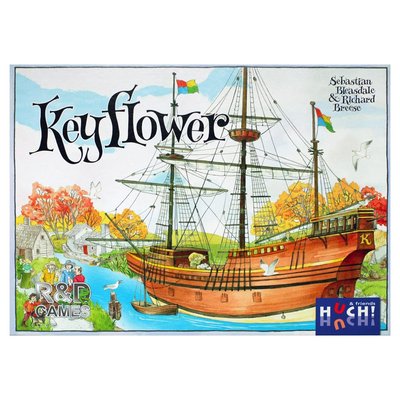
It's out of print. But he did a whole series of games, and one of his best-known ones is called Keyflower. It's fantastic! It's a worker placement game with an auction mechanic folded into the mix. i really like it. Maybe a little bit too hairy for a beginner, so if you want more of a... an ease in, dip your toe into the pool kind of thing, i can recommend Lords of Waterdeep. Now, if you see the cover of Lords of Waterdeep, it's gonna call it a Dungeons & Dragons game, but don't be scared off by that. It's not a classic role-playing game. It's a worker placement game that's themed with Dungeons & Dragons-y kind of stuff. If you want to dive right into the deep end and play a game that's sort of more of a gamer's game that's also a worker placement mechanic, i recommend Agricola!
It's a fantastic worker placement game. The theme is extremely boring. You're thinking "Why am i gonna spend my Friday night playing a game about subsistence farming in the 1600s?" Get past the theme because who cares? The animals are adorable, it's really really fun, and really really thinky, and i think that you'll have a good time with it. Now, board game design and game design, sort of, in general, is an ever-evolving art form, and what a lot of designers have done is they've kind of remixed or come up with different variations on a theme with this style of mechanic. So i'll mention two more games that use a worker placement mechanic in unique and original ways. One of them is called Village, where you have pawns, and you're placing them in different spots in a medieval village, but all of the spots have cubes on them, and when you pick a spot, you're taking a cube away from the spot.
And that's a hallmark of a worker placement game: there are a limited number of spots to take, and players are kind of fighting each other or jockeying for position for an increasingly dwindling number of spots. In Village, placing the worker, or the villager, is actually kind of optional. It's taking the cube away from the spot that's the main action. It's just an interesting twist. Another one is called Tzolk'in: The Mayan Calendar, and in that one, you're placing workers on a rondel which is another game mechanic that we'll talk about in one of these videos, and you're removing your workers from these circles, and the longer you let them ride the circles - the circles turn every single round, and the prizes get better and better, and you stand to get richer the longer you wait letting your work ride around these little conveyor belts, or circles.
All great games, all worth checking out, all using a worker placement mechanic. If you're sort of slumming it watching this video and you already know all about worker placement games, tell me: what is your favorite worker placement game? Leave me a comment in the section below, or tell me on Discord. But if your favorite is a dice worker placement game, mine is too. Don't tell me that, because that's going to be a completely separate video! See you next time on (singing) Board Games 101! Nights Around a Yable is the only place you can earn your pH B in board games. (disclaimer voice) Nights Around a Table is not an accredited educational institution. (Ryan) Really? i thought we had that set up in Uruguay? To see a full course syllabus, go to nightsaroundatable.com. To fund an endowment, visit me at my Patreon page. And as usual, click the subscribe button and the bell to get notifications when new course materials are available.
If somebody returns my chalk, none of us have to speak to the Dean.