Let's Talk Board Games #41 – Origin Story, Unmatched Vol. III, Witchcraft, Dracula vs Van Helsing!
Games in This Video
3 games are featured in this video — they unlock as you watch.

Transcript
Hi everyone, my name is Monique
and I'm Naveen from Before You Play
and welcome to another episode of Let's Talk Board Games where we talk about a couple of games that we've been playing recently and how we feel about them. It is now spooky month.
Yes.
So, this is a spookier episode.
We have four games that are spooky adjacent, I would say, at the best.
At best.
At best. Um, well, I guess a couple of them are
I think only half of them really of any sort of relation to October
and its goingabouts, I guess. Uh every year we do try to play some games that you know in the past we've enjoyed playing games such as Dead of Winter.
Oh yeah.
Um and that's probably the most prominent one that we return to every year.
Horror themed games like that. Yeah,
basically. So if you're playing any games that are in the spirit of the Halloween season, let us know what games you've been playing. But for now, we're going to be talking about four different games today. One of which is a solo game.
I have not played it. You have played it.
Yes. And otherwise, just so you're aware, um, all four games that we're going to be featuring are games that were sent to us as review copies.
Yes, that's right.
So, let's get into the game, shall we?
Okay. First one came out originally in 2023. We've been wanting to play it for quite some time now, about 2 years. This is from 25th Century Games here in the US. Designed by Maxim Romberg and Theo Rivier, and it is Dracula versus Van Helsing.
Spooky game.
Yes, this is one of the two spooky games. Uh, this is a two-player only game where one player is going to be taking on the role of Dracula and the other one is Van Helsing. And you basically have an asymmetric wind goal as Dracula, you are trying to convert a good majority of the town's folk into vampires. And if you're Van Helsing, you're basically trying to stop Dracula from doing that, but also erode Dracula of their health.
Yes. So very thematic, right? Because Van Helsing is a vampire slayer.
Yes.
And of course, Dracula is a vampire.
Heard of them. I've heard of them.
Now, the way that the game works is there is a map that is split up into various districts, and each player has their own uh card holder. And uh at the start of the game, we're going to have various cards, which are more like cardboard tiles in each of the different slots on our card holder, which corresponds to the various districts on the map. And what you're trying to do is by the end of each round, you want to have the stronger tile in the same spots on each of our tableau because that means you win over that district. And so if you are a Dracula, that would mean that you get to convert somebody in that district into a vampire. And if you're Ben Helling, then you get to remove a health point from Dracula. Right
now, the way that the game actually works is it's very simple. On your turn, you're going to draw a card tile from the deck and you'll either replace one of your own card tiles or you just discard it. But regardless of which you choose, whatever card gets discarded is the card that you activate because all the different numbers have a different effect, right? That will allow you to do things such as swapping the placements of several cards or even swapping the positions of one of our cards. I think there's like one that was like reveal your opponent's card or like the position you know that you would like. So, uh this game is really about optimizing uh your personal hand so that by the time the end of the round is triggered that you are winning a majority of these different regions so that you can push your endgame goal,
right? And there are actually different suits. So, the the cards are colorcoded because there's always going to be a Trump suit at any given time. So, you know basically which color is the strongest. But one of the values allows you to also just change whatever color that is. So you're really having to sort of go with the flow and you really just like Nian said, you want to optimize your tableau by the end of the round. And after a certain point on your turn, instead of drawing a card, you can choose to just end the round, but that would allow the opposite player to take one more turn before the round actually ends. So, if you've played a game like Cabo or uh the Silver series, it almost feels like those sorts of games where you're trying to optimize the cards that you have in front of you uh to try to have like the lowest score. But with this game, there's a little bit more to it because you're trying to win over the various districts. The positioning of your cards matter. Yeah.
And but just like those games, uh there is a mechanic in here where if a card becomes revealed, it stays revealed. So there is a little bit of oh I know which card is in Naveen's you know X position so I can sort of try to cater my tableau accordingly.
Yeah. Like if you know that like there's nothing you can do because I have a very strong card, maybe you can focus your attention on the other four districts instead of saying, "Okay, how am I going to beat that one card?"
Or if you know you have something of high value, you're trying to find a way to get it so that the round ends as quick as possible so that you can one up your opponent. Especially if you're Dracula, you're really trying to flip those towns folk over to vampires. And there's some valuable districts as the game kind of uh goes on. You're just trying to get as many of those people to kind of flip over to your side.
And it's interesting because the lower the value card you discard, the worse or the more painful the card effect you have to resolve because obviously if you're swapping out like a one for something of higher value, then that swap is beneficial to you, but the card effect is not typically beneficial. It'll it probably will make you reveal your card or something. But the higher the value card that you have to discard, the better. The highest value of each suit is an eight. And if ever you were to discard an eight, as long as six cards have already been played that round, then it immediately ends a round. So it could be a good strategy for you to be able to end the round without giving your opponent an extra turn.
Yeah. So the the eight is basically you can't just discard it. It's like sometimes, you know, in these kind of games, you get a good a good kind of like hand. You can't just end the round like on turn two, right? The game has like this built-in mechanism that forces you to have to continue to play the round. Yes. To give your opponent at least a chance to kind of chip away at you. So, I do appreciate that. But, um, the eight is, uh, like kind of a power move. When you when you discard it, you're like, I'm doing this because I know I'm ending this game right now.
Yes. You're you're you're forfeiting a very high valued card, but you're getting the upper hand in terms of uh potentially scoring better, right? If you know, if you feel like your hand is stronger, y
now, like the was mentioning, there is a bit of a timer that requires you to wait a little bit before you can end the round. And I appreciate that because even if you're not removing cards from your tableau, anytime you draw a card, even if you were to just discard that card and not replace, you still have to activate that card's effect, which may require you to sort of mess with your tableau.
Yeah. Sometimes like uh you'll find yourself you draw a card and you're like, I don't want this to trigger. This is really bad for me. This does not help with with the other five cards that I have on my side. And uh by the way, all these cards are secret to your opponent until they get revealed. So, it's like I have no idea what you're doing over there with with your tinkering and you have no idea until it gets revealed.
Sometimes you get a a card and you're like this effect stinks right now, but if I just discard it, it's going to really hurt me,
right?
So, I guess I can put it here, buy myself some time, get rid of this card, I can activate that effect. Okay, fine. That that effect is okay. Let's just move some things around and I can find my way out of this kind of situation. So, it does create a little bit of those moments. Uh, and then also once you start getting like a leg up in certain districts, uh, then you know, like if you're Dracula, you're like, I need to get into another district so I can flip those humans over,
right? So now your attention is only on specific positions in your tableau, not necessarily the entire hand. Now, in terms of the endgame goals, the game ends either if uh, Dracula completely runs out of health, then Van Helsing wins, or if Dracula is able to convert four citizens in the same district into vampires, then that is another way the game can end. Otherwise, if you get to the end of the fifth round, then Dracula just wins.
Yeah, you can run out the clock. So, this plays an important role in the strategy as well because you're not just trying to win, you know, as many districts as possible as Dracula. You want to flip over specific
specific humans.
Yes.
Whereas Van Helsing just wants to deplete Dracula's life force. So, it's interesting. It's actually a very quick game. Like the five rounds you depending on how the game goes, you may not get there.
It's got to be 20 minutes, 30 minutes, it says. Yeah. Okay. Yeah, that seems about right.
Yeah, each round is very quick. Um, you just sort of reset and you do it again. But the visibility rule was a little bit difficult to remember to do at first.
Yeah, even though like we've played Cabo, which like is like once a card is exposed, like it always that that section always stays exposed. This for some reason it was just not clicking. Uh, like
it's not as intuitive when it's in like the card stock form and like when they're actually in a tableau like having to lay it out for some reason is not as intuitive. The more you get into it, the more it flows a little bit more. Um, components wise, the card tiles are a little bit difficult to shuffle.
Yeah.
So,
I don't know why they didn't just use cards. It's like these like uh
they're small. It's
like smaller.
They can fit. I guess it it just makes sense to be able to slot it in your top
probably for packaging purposes. I don't know.
But otherwise, it really does feel like a two-player Cabo. I don't know if you've ever played that that game before, but this is a game that we played a lot of in the past, like the Cabo Silver series. I think they're based off a game called Golf.
Yeah, the card game golf where you're trying to lower your score.
Yeah. We're just trying to have the lowest score, but there's just a little bit more to it. So, I feel like we're a little bit more biased towards liking a game like this, but there's also I don't know the added complexity. I don't I don't know if it necessarily adds more enjoyment to it. What do you think?
I think it like even though I said it plays short, by the time we got to round five, um it still it felt like what we were doing in the game was a little bit dragged out.
Like syy maybe a little bit. Um, there was some times like where I like I just didn't feel like I was making super clever moves and it was just kind of like at the end like especially if you get like a good draw. You're like, "Oh,
I just drew like a really nice trump card.
I'm going to slot that in right here and then like unless Mon'nique can somehow draw or discard a card that's going to force me to kind of reveal this or or mess around with my stuff.
Like I got this thing locked out." So, so like there is a luck of the draw in this game um that I think uh for me it just it's like just okay. It didn't meet expectations. It might have been like a little bit under expectation but still an enjoyable experience but it's not one that I am going to be gravitating to on a regular basis.
For me, I think I liked it a little bit more than the dead. I really enjoy the fact that it is so quick. You know, it's that same experience with a little bit more strate strategy to it, a little bit more depth in a very short amount of time and it's two-player only. But I do agree that it's not necessarily one that I would uh constantly gravitate towards. So anywh who, that is Dracula versus Van Helsing.
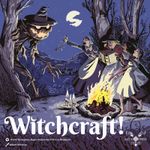
All right, moving on to the next game. This is a solo game this time. So Naveen has not played this, so please bear with me a little bit here, Nav, but it is our second spooky theme game of the day and it's a solo game called Witchcraft. Now Witchcraft is published by 25th Century Games and it's designed by three different designers, David Thompson, Roger Tankersley, and Trevor Benjamin. And I believe this is a re-implementation of another solo game called Resist.
Now, what you're doing in this game is you have I believe you lead a coven of witches. And each time you play, there are three jurors who you are trying to convince of your innocence.
Okay?
And so the way that you do this is by going on a series of missions, playing which cards from your hand, and trying to increase each of the jurors persuasion markers because you want to persuade them.
Yes. You're trying to persuade them. Exactly. Because at the start of the game during setup, each juror is assigned two facedown secret conviction cards that have values that go up to, I believe, five. And at the end of the game, you're going to reveal those conviction cards. And if the persuasion of that juror is higher than the sum of those values, then you've convinced them of your innocence. And your true goal is to get all three of those jurors to think you're innocent.
So your target goal is to exceed the values of the cards
of the values of the cards. Exactly. Which you don't know what their values are at the start of the game.
Okay. Now, the way that each round works is you have a you're going to have a hand of cards, and these cards are all witches. Uh there are also a few curse cards in your deck, which sort of clog up your hand and make it so that you can't play a full hand of witches, which is unfortunate. And uh each round, you have to play out all the witches that are in your hand. Okay.
Now, when you play them out, there's two sides to each witch card. You can either play them as hidden, uh, in which case you would be able to shuffle them back into your deck once you run out of cards, or you can reveal them and they'll essentially go out of your deck because there's a bit of a deck building sort of. You don't really add witches back into your deck, but they do leave your deck.
So, when you say they're they're two-sided, is like one side a higher value than the other one? It depends on the witch because each witch is they'll have a certain ability and uh sometimes they're better depending on where you are in the game. But each witch also has a certain amount of power. And that is really what you want to look at because each round you're actually going to choose a juror. And each juror has a mission assigned to them as well as a certain amount of these challenge cards. And your ultimate goal is to try to overcome that mission while also overcoming as many of the challenge cards as you can. And when you actually do this, it's really just about adding up the total amount of power that you had in your hand
via these which cards
and uh doing the math and seeing basically which cards you can divvy out your power to and eventually overcome that mission.
Gotcha.
So there is a sort of strategy in terms of when you play your witch cards because there are two times during the round when you can play them. You can play them at the very beginning before you choose the mission.
Uh or you can play them right after choosing the mission cards because that's when all the challenge cards get revealed and you sort of know what you're working with.
Okay.
But you never really know which challenge cards are going to come up and some of them are really bad. Some of them are like you cannot even attempt the mission until you defeat me and what if I don't have enough power in, you know, amongst all the witches that I play.
So you just get surprised by the situation.
Yeah, it's really just divvying out the amount of power to these various cards. But you really want to accomplish the mission because if you do that, that is truly the way that you increase the persuasion of the juror. I see.
And one of the ways in which you can just lose the game is if you fail two missions. And the the various missions are going to uh some of them give you rewards for succeeding them. Some of them give you penalties for failing them. So, it really just depends on which cards you have in play. There are actually a ton of different jurors and uh a ton of different witch cards. So, this is a highly replayable game. There's like a starting setup that it recommends that you sort of use your first game and become familiar.
Yeah. And the challenge cards as well as the missions are also tied to the jurors that you have in play, but the more you play the game, you can actually customize which witches you're playing with because some of their abilities sort of combo off of the various like family names that are in the game.
Okay.
Because there are several witches that come from the same family. Okay. Yeah, I thought that was an interesting aspect. Now, some penalties in the game will require you to discard these villager cards, which is another way in which you can lose the game is if you discard a certain amount of them. If you run out of curse cards in your deck, that's another way that you can lose the game. But basically, each round, you only go through one mission. And at the end of the round, you can either choose to play another round, uh, picking another juror to try to overcome their mission to basically just try to increase their persuasion points.
It all comes down to that.
It all comes down to that. Yes. or you can just eventually choose to go to trial. And unfortunately, there are some penalties in the game that just say if you fail this, you're going to immediately go to trial.
And going to trial is when you actually reveal all the conviction cards and do the math comparation.
Yeah. So that's what it comes down to. The game is basically this like deck optimization game with the witches because every time you play around, you're having to decide whether you'd like to play them as hidden or play them as revealed. So that is one of the first sort of uh strategic decision points and then how to to divvy out the power amongst the challenge cards so that you take the least amount of penalties while also accomplishing these missions to increase their persuasion.
So it's not a deck builder.
It's really like a deck optimization loser.
Okay. Okay. There are some effects in the game that allow you to add new cards to the witch deck, but more often than not, you are losing cards from your deck because you're choosing what when to actually reveal these cards, play them as revealed witches.
I got you.
So, that's essentially the basic gist of the game. Like I was mentioning, there's a lot of replayability. So, if you enjoy this sort of system, then there are a lot of different uh witch cards. There's actually a campaign that you can play. Uh, and then there are several different jurors and you only play with three of them each time. Uh, for me though, I think the system of the game I think I'm learning because, you know, I'm sort of I'm not really new to solo gaming anymore, but I sort of started my journey not too long ago and I'm I'm still learning like which types of genres of solo games that I I enjoy. And I think for me, games that are heavily card dependent where basically the entire game is just built off of different types of cards, I think they're just not for me. Honestly, so the system of the game I thought was just okay because the system is basically this like decision point with the decks and just diving out values. I didn't find it to be the most interesting in terms of decision points.
The art is stellar. The game is also quite challenging and I do like the fact that you can construct your deck. I do I think that makes the game more interesting. The fact that you uh construct the deck before you even start playing so that you know I feel like that's a part of the strategy
for more experienced players.
Yeah. For more experienced players. Exactly. But for me, like I said, the main aspect of the game, which is the overcoming of missions, I found to be just okay. And it is possible that it is it's a preference thing, like a genre preference thing. So, if you enjoy games that have like a lot of cardplay and you're a dedicated solo gamer, I do recommend you try it because it does have a lot going for it. And like I said, the replay-ability is very high. But for me, it was just okay. Okay, so anywh who, that is the solo game Witchcraft.
Okay, moving on to the third game we want to talk about. This is much less spooky. There are some spooky character elements in here,
but we have Unmatched: Battle of Legends Volume 3. So, this one introduces four new characters, two new maps. If you're familiar with Unmatched, it's basically a two-player, well, you can play more, but we play a two-player uh dueling game where you're basically one of these characters and you have an asymmetric deck and you're trying to battle it out. This one encompasses Blackbeard, Chupacabra, Pandora, and Loki from Restoration Games. And it is designed by a team of people. Yes.
Many, many designers.
So, we've featured Unmatched, I think, a couple of times in the past. Um, this is a it's a card-based battler where you're basically trying to bring your opponent's health down to zero.
But sort of the the thing about the game is its asymmetry. It typically features combination of characters either from different cultures or just from popular media. I believe there's like a Marvel set, Little Red Riding Hood.
There are lots of different sets out there. And uh specifically, the volumes are the ones that have four characters in them, and this is the third one. It's the one that most recently came out.
So, we played all four characters. We've also played on both sides of the board because the boards also feature different rules for play. Typically, depending on the character, there's also some sort of thematic mechanism that ties into the asymmetry of that character. So then starting with Chupacabra, Chupacabra is probably the least complicated of all the characters in this one because
more basic than the other ones.
It's the one exception uh basically to that. They don't really have their own special rule. They just have a standard deck of cards. They don't even have any sidekicks or anything like that, but they are quite strong. Chupacabra is a Latin American crypted and so it sort of thematically checks out that they would have a stronger deck. The weaker they become, the stronger they become. They can also draw additional cards from their deck, but no additional sort of rule set for them. So, if this is your first time playing Unmatched and you want to sort of go for a character that has the least amount of fuss, then it's going to be Chupacabra. As for the other three characters, there's also Blackbeard, who has dloons,
dloons, and I think two sidekicks that are like his mates. Uh, and those dloons, you can basically spend a dloon to take an extra action. But anytime you spend a dloon, you have to give it to your opponent. And if your opponent amasses enough of these dloons, they can basically counteract some of the actions on your cards because there's like a negating effect by your opponent spending the dloons back to you,
right? There's some cards in Blackbeard's deck that allow Blackbeard to do additional actions or additional bonuses unless their opponent can pay a ransom, which is going to be in the form of those dloons that they they're given.
So, the dloons go back and forth between the players.
Yes. And that is the main sort of aspect of Blackbeard's deck. Uh, next there's Pandora. And Pandora is a Greek god, I believe. You know, we all know Pandora from Pandora's box. And so that is the main mechanism when playing as this character. Pandora has this deck of extra cards called miseries, I believe. And at the start of your turn, you're required to draw one. It is a push your luck element of the game because these cards can either be great or they can be nothing and just be full of risk because after you're done resolving the card and these cards can do stuff like allow you to draw an additional card or uh one of the ways in which you can put out Pandora's sidekicks is via these these cards or maybe they can make your attacks stronger that turn. Basically, after you're finished resolving the card, then you decide if you'd like to continue drawing. Y
and either you'll stop drawing or if there are enough feathers, I believe it's like three or more feathers.
Yeah. So, some of these cards they'll have a uh some will have no feathers on it. So, and some will have up to two feathers on it. If ever you draw three feathers total, then you are going to take damage equal to how many cards you've drawn.
Yes. So, there is a little bit of that risk, but you get to do this this push your luck game at the start of all of your turns. So that is Pandora. And Pandora has some sidekicks that will, you know, go onto the board uh whenever they're summoned.
Yeah. And then they'll get in the way of your opponent. They kind of create barriers to kind of protect yourself just like most of the sidekicks do in this game.
Right. And finally, we have Loki, who plays tricks on their opponent.
Yes.
In Loki's deck,
I was not.
There are trick cards and whenever they're played, instead of getting discarded, they actually go into your opponent's hand. And if at any point the card gets discarded or played by their opponent, then the trick aspect of the card gets
triggered
gets triggered. And the the trick aspect is always beneficial for Loki. And then instead of the card going into Loki's discard, it actually goes back to Loki's hand. So Loki does have the ability to sort of reuse cards, you know, uh force their opponent to have to make decisions regarding these trick cards. It can kind of be annoying for their opponent.
You got to remember if if you're familiar with Unmatched, you have a hand limit. Yes. So, if Loki's cards are starting to clog up your hand, you're like, I got to get rid of these things. The only way I can get this off my back is by spending it, but now I'm going to have to enact the trick that's on here. So, that becomes kind of like one of the problems that you deal with, right? Yeah. But the rest of Loki's deck is not very strong.
So, I will say you have to play very cleverly, I guess, when playing as Loki to try to make those trick cards actually, you know, work towards your advantage.
Yeah, you can actually like as Loki, you can be like, I'm going to use this card. You're going to take it. I'm gonna buy some time with my own hand and then whenever you're ready to give it back to me, give it back to me so I can re like unleash it on you. So, there's some clever play with Loki.
Yeah, that is Loki. So, those are all four characters that come with the game. Now, I'm a big fan of Unmatched. Um I am always sort of like looking to see what the new iteration of these characters are going to be. Which ones were your favorite?
Um I did like Blackbeard uh for for you talking about for this set.
Yes, for this set. Yes,
I did like Blackbeard. I like that whole dlooon going back and forth. And I actually did like Loki as well. Yeah, the the playing tricks. So maybe that this concept of like swapping and like I liked um Pandora I had played as Pandora. It was fine. The push your luck part of the Pandora flipping of the cards
wasn't too interesting to me. It was it was it was fine but like as Pandora I didn't feel like it was like this major like thing that I was like kind of embarking on or anything.
Um and then I did not play as Chupacabra. You did play as Chupacabra.
Yes. A Chupacabra is just very strong. So, like I was saying, if you just want a low fuss character, somebody that you can really do a lot with, Chupacabra is probably the the character in this set. Loki, as interesting as Loki's deck is, I found um him hard to play as
because some of like his attack cards were like zero strength or something like that. Like, you really have to figure out a way to be strong with that deck. Like, you have to try to play in a clever way. And playing against Blackbeard was also really annoying because Blackbeard has a lot of control over the
when the deloon go into your possession.
Yes. I felt like I was getting played like I think the combination of like Loki and Blackbeard. Oo
yeah.
It's like hard to play as Loki and then you're getting played against Blackbeard.
Yeah. Like you want to spend those, you know, you can avoid what I'm doing right now.
Yeah. But I do think that Blackbeard is a cool character. And surprisingly, if I just want to like try to win the game in a low fuss way, Tupac, I think was the easiest to play as. Yeah. Like I mentioned though, I'm a big fan of Unmatched. So, I think that this specific volume, I don't think we played all the characters from the other two volumes, but this one we have. And I thought that the the characters felt innovative. Like the stuff that they put in there for the thematic application of these these legends, I guess, I thought were really interesting.
Yeah. If you want to see a gameplay of this, I'll leave a link up here as well in the description and you can check out one of the playthroughs that we've done on the channel as well.
Now, in addition to the characters, there are also two new like board sets. There's the Venice rooftops as well as Santa's workshop. And I love anything holiday themed. So, I was really excited to play the Santa's Workshop side of the board. The Venice side is it's it's cool in theme because it's kind of like you're hopping around to the various rooftops. The thing with that one is just that some spaces are connected. Some spaces you have to kind of go around because it's it's kind of it really is thematically like you're hopping from roof to roof, but there's no other real rules to it.
That one was more basic than than what Santa's Workshop offers.
Yes. It's just a especially if you're playing like a four player game. It's just about sort of like how you can run away and how to like catch each other. The Santa's Workshop side of the board is interesting because it has this like uh
conveyor belt.
Conveyor belt. Yeah. That that that requires you to move down the conveyor belt every turn.
Yeah. So like if you have a character on a part uh that is part of the conveyor belt at the end of the turn you will be forced to move one space and then if they're still there at the next turn then you're going to continue to move. So you get these kind of passive moves along the way but sometimes it's like if your opponent is like running away to lick their wounds you're like I got to get up and then like you're getting kind of dragged back down
and eventually if you reach the last space of a conveyor belt you get tossed into the toy
like a toy bin
the toy bin that you can only enter in through certain areas. So, I thought that was interesting.
Of the two, I enjoyed Santa's Workshop's map better.
Yes, I did, too. I mean, there's a little bit more to it than the Venice one. The Venice one is like if you just want to play the game for, you know, for the game itself, then you just kind of go with the Venice map, but the Santa's workshop had a little bit more to it. But there you go. That is Unmatched Battle of Legends Volume 3.
There you go.
All right, moving on to the final game of today's video. This is a new game from Stonem Games called Origin Story. So, this is a game designed by Jamie Stagmire as well as Pete Whissinger with art by Clementine Campardu, who I believe is the same artist as games such as Worm Worms Span.
Yeah.
Yes. There's a few a few games that that she worked on, but this is another one.
And so, this is actually a trick-taking game and it plays solo. It plays one to five players.
One to five players.
And thematically in this game is played over the course of five rounds. And it's called origin story because over the course of the five rounds, you are building a superhero. You're starting from the very beginnings of their story and you're sort of developing what sort of happened along the way to get them to their final superhero form.
Y
it's a trick taking game.
Yeah. So like you're building up your character from round to round with different abilities uh based off of kind of the the setup of every single round. And so there's kind of a currency in the game where you're trying to enact certain abilities. Uh because the game is a a typical standard trick taker where it's like a must follow
must follow
with a trump suit. And so you are trying to earn points. Uh, obviously by the end of the game that's exactly what you're trying to do, but it's kind of like your story along the way and the different combinations of abilities on how you can kind of break and tweak the rules of a standard trick taker uh, and kind of like play out in five rounds and kind of just see what you've created by that point.
And so, like I was mentioning, the game plays one to five players. We have not played this solo and we also have not played it at five. We played it at higher player counts and we actually also have a two-player playrough of this that we filmed for both our Patreon and membership communities. Now, uh we did that so that we can sort of understand what it feels like to play the two-player variant of it, but it's not a polished playthrough, which is why we sort of just put it on the put it there.
Yeah, cuz when we played it, we've only we originally played it at the higher player counts and then when we're like, how would this play at two? So then we decided to like, okay, we should probably play this at two to really speak on this game with the different player counts.
And we figured, you know, we're already playing it, so we might as well film it. So if you're interested in seeing it at two, you know, it is available there. Like Naveen was mentioning, this is a standard trick taking game at its heart. So if you're familiar with trick- taking games, that means it's must follow. There is one trump suit. The suits are actually like different thematic. Uh,
it's like
it's brain, speed, strength, and love. kind of what I said.
Who do you think is the trumpsuit? Of course, it's love.
Love is the trump. Love trumps all.
Yes. And so each round, what's going to happen is each player is given a they're given a hand of cards for the round, but you're also given three story cards. And these cards are what's going to allow you to break the rules. This is sort of the the actual aspect of the game that sets it apart from other
like your character personal asymmetric ability building. Yeah,
it can be like a super suit or it could be an ally or, you know, there are different um I guess genres of these story cards, but they'll basically do things like add plus one to the blue suit whenever you play it or swap out some cards from your hand before starting the round. There are a ton of these story cards and they all have a certain amount of stamina requirement that you need to pay in order to charge the card so that it's actually valid to be used during the round. So each player is going to gain an additional uh stamina token, which is a currency in the game. And before you start the round, you choose which of your story cards on your tableau to actually charge because even if you're choosing these story cards, they're not all going to be active every round.
Yeah. So you're going to get your hand of cards and you have whatever story cards you have already selected over the course of the game. Mhm.
Um any story card that you've chosen like in round one or round two will stick with you because this is your origin story over the course of the five rounds as to how you became said superhero that you've just kind of created amongst these story cards.
So you will look at your hand and say, "Okay, based off this hand, I think I should allocate to these different abilities
for this round because with this hand, this is kind of a mid hand. So I'm really going to need this, this, and this to help me move on."
Right. Which also means that the further you go in the game or the the further you you play the game, the more of these story cards you'll have because you're only playing one story card per round. So in the first round, you'll only have your your actual uh
main character ability plus one card.
Plus one card, exactly to choose from to actually power up. So you do get stronger. You have more tools into your tool belt by the end of the fifth round. Uh at the start of the third round, there's also one event card that'll come into play just for the round. And it's funny because there's actually a big deck of event cards.
I think there are 18 event cards and you'll ever only pull one in any type of in any like game
play any game. You're just going to play one. So there's plenty to to, you know, to experience. And then at the start of the fifth round, each player during setup was given two faceown superheroes that you can see, but they're kept secret until the start of the fifth round where you're actually going to choose one of them to reveal and put into play. That is your final superhero form.
Yeah. So at the at the beginning of the game, you know what two combinations of your final potential is going to be. So you can kind of try to play towards it a little bit if possible. Um but you're ultimately trying to score the most amount of points in this game.
Yes. Now the thing that we didn't mention is during the round, like before you actually start the trick taking aspect, there is a dial that keeps track of your points and all players simultaneously decide if they would like to be a superhero or a super villain for the round. And that's basically the the mechanic in trick- taking games where you decide if you want to uh try to score the most amount of points by winning tricks or if you'd like to win zero tricks.
Yeah. You want to force it on other people
because maybe your hand is so bad that you know if you win zero tricks then you'll score just a base amount of like four points.
So that is something that's done simultaneously and some of the the different story cards play to either side of those. Like some of them help you become a villain, some of them help you become a superhero. Like you could have a one of your abilities that maybe you selected as a story card could be win a trick with no trump suits in it. If you do that, you get two points at the end. So then you're like, "Okay, with this hand, I want to activate that cuz I don't have any trumps and I don't think I can win any tricks with trumps because I don't have any." So then you're going to kind of try to like tailor your gameplay around these kind of different uh abilities.
Yes, the story cards are all just tools that you can uh enact when the time is right depending on the quality of your hand. But that's essentially the game. Now, there is a large deck of story cards. So, there is a wide combination of these different tools you can have each time you play, which means you're going to customize your character very differently each time. There are five different player boards and they all have asymmetric uh starting superhero origin stories that have their own sort of starting abilities. And so, what did you think of the game?
Yeah, so I like trick- games. Um, Mo'Nique uh explained it to me kind of like the way we're explaining it to you right now and I was like, I have no idea what you're talking about.
It's one of those games where you have to see the cards. You have to read through the cards and like, okay, I see what it's trying to get me.
Yeah. Like, oh, that's what you me Oh, oh, oh, we're building a character. That was kind of like like the pitch just was not coming. And I'm like, oh, I see. So, um, but I actually really enjoyed the game um at the higher player counts. We'll talk about the two-player experience in a little bit, but at the higher player counts, the trick taking way more.
Um, the selecting if you want to be a villain versus uh you want to try to score points. The traditional way of just winning tricks uh as a hero uh is also more dynamic and that and more meaningful in a higher player count. Yes.
Because uh you're only going to ever play eight tricks per round. Mhm.
So, in higher player counts, there's only so many points you're going to try to grab because everybody is trying to compete for these same points.
Yes. Because as a superhero, we didn't mention this, but you score one point per trick that you've won. Yeah. So, your goal is to to just win as many tricks as you can.
If you're a villain, that means you're trying to win no tricks. If you're successful in winning no tricks, then you get four points. Which is half of winning tricks as a hero,
right? But it's going to be hard anyway in like higher player counts to win all eight tricks unless you have something really super comboy, which can happen. I will say that is so I do agree. I think it is way more interesting at higher player counts. And I feel like tricking games are sort of like that anyway.
The fact that it said one to five on the box made us interested after we played higher player counts like okay, what is the two-player experience like? So we went back to like make sure to play that so we can speak on it. It's really hard to create a trick-taking game that plays evenly at all player counts, right?
It plays at two, but is not exclusively a two-player game. You know what I mean? So, that that's where it like the two-player game for me was kind of lacking because you use these like sidekicks uh in a two-player experience. And these sidekicks are basically um it's clever in the way that they're set up.
They are also delt your sidekick is Delta hand. So, I have a sidekick, Monnique has one. And you can ever see only see of their hand only two cards at a time.
Yes.
And it's a must follow trick- taking game. So if somebody if Monnique leads with blue and my sidekick has one of their cards is blue, they must play that blue.
Yeah.
Um but if not, then I get to control that sidekick and I determine what what of the two cards they play.
And so it's just not very dynamic. Like in theory, it sounds like it should work really well in a two-player game. But what we found was that it just made it so much easier for them to play their trump cards, which might be the point because it's not like, you know, we're going to be winning a majority of hands in a four player game necessarily. So, I think it tries to simulate the fact that other people will be winning these hands.
I will say despite uh your sidekick being your sidekick, if your sidekick wins a trick, you don't get the points for it.
Correct.
The sidekicks are not players and they also never lead. Mhm.
Now, the biggest issue I think that we probably both had with the two-player game is that the, you know, there's a large deck of story cards and the game is pretty much built off of these cards.
As a reminder, story cards are the unique abilities that you're building in into your character.
Yes. That you choose every round and you choose to to charge and all that stuff. And they're not scaled for player count.
It doesn't feel like it.
Yeah. Yeah. It doesn't feel like it. Some of them are are like you can't play this in a solo game, but they don't say anything about a two-player game. And so there are certain things that are like, oh, that is way more beneficial if you're playing that card in a four-player game because there are more players around the table. Same with the events. So it just didn't feel like it was necessarily geared towards a two-player experience, but you can play it at Yeah. It's like you can't you can, but should you? Probably not in my opinion.
No, you can. You can.
Um, but higher player counts are more interesting. three and four player experience is significantly better. Like for me, this is I I would not play this at two players.
Yeah, I wouldn't be I wouldn't sort of go for the game just to play it at two. Like if you know you're going to play this with a group of of players, then definitely a way better experience.
Yeah. If you like trick taking games, if you like asymmetry in like uh in your games, I know you like asym asymmetric powers in your games. So this is like a a really nice combination for you.
Yeah. And I think like even the the players who we were playing this game with um they found it really interesting to be able to customize your character and customize the abilities and the tools that you'll be able to use from round to round. That is a really cool aspect of the game. That's not something that I've seen in trick taken games before. And I feel like you know there's so many trick taken games coming out and that was sort of the way that this became innovative.
Very good theme uh connecting with the mechanisms of the game, right? So like you it's the origin story. It's like you were just this
simple human, but all of a sudden your superhero powers
kind of unlocked after every single round. The game does not overstay its welcome, which I appreciate. The five rounds is just right. I had this misunderstanding the first time we played thinking it was going to be eight rounds.
And when we went into the final round of five of five rounds, I was like, "This seems like this should be the last round." You're like, "It's because it is the last round." And I'm like, "Okay, perfect." So, the arc is just right on this game.
Yeah. Yeah. The arc is just right. But I do think that people will play the game. Some people will leave the game feeling like, "Oh, some of these cards are not balanced." Or like just the way that, you know, you only get to choose one card from round to round. Somebody around the table could probably find a way better combination of stuff than you
and just have this like really OP superhero. That is possible. Um, and I I feel like some people will leave the game feeling that way. But again, you can always go to villain and then get four points that way while that person who has OP might be just scrging to get three points, you know? So,
it's also really like in a trick taking games, you really don't know what's going to happen in the round. Like, you could feel like, oh, I have this huge hand and now I have this ability that gives me plus two whenever I play the lightning bolt, but suddenly nobody else has a lightning bolt but you. And now all of your lightning bolts are worth nothing. So, I think that's sort of the point of the game. It just gives you these tools and you just kind of have an experience with it. Like one of my abilities that I thought that everybody around the table thought was very overpowered was uh if I'm leading the trick, I can basically ask everybody around the table to show me what their highest valued card was. Oh yeah. And I thought, "Oh man, I'm going to use the heck out of this." And I used it, but it's not like I won,
you know? So this thing so it was annoying.
It was annoying. Yeah.
But yeah, that he didn't necessarily win with that one thing alone.
So in the end, I actually really really like this one. We both like trick- taking games, so we have a higher affinity for these kind of games. Um, I don't like it at two. If I was to just review it on that, I would say I do not like the game, but at three and four, and then I'm thinking at five, also really really like it.
Yeah, I agree. I not definitely not uh something that I would like to return to at two, but I thought it was really interesting at higher player counts. Now, the one thing that we didn't mention is if you have never played a trick taking game before, I don't necessarily recommend this as your first foray into trick taking
like this cat in a box. probably those are the two that I would say don't start with
play something else first like be familiar with trick taking and then jump into something like this because especially if you play this game with other people who are really familiar with trick taking it will it probably will sour your experience of the game itself
but anywh who is origin story
and there you have it those were four games some spooky some not so spooky
some definitely not spooky villains I guess yeah
villains yeah I guess that was a sort of the running theme
that was your idea that was her this is her concept But anywh who, let us know if you've played any of these games before, if you recommend any games to play during the season, and what you are playing for the Halloween spooky season as well.
There you go. Well, thank you all so much for watching the video. We hope you enjoyed it. If you'd like to see more videos like this in the future, please consider subscribing.
Thank you. Bye.