5 Card Game Reviews: Insurrection, Fetching Feathers, Point Galaxy, Park LIfe, Capybara Crush


Transcript
Welcome to Allies or Enemies. I'm Jess.
And I am Sean. And today we are talking about card game. So it has been a hot summer and there have definitely been a lot of days where a thinky game is just too much for my brain. So we have been playing an awful lot more of light card games, quick games, the sort of game, you know, a little bit more social, just a little bit easier on the brain. And so today we are going to talk about a few of those that have been in pretty regular rotation this summer.
And all of these work well at two players, which is how we've primarily played them. And some of these were provided, but the thoughts are all our own. Let's get right to it.
The game I think we have actually played the most this summer is Insurrection. And this is an interesting one because it plays from two to six players. And I think it would be really good at six players, but we have just played this game at two. And I really do like it at two, even though I can see how interesting it's going to be at more players. But what this is is it's a little bit kind of fantasy realmsish. So, you're going to be building up a bunch of cards in your hand. Every round, you're going to bid one of those cards. Then, based on the number of your card versus everyone else's card, the highest number is going to go first. You're going to take a card out of the middle area. You're going to add that to your hand. You're going to take the card that you bid and add it to that middle area. Now, someone else can take that at the end of the game. You're going to look at all the cards in your hand.
They're all going to have a different scoring condition. Some of them are going to have different icons on. And you're going to each one of those cards, you're going to score every card that is left in your hand for positive or for negative. But the interesting twist in this game, there's actually a few, but the big interesting twist is that insurrection part. So, what is happening is there's this evil queen named Kristen, I think, which is such a normal name for an evil queen, but there's this evil queen and she's trying to build up corruption. Some of the cards have corruption on them when you add them to that middle area. If ever there are 10 corruption symbols, that's it. That is going to be the last round. Evil wins the day. That means all the scoring cards in your hand, well, most of them are going to have something on them that say if corruption wins, you get this many points. On evil cards, it's going to be more points. On good cards, that's going to be less points. On neutral cards, they don't care either way. So, that is really going to change up the scoring, change up the game. And it makes it really interesting what you're adding to that middle area.
Yeah, definitely. Because you'll find very quickly that there'll be players who want evil to win. So, they're going to be pushing to have as much corruption in the center as possible. But the challenging thing is if evil wins, you want a lot of corruption cards in your hand because those are going to score the most. So if you're trying to get corruption to win, you're probably also going to want corruption cards in your hand. So you're balancing that of trying to keep them in your hand whilst pushing the number that are in the middle.
Yeah. Yeah. And that is a little bit a luck of the draw a little bit. So each round, so there's six rounds I believe in the game. In each round, you're going to have a variable number of cards come out and be added to that deck. And that might be corruption cards that might just naturally add to what's happening there. But also, you've got some special powers that you can use. So, one of them allows you to look at the top card of the deck, either add it to that row or tuck it underneath the deck. Another one allows you to remove a card from the middle. So, you can see how that might help to add more corruption or to get rid of more corruption as well. But you're right, for the most part, you do have that interesting decision of having to play the thing that you also want to keep. And I really like that in a game.
Yeah. And I I like for this one that there are a few different routes, too, because some of the ones will score quite highly, but if there is corruption, they'll score like nothing or negative. So, if you have those, you're going to really bet that corruption won't win. Other ones won't be affected either way. So, that's kind of like the safer strategy. But I find those won't necessarily score as much. And just like with fantasy realms, amongst all of this, you're also just trying to find the synergies amongst all of the cards, too.
Yeah. And those synergies are interesting, too, because you'll have some that like they want a whole bunch of fire symbols. And that might be a mix of good and bad stuff. You've got uh the three musketeers. Obviously, you want to get three of those. If you get two of those, it's actually negative points. You definitely want to have three of those. And then you also are going to start the game with one leader card. And so that is usually, but not always, a fairly powerful scoring card. And that is really going to help drive what you're doing. But at the same time, those are going to have the highest numbers in the game. So if you play one of those, you're definitely winning that round. So if there's a card you really want out, maybe you get rid of your leader even and someone else can take that as well. Someone could collect up all the leaders from around the table and conceivably have all six leaders in their hand. I don't think it'd be worth a lot because they really they score very differently. But that is an interesting twist to the game as well.
Yeah, because which value card you play gives you also often another option too because each round there's going to be a special condition where the highest initiative or the lowest initiative will get a little bonus. So they'll be able to like draw a card and discard a card or be able to maybe add one to the center. So sometimes there's a lot of value in just being able to fulfill whatever that bonus is.
Mhm. And really this game was interesting to me because we've always been really interested in Fantasy Realms. We really like Red Rising, which I know kind of borrows a lot from that game, but Fantasy Realms doesn't play at two players from what I understand. So we've never bothered to pick that up. This really does play at two players. So, it does what I think as someone who hasn't played Fantasy Realms, but has read about it and watched things about it and is interested in it, I'd love to play. If you see me at a convention, you want to play Fantasy Realms, hit me up. I would love to play it. But this, I think, does a very similarish thing. But because of how you're playing those cards, because of how that corruption thing works, I think works surprisingly well at two players.
Yeah. And it is funny when you think, okay, I really I don't think he wants corruption to win, so I'm going to really push it. But then one time I did that and you actually did and you were like, "Oh, great." Like, you're doing this for me.
Yeah.
But I I am also really interested in trying this at a higher player count, too. I think it's just such a good mix of finding those synergies of the cards with that uncertain ending and scoring. Yeah. So, I've been a pretty big fan of Charming Games Collective ever since I picked up Otter a few years ago at Essen and it was just adorable. And I've actually enjoyed I think pretty much everything that I've played by them. And one of those I want to talk about is Park Life. And this is specifically the people edition. I guess there's other editions, but this one has got all the people, so many people. And you know the rest of the words, but Park Life is kind of sort of a trick taker. So, what's going to happen is you are going to play a card. You're going to have a hand of cards. You're going to play a card.
Other people can choose to follow or not follow. And that is kind of important. But whoever has the lowest card on the suit that was played is going to win that hand. They're going to get their card. Now, the interesting thing, one of the interesting things is you are then going to have to get rid of other cards from your hand depending on whatever the cost of that card is. So, a one will usually just cost you one card. A seven would cost you three cards if if you can win that. There also cards that are going to score depending on how many of that same suit you have, or cards that are going to score depending on how many of that suit your opponents have, either of your neighbors, or if you're playing two players, just your one neighbor. At the end of the game, you're going to add up all of your cards. You're just going to add up the numbers on them or the amount if they're those special cards.
Whoever has the most wins. But there's a lot more nuance to it than that.
Yeah. Cuz when we were reading the rules and you said that you don't have to follow suit,
I wasn't sure like how it would play, but it is because if by winning those cards, you have to discard additional cards where all of that nuance comes in because you may not actually necessarily want to win a seven. I mean, a seven is a lot of points, but getting rid of three cards is a huge cost. It is a huge cost because re one of the big trickies in this is if you've run out of cards, your opponent can still play all their cards. They can just then decide freely what order they want to play those cards in and play it the absolute best that they can. And another neat thing with the seven or six or five or whatever, if you play a card and it's one of your last cards and you can't afford, that's fine. You just have to get rid of all the cards you can. So if the last card you play is a seven, great news. That's a lot easier if you're the last one that still has cards.
Yeah, it absolutely is. And ideally, you're holding on to a six or seven if you know you're going to be the last one in the round. And that's going to be easier to achieve at two players because you'll have a better sense of if you'll have more cards left at the end. Whereas when there's obviously more players who are playing, you might be hoping to hold on to a six or seven, but that's going to be more easily beaten by lower value cards. I feel like you are really testing to see how many viewers we have that are under the age of 12. How often you're saying six or seven. But in this game as well, another interesting thing is the zero cards because a zero card is basically always going to win a suit if you play last because if people are tied, whoever played the final card that was the lowest card is the winner. And a zero counts for everything for everything because it is a wild card. So every single one you have that is plus whatever color a zero counts for that and all of them. You don't have to choose every single thing that a neighbor that someone else has that's for their neighbor that counts for all of them. So that can actually kind of trip you up as well because you're going to play that zero. You're going to definitely win that suit if you go last.
But now if they've got a bunch of for your neighbors that zero is going to get them one for every single one of those cards. So it can kind of you can be a little bit hoist by your own petard.
Yeah, the for your neighbor ones are really interesting because as soon as that gets played, then obviously your neighbors are not going to want to win any of that suit because they're just giving your opponent points then. But the interesting thing as well is that value is dependent on the current state of the game. So at the very beginning, if no one has any cards of that suit, it's going to be worth zero. are likely to win it, but they already have that information that you have that card. So, they're probably not going to play a lot more of that later on. If they have a lot, then it's going to be harder to win that card.
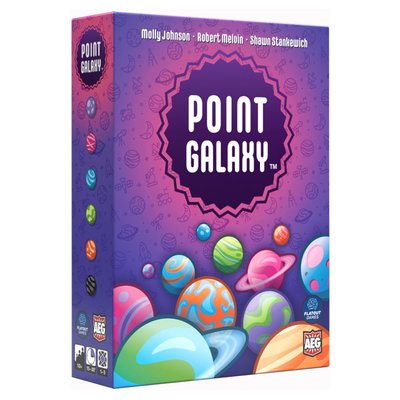
Yeah, cuz if they have five of those cards, that's now worth five. That's really hard to win a trick with a five cost card. So, this surprisingly works well at two players. I was surprised just how well this works at two players because you're really playing that, you know, I get points for every one of your orange. I dare you to try and win an orange. And that it's it's great. It's a really interesting game. And it only plays three rounds, so super super quick. But this game, huge surprise to me. I really like it and super cute. We are longtime fans of the game Point Salad. I think it's just a super super smart game. Great to play with new players. And so we're excited to see the sequel Point Galaxy even though we did skip Point City. I still haven't played it and I really want to. But let's talk about point galaxy because this is an interesting twist on that same core mechanic as point salad. So what's going to happen is you got a row of cards that are kind of sort of scoring cards, but these represent suns that you're going to put out. Then you got a bunch of planets for each one of those solar systems. You're going to put those underneath. On your turn, you are going to draft two cards. They can be either suns or planets, whatever combination you want. You're going to put the planets under the suns. You got to put them in numerical order. Either from 1 to 7 or 8 or whatever it is, or you have to go from seven, let's say, down to one. And then at the end of the game, you're going to score based on a bunch of different stuff. You're going to score based on how many numbers you got in a row. You're going to score on each one of those different sun points.
You're going to score on these rocket little tokens that you get every time you get five rocket ships. You're going to score on these collections of science symbols. You're also going to score for moons that you've managed to get planets above and below. There's a lot going on in this game, but it's basically kind of sort of point salad like ramped up to 50.
Yeah, definitely ramped up. There is a lot more you're thinking about for the decisions that you're making. Even just taking a planet card, there are a lot of things you're thinking about. You're thinking about the planet color for scoring with the sun. You might be thinking about the planet color for scoring with a moon. You're going to be thinking about the planet number because it has to be going like in sequential order. There's also potentially going to be rocket ship symbols or a research symbol. So all of that you're thinking about for even just a planet card. And then there's even like more types of cards as well.
Yeah. So there are asteroids you tuck underneath. Suns. Whoever has the most asteroids is going to get points. There are those moons we talked about. Those are only going to score if you get the right cards that it's asking for above and below it. There are these wormhole cards that can reset your planets, which is very handy. And yeah, there's just it's pretty simple cuz it still is pick two cards, put those two cards in front of you, but this just gives you a lot more little variables to think about.
Yeah. And I like that there are a lot of different variables cuz I don't think there's a specific way that you need to play because if you're able to get all seven planets in a solar system, it's incremental scoring. So that's going to get you 12 points. So that's really valuable. But if you're putting so many in one solar system, you may not have as many sun cards out and those are scoring cards. So instead, you may be able to get a lot of points by having a lot of suns that are scoring really well for fewer planets.
And 12 points is really good, but it also isn't like going to destroy. It's not the definite way to win because seven of those science symbols also is going to get you 12 points. Most of those moons are going to get you three points. So that's just completing four different moons. So there's a lot of different ways to get those points. And I really do like that that it feels different. You also use kind of a different chunk of the deck each time. You only use so many cards. And that is really going to change things too. What those suns are doing, how many of those different special cards you got mixed in there. You don't know what you're going to have at the start of the game. And I like the theme better in this. I just space is more interesting than vegetables to me.
Yeah. Yeah. And well, the other key difference that I like as well is that the scoring is specific to that solar system, whereas for point salad, you're scoring all of your vegetables. And so I like that this is a little bit more focused, but I also like that you're not stuck. Like you can freely start a new solar system without a sun or you could start just put a sun and then add to it later. So, I think that gives a lot of flexibility, whereas I was a bit worried that having this sequential planet system might be too restrictive. I never found a turn where I couldn't find like something that was useful.
Yeah. Yeah. Yeah. You can It's just more or less useful, but you can always play something. Although, I do like in point Salad how some of those cards have the negatives that you can't really avoid. So, then you got to worry like carrots are minus two, but then they're plus three if I've got a carrot and a tomato. But, the so this one doesn't necessarily have that. I don't know if it's lost and I like that it's doing its own thing, but I do think it is definitely worth having both games.
Yeah, I would probably play Point Salad with new gamers, but I think Point Galaxy is the more interesting game.
So, we already mentioned Charming Games Collective, but I've actually got two of those that I want to talk about, and the first one was charming, but this one is so charming. So, this is Cappy Bara Crush. And what you're doing is you got you're trying to make a whole row of cappy bears. Those cappy bears are trying to save their cute little friends from a flood that is happening. And they're saving them by piling them up on their heads. And what you're doing in the game is you're putting a row of cappy bears. Then you're putting a row of capy bear friends on top of their heads. You want the ones on their heads to form a row. They can go up one or down one, but they've got to basically form a row. They also are going to have backgrounds of different kinds of things. They got beaches and forests and uh something cherry blossoms and so you want those to match as well. So you got a bunch of different matching things going on. You've also got stars. Those go on the capy bear's tummies which is super adorable. And you can spend those to get super powers and then when you put new capy bears you can get those stars back and kind of recharge and be able to use those powers again. So it's really just about all that different set collection mixed in. But it's really really about adorable capabas and putting stuff on their heads.
Yeah, it it is super super cute because you're not only rescuing like these critters, but also a fruit is one of them.
It's like five animals and a fruit,
which which I really like. And everyone also has like their secret one that you get more points for. So you obviously want the Cappy Bear to always have that one and you don't want your opponents to be able to like match up their lines. So, it's quite simple, but it's a more strategic than I expected. And I think just because you have those stars that you can use that give you special powers. And those are quite variable cuz I think there's like 12 total different star cards, three for each of the sections. And they'll cost between like one and three stars for their powers. But that does let you like rearrange or draw new cards. So, you don't you shouldn't feel like too stuck because you get those stars to spend. And anytime you add a capabra, you get a star back and you're going to have like eight at the end. So, you'll be able to get those spent stars back again.
Yeah. And it it is interesting as well because when you're drafting those cards, you're thinking about friends that I want to put on my Cappy Bear's head, but you also need the Cappy Bears. And the Cappy Bear is in the back of any card. And that's where kind of the I wouldn't quite I don't think anything's hateful in this game, but whatever the Capabra equivalent to hate drafting is really comes in where you're looking at what are the special friends that my that my opponents want to get and obviously I'm going to take one of those. This is perfect for you. That's going to be one I turn into a cap capiara because it doesn't matter which card I take. So, that is really where you get to mess with people and then obviously you're looking for your own that are going to match that little line. But, I like I like all of those different powers and how you can mix and match that. And I just I love the style of this. The little Capy Bara scorer tokens as well. It's unnecessary and so cute.
Yeah, the score tokens are probably my favorite part. They're very adorable and I think it does have a little bit of like the calico type part to a game where you just can't get it perfect. you're going to really want to make sure that you can draw a line through like every critter, the backgrounds all match, and you you're doing it like perfectly. You won't be able to. So, you do have to prioritize. But, it is nice that so many different things score that you're like, "Okay, well, I can't get two of these animals to match, but at least this is like another background at a place when I really need it."
And there is also uh like another kind of slight level of complexity that you can add to it as well. So, usually we play with the special friends that you need to get face up, but you can play that with a secret and play that face down. You can also change the scoring. So, instead of it being just the simple like a row of five, you score your largest row of each thing. So, a row of five cost worth five points. But if you use the incremental scoring, that row of five is now worth seven points and a row of seven is worth 12 points. Or that is almost certainly not the actual math. But whatever that is, it changes things just a little bit without adding too much extra complexity. So you can add that, but we actually find it's fine at the normal version.
Yeah. And so this is like a pretty like simple game, but it is adorable. And I love these great little boxes that these games come in. And this is one that could be taught like very easily and like bring in new gamers.
Probably the prettiest game that we're going to be talking about is Fetching Feathers. And these cards are beautiful. And this is a draft and pass game. And so you're going to start each round with a handful of cards. You're going to have a mix usually of a couple of food cards and a bunch of bird cards. You're going to pick one of those. You're going to pass. You're going to keep on doing that until all the cards have gone around and you've got a bunch of cards in your hand. Then you're going to play those cards down. So you're going to play down those food cards and then you can put a flock of birds on either side of each of those food cards. You can have two different birds attached to each food card. On those birds, you got a bunch of different things. First of all, you have got how many can be in their flock. Then you've also got points that they're going to score. You've got a type of food that they want. And you've got some special bonus if you make that thing work. A few of the little kind of tricks in this game. One of the big things is with those food cards, before each round, you are going to flip another card. That's going to decide if you're using the blue food or the yellow food.
And that might mean you have to twist all of those food guards around. So that's one of the things you got to think about. Then the other interesting thing is at the end of each round, once you've tried once everyone's tried to put out their birds, if someone does not have a home for all of their birds, those birds are going to fly to their neighbor. If their neighbor can place those birds, they get them. Obviously, that is not what you want to happen.
No, you really don't want to that to happen. But it's a tricky balance because often the higher scoring value bird cards, you can only have like one of them. And so if you have a couple of those, that's a lot of space that they're taking up. Meaning if you end up with just a whole bunch of different kinds of birds, it's going to be harder to place them out. Particularly if any of them need two food or score better with two food because then you're having to like stack your food and give fewer habitats. So, it's a it's an interesting balance of wanting to make sure you're scoring the most points for your birds, but being mindful of how much space you have and wanting to collect the the groups of birds who can all score together, but also trying to get their bonus. And their bonus might be like being in the same habitat with like a different type of bird. That bird might need different types of food. So, there's a lot of different things you're considering.
Yeah, there's a ton of different things. But I really like that idea of if I can't place it, like I want to make you take a card I know you can't place. I really want to pass back and forth so you end up with that card and I want to have a home for that. And I love that the you can't put this anywhere. You know what? I can home it for you. No problem. And to be able to do that. I think that is such an interesting twist on drafting. I also like that these birds wear hats. And I love that they have been doing a thing at conventions where if you are are playing this game, you actually put on these different hats as you play the game. I think that's really cute. But it is really cute the bird art and how they all have those different hats on.
Yeah. And I think it actually works mechanically too because I'm not a big bird person. So just being able to quickly distinguish the birds at a glance, it helps that they have these different hats that are like slightly different personalities for each of the birds, it makes the symbology like clearer as well as just being really nice looking. Um, and but another thing that's interesting is is when you switch that habitat card because you may have the perfect plan and everything works out for all of your birds, but then all of a sudden it goes from being like a desert to water. everything switches and you're going to have to group your birds incredibly differently. Your food may not work out. So, it's an interesting balance where you want it to always work, but you have to kind of just plan for the current situation.
Yeah. And all three rounds may end up with the same. You may you may be just fine, but you probably aren't going to be. And if one of those rounds changes, Yeah. it really does change things on you. So yeah, it's not it's just it's a really nice simple draft and pass game, but it just has those those few little twists that I think just make it a little bit more interesting. And that is it. That is a bunch of card games. And really, what is better for a summer night than having a card game? I love it. So if you have any other card game suggestions, please let us know in the comments. Thank you so much for watching and as usual, please like, subscribe, and hopefully we'll see you next time for another game.