Top Card Game Collection: Volume 3
Games in This Video
4 games are featured in this video — they unlock as you watch.


Transcript
Over a year ago, I started a video series called My Cool Card Game Collection. Basically, it was a series of videos where I talked about five really cool card games that never leave my collection because they're just ones that I love playing so much. I did volume 1, volume two, and now over 12 months later, I finally have started on volume 3, and I hope to bring you more because there are some really, really great card games out there, and I really want to share with you some of my favorite ones. So, without further ado, hi, my name is Danny. I'm an avid modern board gamer from Australia. Love sharing my passion for this hobby with you, my friends, and my family. Come and join me for this journey, and don't forget to subscribe for more wholesome board game content.
Now, there are hundreds of trick- taking games out there and um Japan is full of different v variations and varieties on the trick taking mechanic, but this one stands out above the crowd mainly because it has a very party-like atmosphere. It's one that you can play with a big group of people, a big group of friends, and there's enough variation in the base game, as well as all the different add-ons you can add into the game or infuse into the game to bring it to a more advanced level if you're playing with more advanced players. The game is called Skull King. And in Skull King, what you'll be doing is there are four different suits. And the black suit actually is the trump suit. And so if you don't not really familiar with a trick taking game, what will happen is the lead player will play a card or a suit or a card with the suit obviously and the other players must follow that particular suit. So if they play a yellow card, the other players must play a yellow card from their hand and follow suit. And whoever has the highest numbered yellow card, if everyone plays a yellow card, that person wins the trick. If you don't have a yellow card, you can actually just play off suit um and put a card out there and uh it kind of is usually given away unless it is the black suit because if you play black suit that becomes the trump suit in this game. So what's interesting about in this game is the scoring and it's quite unique. Uh basically at the beginning of each round each player will be making a bid and it's basically a guess of how many tricks you're going to win. If you
say in round one bid one, it means you're going to win the trick, the only trick in that round. And basically what you'll do is you'll win uh 20 points per trick that you win if you win exactly the same number as the bid that you put at the beginning of the round. So if at round five I say I'm going to win three tricks and I win three tricks, I'll get three times 20 points. So it'll be 60 points. Alternatively, if you are off um your guess by one, two, or three, you'll lose 10 points per number that you are off your bid, the bid that you made that round. And then also, if you um bid zero and you actually win none of the tricks that round, you will get 10 points times the number of that round. So if it's round 10 and you win zero of the 10 tricks, you'll get 100 points. So in a way, this scoring mechanic has an interesting catch up mechanism that as you get further and further into the game, there is always a chance that you can win. Now, the interplay action of cards, there's particular cards with special abilities that really reshape the landscape of the game. There are some ship cards that have like a little escape icon on them. And basically uh you can throw that escape card into the mix which allows you to lose all the cards and lose that trick automatically.
So there's no way you're going to be winning that trick. There are also red suited pirate cards which allow you to um beat all of the other suits except for the skull king card. So if you play a pirate then you basically trump everybody else who's played uh the other cards. And if someone else plays a second pirate, then it means that um the person who played the first pirate takes priority. And then you've got the blue mermaid cards, which basically uh lose to all the pirates, but trumps the skull king. And then you've also got the skull king card, which trumps everything except for the mermaid cards. So, you can see how the nuanced interaction of the cards and the tricks that you can play across the game are really going to bounce and make the outcome of your tricks quite tricky to predict, but also hilariously fun. The next game is one that is quite simple in its nature of learning how to play, but the complexity and the layering of the game uh really taps into that completionist in you where you struggle so hard to try and create the perfect nine 3x3 combo grid that it's it's a feeling that you that keeps bringing you back to the game.
You're like, "Ooh, I just want to synergize better next time. Ooh, I really want to see if I can make the be perfect like grid." Um, and the game I'm talking about is Castle Combo. And Castle Combo features two decks of cards. And there is a figure that alternates between the two decks of cards, which opens up your options for what cards you're going to be drafting and placing in your tableau. And you have to buy a card every single turn, and eventually you'll create a 3x3 grid. But what's interesting about this game is that each card has icons on it. It's got a little scoring ability and it's all about the placement of the cards and those abilities with respect to each of the other eight cards in your grid. And so there are certain cards that will force the movement of the little uh wooden token uh that alternates up and down these two different sets of cards.
So there might be a card at the top, but you know, someone plays a card and moves the token down, it might make it harder for you to get those cards that you want. You also have to place the cards adjacent to each other as you're building your 3x3 tableau. But it's really the synergistic effect of each of the cards and how they help you to score and acquire money and keys that are going to really matter in this game. And you can spend a key to move the little figure to the other row or clear some of the market. But ultimately, it's about the synergy of the icons, the synergy of your placement of your cards. uh there might be, you know, scoring per column of a particular blue icon, for example, or you want particular types of cards in the top row or bottom row. And so the layering of the scoring of each card is important because the position of each card is important with respect to helping the other cards to help you score. And so it's not just going, okay, I'm going to place this card here and that card here. You're trying to overlap everything so that this blue icon can score for this card on the right and this card is in this column so that you can score that top cover. Then this card in this column is going to help you score for something else in that row or that area. And so the interplay of the duality of the two dual markets as well as the two different types of currencies really adds a huge interesting dynamic to game as well as the monumental amount
of diversity in the different types of cards that you find in the game box. So if you haven't tried Castle Combo, definitely recommend it. The next game has um a theme that's really really I'm passionate about. And you can see behind me, I've got this fish tank full of uh freshwater minnows. But this next game is got a fishlike theme to it, but I guess the thematic depth of this game stops at making the same types or schools of fish as cards in front of you. The rest of it, however, has some nice deep frills or gills to the actual gameplay. The game I'm talking about is Sea Scroll. And in Sea Scroll, you basically have different species of fish cards with numbers on them and the numbers tell you how many copies of that fish are in the deck potentially with some removed per game. Uh very much like flip seven where you have uh the number indicating the copies of that card. But here, what you'll do is you'll draw two cards and then there is a reef where the players have collectively been building several schools of fish um species at a time progressively throughout the game.
And you'll have to make a decision to claim the entire school of one species of fish that's currently in the reef or kind of decide, okay, I'm not going to claim anything this round. I'm then going to have to play a card. And so across the game, you'll only be able to claim a school of fish three times. And then once you've done that, you'll be kind of locked out of being able to claim more schools of fish. So why is that interesting? Because this game scores at the end based on who has the most copies of that species. So if it is the royal tang, whoever has the most copies of the royal tang is going to score that particular fish equal to the value of that fish. So if the value is four, then that player is going to get four points. However, if any other player also has a royal tang or has claimed a school of royal tang, they're going to lose points. So, it's got this kind of area dominance uh scoring mechanism at the end of the game where it's like, well, if I take this car, this school of fish really early on, I know it might lock other players out and other players may be forced to take the remainder of those cards across the game, meaning that they'll lose points.
So, it's almost like a little game of chicken whilst with fish. But, it's that sense of like timing it correctly. It it really reminds me of a game called Herbaceious where you're placing a herb in the central area that everyone can access or and then also playing your second card into your private garden and you're trying to pot the different types of herbs. This has that similar level of tension that two and fro of like, okay, I'm going to add another card to the middle school of, you know, betters or whatever. And then I'm going to decide my next turn to take them. But then someone else might snatch that school of fish that you've had your eye on and it's like, "Oh my gosh, why?" And so it has that kind of level of timing everything correctly. Which of the species or schools of fish are you going to help build up and which one are you going to hold back in your hand? It's got a lot of nuance layers to it which I really enjoy in a card game. The next game is a game that I kind of featured in one of my other volume collection videos before, but um it's a this probably came out before that other game and the game is called um Jungo. Uh this game has a bird theme whereas Jungo has kind of like a monkey theme, but essentially the games are very uh similar. And it's a game where you are basically trying to shed your hand. And this game is called Nanatory Dory, which
basically has um cards that go from one to seven. You're going to be dealing a hand of eight cards out, and each person's going to hold their hand of cards, and you cannot alter the position or the order of the cards that you've got. And what you're trying to do is, if you ever play games like Big Two, you're basically trying to play cards that will beat whatever's out there. So if I play first player plays a one, second player plays a seven, then I can play, you know, double twos and the next player can play double fives and someone might play triple sixes. Anyway, whenever you play something out, whatever card or thing is out on the central area, you've got to actually decide, are you going to discard it or add it somewhere in your hand? And so, you know, someone plays a one and you think, oo, I've already got two pairs of ones next to each other.
that will slide in next to the pair of ones to make a trio of ones. And so that makes that little part of my hand a lot stronger and easier to get rid of as the game progresses. And so the aim of the game is basically to shed your hand as quickly as possible. And so in this game, um if everyone if you can't play a a thing that trumps whatever it is out on the field, you say pass. everyone passes and the next player or the player that played last continues and starts it all over again. And one of the big differences that this version of the game has in comparison to Jungo is uh in Jungo I think you're allowed to draw a card from the deck when you pass and then if it has something that you can play you can invoke the law of the jungle and play it whereas in this game if you pass you take a card put it in your hand and then the play continues on. Jungo also has um some dual cards which have two values on it and I think the value of the cards there go to eight. The end game in Nantorii is a little bit different too. So in Nantorii, everyone has two penguins and basically players lose penguins if they're the last to shed their hands each round. and whichever player loses both penguins first is actually out of the game and the other players win, which maybe isn't as satisfying as Jungo. Um, but it's more homage to the original rules. The game rules does
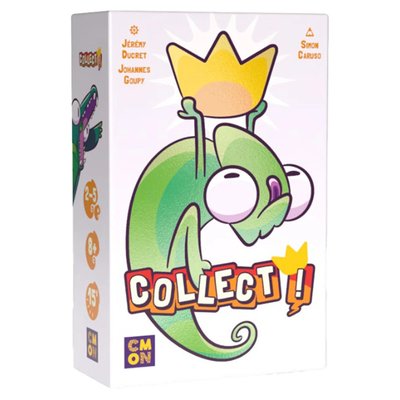
include a two-player variants as well as a one winner variant which uses point scoring which actually uses the side of the box. So, this uh KTBG version has this little scoring track on the edge of the um box that you can use to race the penguins against each other, which are not in the uh Jungo version of the game. So, I think the reason why I think this is a cool game is not only is it a homage to the original, but also I just really love the bird flavored theme. The final game that I want to talk about is one that comes in a small tiny box that has this crafty chameleon on the cover which is kind of holding a golden crown cuz in this game you are trying to collect two halves to make a full golden crown in order to be crowned the winner. The game is called Collect and it's a really ingeniously simple smallbox game that has the similar sort of kind of level of strategy as Sea Salt and Paper if you've ever played that game. If you haven't, check out one of my my volume one video.
I think it might be in. That is a game I 100% recommend. But in collect, what you'll be doing is there'll be two piles of cards. You'll be choosing one of the piles to reveal the top card from and you'll be showing it to the group. And then you'll have a very simple decision. Place that card on top of either pile or keep that card. And then what you'll do with that card is each player is creating a row or a panorama of animals or creatures in front of them. And so you'll be placing your acquired card either to the far left or to the far right. And in order to claim half a crown, you need to have four identical animals adjacent to each other and that will trigger the end of the round and a new one will begin. So that is basically it. Create four in a row in front of you and do it twice and you win. You might think, well, where is the depth? Where is the strategy in that? as well.
Revealing an animal card and putting it face down means that the next player will have knowledge of where that card is and what creature ability it will have that might help them. If you then draw or keep that card, you then have control of that ability. If you risk and want to fish for something else, there's a chance that you'll get a card that will work in your favor. So, there are different types of creature abilities that happen. So, if you've got the crocodile, you'll be able to choose a card from any players row around the table and put it at the bottom of either of the two decks. So, you can kind of dismantle another player's adjacent or I guess gathering of animals. With a crab, you can choose uh any players row or including your own and move any card to the left or the right, any number of spaces. So, it gives you a chance to reposition the order of your cards that are in front of you. If there is a I guess a card that's kind of wedged between two pairs, using the crab is going to be able to pick that up and then put those two pairs together to help you win. You've got the monkey where you get to swap this card with any card from any players row. So if you see someone who's got a group of three, you can use the monkey and swap it. Or if there's a card that you need to create a three or a four, the monkey is the way to go. Hermit crab allows you to take another turn if you've got another hermit crab or chameleon in your row.
The lion actually gives you an alternative win condition. If you've got seven different creatures already in front of you, you also get a half crown as well. Then you've got an octopus, which also has another or third alternate win condition where if you've got three pairs of the same animal but across, you know, can be across different creatures. And you've got the octopus that will also trigger an auto win. And you got the parrot, which allows you to, I guess, predict what you think the next animal will be on the deck and announce it. And if it is, you get to then apply the animals ability. And so all of the combination of these animals as well as the strategy of being able to keep the card or putting it back down and thinking about and observing what other players are doing creates an interesting table dynamic where the information that you can see, the information where why would someone, you know, return, you know, that crocodile card or that lion card, how are they going to be planning their way to collect the cards that they need? So, very brilliant game. Doesn't take up a lot of space on your shelf. Definitely recommend. So, it turns out I totally forgot to film an outro for my video.
So, here it is. Um, so if you found this video super helpful, please consider liking and subscribing to my channel. Yes, that's my baby's bedroom back then. Yes, that is the baby you can hear in the background. Uh, if you really want to see more amazing, wholesome board game content, uh, consider liking, subscribing to my channel, and please head over to my Patreon page if you want to buy me a coffee a month and help the channel grow. This is Danny signing out. Hope your next board game experience is a cool one. See you soon.