Beyond Solitaire Podcast 01: Chris Dobbs Talks Ancient Board Games
Games in This Video
3 games are featured in this video — they unlock as you watch.


Transcript
hey gamers this is Liz Davidson from beyond solitaire and I am here with the first ever episode of my podcast beyond the board it is gonna be a podcast about history and culture behind board games and I have an absolutely fabulous first guest dr. Chris Dobbs who wrote his dissertation on ancient board games what is Chris hey hey thank you so much for coming on do you want to tell us first really quick about the academic work that you do absolutely I work at the University of Missouri I'm in the learning center and I work as a tutoring coordinator so I hire I train and I manage a large team of tutors who help their peers with whatever their academic needs are but then I also get to work with students directly help connect them to different resources and make sure that they have all of the support that they need to be successful and then on the side I teach for the Honors College all sorts of different courses about the ancient world board games leisure fun Latin literature anything that I think students will really enjoy I actually just get to design my own courses and they have filled up every semester which makes me really excited and then I also do some research on the side because I'm at a university and have access to one of the great academic libraries available so what is the most exciting class you've taught so far the
most exciting class for me has been my course board games in the ancient world we start off in ancient Egypt look at some games move to Greece and then we end in Rome and depending on what my students want to do sometimes we move to sub-saharan Africa just very briefly we always explore what though the games played in each culture mean to that culture and to our own lives so the Egyptians had strong religious associations with boardgames and when i introduced that idea about Mahan or sunette often students look at me with a little smile or like they're really puzzled and say well how could anybody think that there could be spirituality from a board game and then I hit them with the Ouija board and suddenly all the sort of drop and their mouths open they say oh my goodness we do the same thing we have this thing that was invented as a game and we then started to ascribe religious significance to it a sort of spiritual power and as soon as students realize wow you know what we do this thing that I first thought was sort of weird then everybody realizes we're not so different right there's a real continuity of humanity and the human condition and games serve as a lens for
us to understand exactly what those continuities are so what is the spiritual significance of Senet I did not know that it had religious implications I've just seen images of ancient Egyptians playing it sure so so I understand that we sort of have to shift one game earlier chronologically to mahem which starts off so it's in the shape of sort of a coiled serpent and players move their pieces at least as far as we understand from the outside towards the inside where the snake's head is and then back around and so this symbolizes escaping from a hen who starts off as an evil deity in the Egyptian Pantheon and if you escape from this evil deity who's trying to destroy raw right in the afterlife then you have symbolically achieved immortality the sort of life after death and then the game starts to lose popularity because mahem for being an evil god to a good god because everybody really likes this game but then to carve one of those boards you have to get squares carved onto that coiled serpent which means you're cutting up Oh God and so to carve out a deity is blasphemy so people stop playing that game and that's where sunette this 3 by 10 grid really starts to take off in
popularity almost as a replacement and that board we can see from different tomb paintings and from different texts in the Pyramid Texts or the Book of the Dead different descriptions we should say of how the game board serves as a conduit between the living realm and the spirit world so that's a way that we can actually talk to deceased loved ones they can channel their spirit through the sunette board almost in the same way that we talked about Ouija boards in modern culture so you can have both a competitive game and an otherworldly experience all in one convenient gaming package absolutely one-stop shopping fantastic and what kind of games did the Greeks and Romans play of course you know I'm a classicist so yeah absolutely the Greeks and Romans played all sorts of different games including a really fun version of tic-tac-toe that dates back thousands and thousands of years we find it in Egypt we find in Greece we find it in Rome we find it still to the modern day this Merrill's game where after the pieces go down they then get to move around the board often this is a
9 by 9 grid instead of a 3 by 3 grid and it's one of the most common games in world history so it's called Merrill's or more Recio and you'll hear about nine men's Morris and that's the iconic 9 P subversion and what I really like about it is that once the pieces go down we think it's just like tic-tac-toe but then when they start to move it has this whole extra dimension to it instead of just getting three in a row when get three in a row you get to take one of your opponent's pieces off the board so now it's nine pieces versus eight that 9 versus 7 then 8 versus seven and back and forth and the battle keeps going they also had different dice games or games using knucklebones which are four sided randomizing agents taken from the ankle or the tallest of originally sheep but also other animals and the Romans in particular had a really great game called awliya and it's precursor duo deck and scripta where it's set up with 36 spaces typically six words of six letters each put in a three by twelve grid and these words form fun little messages so we can have just circles or squares or anything else to mark the playing surface and show where
the pieces go but I love the boards that use letters instead because they form really funny messages so often we'll see attestations of power something that says oh the Empire is so strong and the enemies have been beaten so let the Romans play on without fear there's even one that's a menu that's been found outside of a tavern that just says we have for dinner chicken and fish and ham and peacock oh yeah so it's kind of like the equivalent of the peg game at Cracker Barrel except that it also has a utilitarian purpose yes exactly so anyone who's walking by who is sort of initiated into the gaming circle they know they can say oh wow that's not just a menu that's also a gaming table and I know that I can get my gambling game on in there and they'll have a lot of fun with it and what I really think is neat about that game is how mean some of these boards are you typically don't want your game board to be mean to you but some messages in clewd things like if you win then you get to celebrate but you you don't know how to play so you lose and you cry and it's not enough that you're losing the board game against your friend but then when you look down and not the board game but the game board itself is
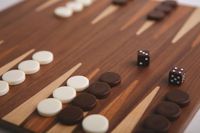
calling you a crybaby it just adds this extra dimension of fun to everything about this game that sounds delightful and you also mentioned that do a deck of scripta has an element of gambling to it but gambling was not considered socially accessible or illegal at various points in the Roman Empire so how did this game continue to be so popular that was all the restaurant menu in such a hostile climate sure so games that involve dice have a chance element right of course because throwing dice that is a an actual role of chance a roll of the dice quite literally and all of those games were assumed to have gambling obviously we know that we can play poker or backgammon without gambling on it and yet any backgammon set you buy has that doubling cube in it which is specifically for betting and unsurprisingly backgammon is a descendant of duo Deccan scripta so even in its very origins all the way through to the modern day we assume that gambling is part and parcel of the game so it had to be played in secret it had to be played inside the Roman Forum has a couple hundred different board games edged into the pavement on temple steps in the middle of roads and these are a
couple hundred boards that are still visible to the modern day but what's fascinating is absolutely none of them or do a Tekken scripta we find those in taverns we find those in houses we find those in some of the provinces for instance in tim gad we find one by a colonnade in the forum but in Rome proper these are all hidden and yet we know people are playing Cicero mentions in a letter that if he's having a philosophical conversation with someone and that person wants to as it were take back a move as if they were playing do a Beckham script uh he'll let him retry what he wanted to say so we know that people are playing from these casual references and from the dozens of boards that we have found but these boards are always hidden away or are portable in some way so they can be you know sort of shoveled off to the side if the e dials are coming to bust up the party so basically you can tell people not to gamble but they are absolutely going to etch their game boards everywhere carry game boards all over the place and then just act like they weren't doing anything when you catch them absolutely my favorite example of that because he gets so angry about games he says oh I can't believe that people would play games oh these terrible people they're so Slaven ly and
lazy he goes on and on and many of his works especially about how people waste their whole lives playing games and then when we look at his private correspondence sure enough he's playing games because he talks about it but he has his very public display of virtue what he knows will be circulated immediately where he says no no no games are bad and then he has his private life that is delicious but we also know that not all games of this time period were games of chance right we have sort of a relative of chess that is an ancient Roman game as well yes ludis Letran coulis or ludus ladronka lorem which translates to the game of little soldiers or the game of little robbers depending on how you want to translate that last word it looks a lot like chess or checkers but we should note that there's no actual connection between them that's been proven but it's really difficult to find a good way to explain the game because it's two players facing off against each other on a board that's usually eight by eight squares so for all intents and purposes it looks just like chess and you'll see lots of translators actually use chess as the word to describe this game and yet as far as we can tell it has no direct
relationship with chess or any similar games of that family but here we see it mentioned in for instance a bit of praise poetry from the first century CE II the Lao spice Onis where it's mentioned that he's so good at this game that everybody comes rushing over to watch they're playing their games and he's great at playing ball games out in the middle of the forum every abandons their own games to go watch Paizo play and then he starts playing board games as a way to relax his mind from all the weight of his studies and from being such a good leader in the Roman world he finds his opponents he captures their pieces and his whole hand starts to rattle because as he captures the pieces he keeps them in his hand and he shakes it and you can hear this rattling because he has so many of his opponent's pieces captured in his hand that is hilarious and also I think a really interesting indication of games being problematic for your character in some context but in others an indication that you're very skilled and smart but perhaps also relatable yes so to use Cicero as another example or I guess as an example once again in the day or at or a in book three he actually says that when day laborers are kept from their
jobs because of the weather so they can't go out and work then they just waste their time and one of the ways that they waste their time is on playing these games they will play ball games or knucklebones or they'll invent a new game just to waste the time and then almost in the same breath he talks about aristocrats who have been cut off from their work because the times are so dangerous that nobody wants to work in politics there have been assassinations and and civil wars and uprisings this is around the same time that Cataline has his infamous conspiracy but when aristocrats are kept from their work according to Cicero then they devote themselves to wholesome intellectual virtuous things including music and philosophy and literature and sure enough inventing new games but when it's the aristocrats games he says that they specifically turn young people's minds towards virtue so if you're on the in-crowd then games are great and you can invent games that make you a better person but if you're not on the in-crowd if you're on the outs with Cicero then when you invent new games you're simply wasting your time so the idea of novelty is also an interesting thing to discuss particularly in the context of ancient Rome and Greece partially because Romans don't like new things typically and also because Plato has some comments about
commitment to try to true games versus constantly looking for different entertainments if I recall correctly yes absolutely in the laws he mentions that people legislate the same way that they played as children so anyone who has constancy in their games as children they play the same games in the same ways meaning with the same rule sets in my interpretation then they legislate and they govern with constancy but anyone who had too many new games too much novelty who always wanted to try a new tactic or a new rule then they change laws just for the sake of changing them which leads to the detriment of civilization it always reminds me of the German philosopher Hegel who said that all progress is good but not all change is progress and that's exactly what we see in play-doh discussing how people legislate whether they might change the laws simply for the sake of changing them rather than leaving well enough alone if you have a strong constitution already ooh that is really interesting it's also seeing that you mentioned theorizing that plato was referring to playing by the same rules because how do we even know that people in the ancient world were playing by the same rules from place to place much less over time do we have any written rules for any of these
games I am large no we have just simple side references here a small allusion there in the literary record we don't have any actual rule sets written down so everything that we know is put together sort of piecemeal from different texts different bits of archaeological evidence especially when we find boards and pieces and also from paintings or when we have them base paintings can show us okay there's one person on one side of the board another person on the other it seems to be a one player versus one player game as long as we can link what we see in the picture with the archaeological evidence and with the literary record often that's not possible and there is almost certainly regional variation hence why we see certain evolutions in game boards especially do it a conscript and alia moving from three rows to two rows in the archaeological record we find different numbers of dice different numbers of knuckle bones especially in burials and although we can't prove it we would love for someone to have a complete set that is probably unlikely especially with all of the hazards that go into unearthing a tomb that's 2000 or
2500 years old we can never be completely sure but we do the best that we can and ultimately even if we can't ricans every game to being perfectly playable what we can do is show the literary and especially the social significance of those games on the cultures in which they're played so I have a question you mentioned looking at a vase and seeing one player versus one player and deducing it's a two-player game are there any games from the ancient world that aren't two-player games other than athletic games when we look at ancient India we seem to have four player games it is also possible that a version of Mahan in Egypt was a four player game we have nothing to my knowledge that really resemble a solitaire or a one player game certainly it would be possible for someone to sit down and really think okay if my opponent does this I can do that in the same way that chess players will play both sides of the board in practice but in an actual game sort of to completion it really seems to have that antagonistic competitive streak that we find so prevalent in the ancient world yeah and I thought it was interesting that so many of the games do seem to lend themselves to one versus one play it's very to me it seems very much like it's about one person
competing against another and having an intense rivalry instead of like a game might where four people get together and play something and there's a winner yeah exactly these games all seem to be really trying to deduce a single victor as opposed to everyone getting together and just playing for fun where it doesn't really matter who wins I think it's really great when friends can get together and just have a good time while they happen to be playing a board game but in the ancient world it really seems to be if you're playing a game you are playing to win oh so I have a modern-day question I know that you are a skilled chess player but is that the full extent of your interest in modern board games what do you play in so I love to play modern games and yeah as you mentioned chess-player I did the sort of competitive circuit as much as I could later in life it became more difficult especially to travel around to all of the different tournaments but it was never a profession for me so for the chess players in the audience I'm a Class B player so if you bring in a thousand random people off the street I'll beat a thousand of them but if you put me in a tournament with actual good players I'll lose every time which is a really weird way to describe it as I've spent thousands of hours honing my craft and yet I in fact have met 10 year olds
who are way better than I'll ever be but that's sort of the nature of chess Suthers of Catan is is a personal favorite and in high school in college I really adored playing a risk with run didn't you I did I find risk and Catan and monopoly and sort of that whole suite of games really fun so I have a question for you as a person who spends his time studying what ancient people's games say about them what do you think that our games say about us I'll actually just use those same games as an example since they're sort of iconic games that if not everybody has played certainly everyone has heard of them so absolutely so ostensibly Catan is about gathering resources right making sure that you have enough wood or sheep risk is ostensibly about power and domination and monopoly on the surface is just inherent capitalism and gathering wealth to the detriment of others but when we dig a little bit deeper all three of those games actually appeal to work or humanity all of them are about security they're about having enough to protect ourselves through the vicissitudes of fortune they're about making sure we can protect our loved ones
making sure that we have enough wealth to weather a storm in monopoly that would be landing on someone else's property with a hotel on it you want to make sure that if bad financial luck comes your way you will be secure in Catan you want to make sure that you have enough resources that you're never wanting for anything so that you can have the best life you can and in risk the whole purpose of having the army of dominating is to get more land which gives you more soldiers so that you know if someone launches an attack you are safe so all of these games although they seem to be wildly different really all just speak to the human condition and are want to be secure that is a really interesting way of looking at modern games and I'm now really curious about how that will apply to other games that I play how do you think the traditional games that we still play like chess or backgammon fit into that why do we play those do you think that they create some of those same feelings or is it about skill or is it just upholding a tradition I think it's a little bit of everything certainly we have to look at how the games developed so when we think about chess right we're not a hundred percent certain or scholars don't all agree on the history of chess but certainly it seems to be about the fourth century right India Persia we have chaturanga
that then continues to evolve we certainly have this military style game with the different pieces denoting the different branches of the army but then it changes right originally there was no queen piece there was the vice year who was the advisor to the king and was incredibly weak moved like the king but only diagonally so only one square at a time and only diagonally really a just awful piece to have on the board and then fast forward to just a couple of centuries ago women are gaining power we have such strong Queens in Europe that the piece was adapted into the Queen as we know her today with all the powers of a bishop and a rook combined we went from the worst piece to the single best piece on the board in response to societal change so we can have games that have this sort of their origin stories that still respond to contemporary needs however it is that we need them to do you think that chess still has the capacity for change and given how regimented our tournaments have become or would any evolution of the game happen in something like blitz chess and just different ways of playing so chess sort of classic chess will always be classic
chess it will always have its adherents but we will have many more variants in the future just like we have in the past the advent of bughouse where you have two players on a team but side by side on two different boards so that each team has one player playing with the white pieces and one player playing with the black pieces and then when someone captures a piece you actually give it to your teammate and that person can put it in on their own board we also have chess960 or as it's traditionally called Fischer random chess right because Bobby Fischer 11th world champion the American he really advocated for this new version of chess where the whole back row is completely randomized and that now has an official World Championship that has been going on for a few years we've seen chess boxing in just the past decade or so where you alternate playing chess and yes boxing so we'll always have different ways to use the same base for different purposes we'll see different time controls there used to be games that would last several days right and then players would go to their hotel rooms and could analyze overnight and then come back the next
morning with a game plan but with the advent of chess computers that all had to go away to make sure that everyone was on a level playing field so we'll always see evolutions will always see changes in variants that are all fun and exciting in their own ways but for chess specifically I think classic chess is certainly here to stay interesting so as an archaeologist who studies remains of board games if you could choose one of our games to survive for the next 2,500 years historians like us find it what would you choose and why let's assume that the rules are going to break down because those are made out of paper sure I would love for chess to keep going because I think chess has a lot to offer in the ways that it speaks to music and art and math and forming cognitive abilities but we can't really say that chess is one of our games since that's something that we have inherited over the past couple of millennia but I think that monopoly is an iconic game that really encapsulates everything that we are including the fact that it was sort of stolen right it started off as the landlord's game but when we dig deep into the history I saw a great talk on this it was actually modeled very closely on or in the modern day we might even say completely plagiarized a Native
American game so the family that it shows sort of this iconic imperialism the sort of colonial idea that what's yours I can take and make for my own and it encapsulates the idea of a race of competition of bordering over different pieces or different properties I think it has a lot to say about how we view interactions with one another how we compete or work together how we can operate to take down one player who seems to be doing a little bit too well and if the rule is disappear well that's kind of okay because everybody plays with different rules anyway as much as we hate to admit it the way that we all grew up playing Monopoly may not be what's in the actual rules about whether you get to take extra turns when you roll doubles do you have to go to jail if you roll doubles three times but also are you allowed to swap properties can you sell properties to one another or only to the bank if so can you do it only on your turn or can you have backroom deals during other people's turns and all these subtle variations make for a much more vibrant dynamic playing experience because you have to establish what the rules are at the
start of every single game or at least once you get into your first argument about it so if archaeologists have to have those same arguments a thousand or 2,000 years from now looking at one of our games then really they're just playing the same game we are so one more question before I let you go what is the weirdest or funniest thing that you have encountered in your research into ancient games the weirdest thing I would say is how ancient Romans describe games and sects all sort of in one breath so Ovid in his arzawa Torrio where the art of love tells women that they have to learn all sorts of different games they must learn Merrill's and dice and knuckle bones and ludus the trunk Huli to make sure that they can win a man because love is often won through playing games but then he also tells men that anytime they're playing a game with a girl they like these men need to lose on purpose throw the dice in the worst way possible if you can get the worst roll possible with the knuckle bones let her take your pieces in ludus Letran Coulee and never you know have a bad attitude about it but let her win because if she wins she's going to be in a great mood
and if she's in a great mood than your relationship can progress progress that's the perfect way to put it then why do the women have to learn how to play in the first place right it's a fun mental hurdle to overcome to think about why we have these flip sides of the coin but really Ovid is playing a game with his readers as he's telling them to play actual board games with one another that is both charming and something that I'm very glad that we no longer have to do it because I'd be really insulted if a man let me win the test of time certainly a good part of flirting over a board game is showing that you fully believe the person you're playing with can beat you absolutely well thank you for this wide-ranging conversation about archaeology politics and even some romantic advice Chris thank you so much for coming on I really appreciate your time you've been a fantastic first guest I appreciate you having me on and small disclaimer that's Ovid's advice try it at your own risk definitely it's your own risk so on the internet you can always find me pretty much anywhere at beyond solitaire on any social media but dr. Dobbs is there anywhere where people can reach you if
they have questions comments or further interest in ancient games you are free to email me my email address is Dobbs cs4 Dobbs Christopher Stephen at Missouri dot edu or if you just google Chris Dobbs Missouri I'm sure I'll be the first link there fantastic thanks again Chris and happy gaming everyone