Have Some Random Board Game Reviews
Games in This Video
8 games are featured in this video — they unlock as you watch.




Transcript
Hey everybody. Today I'm doing a bit of a catchup video and I'm going to talk about eight games that I've played recently and just to share my very brief thoughts on them. It's going to be a pretty quick video and of course some of these segments are going to be shorter than others um because a lot of these games there's not that much to say and um all in all there aren't really any big blockbusters here to really shout um shout about and to rave about. Um, but I will do my best to uh to give you an idea about why I did or did not like them. So, let's start with a Cleopatra and the Society of Architects. So, uh, this is actually an older Days of Wonder game. It was reprinted, um, a few years back in this big Kickstarter campaign, and that is the version of the game that I've played. And it's worth talking about because this game or this game's level of production is quite ludicrous in terms of um just how sprawling and how big and chunky all these pieces are.
Um you know to the point where you know the box is massive and the game is pretty lightweight. In fact, you could actually condense this down into a very simple tile placement game or like even a card game just instead of having these big chunky plastic kind of injection molded pieces. Um, but the idea of this game is fairly simple. You're just drafting cards through this quite a neat drafting system where you can take a pile of cards which will be resources or builders. Um, and when you take a stack, the other stacks will top up with other cards, meaning that the incentive will grow and grow into taking those cards. And sometimes these piles do get neglected because you will take these or they'll build up of these um cards that might have two resources on them, which is great, but they will come with a penalty if you use them through the use of these coins. At the end of the game, if you have um, you know, the more coins, the more negative points you will acrewue. But the other part of the game is you'll cash these cards in in order to build different facets of the of the palace of Cleopatra. So you can build these like sphinx, you can build these obelisks, uh the doors, the walls, and even this kind of little garden like mosaic on top of the structure. Um and they all work in very similar ways. You know, this one might take uh you know, three workers and two different colored cards. This one needs two workers and a pair of the same. So you you are doing the same thing regardless of what part you are building and they will all score
points based based on you know the probabilities of drawing these certain cards. So again it's very very spammy in a way. Just draw draw cash in draw cash in cash in cash in. You don't really have to be too meticulous about what you're doing because generally speaking whatever you draw will just work out and you might be able to build one or two things uh on your turn. Um, of course, you can be a little bit more risky and try to take and end up taking these um these negative coins with the hope of getting rid of them later. Uh, through this system where you when you add to the um the mosaic on top of the board, you can put one of your workers down. If your worker is controlling an area that's not been filled in, you can basically every square that you have, you can end up depositing your coins there to get rid of them from your personal supply and avoid taking those negative points. Uh, I didn't actually like that part of the game. I thought it was a bit too speculative of whether you am I going to get four coins rid of here? Am I going to get two? It just felt a little bit too in the air. the rest of it I found a bit too a little bit too much carefree and laxidasical in terms of you know I didn't really care what I was drawing it just seemed to work out and a very small you know minor nitpick is that you know you are constantly drawing cards um meaning that you're going to have to constantly keep topping up the the cards which became a little bit tedious and monotonous after a while so um yeah this one I think the game itself is certainly familyfriendly it's very approachable um you know some
people are going to like that structure, you know, the actual toy factor of the game, but mechanically I thought the game was pretty weak. Um, not really much to write home about and it just didn't really land for me. And I don't really like these games where you don't have to be cerebral or think about what you're doing. Just take what's obviously best and it will just seem to work out for you. And that that's what happened to me in this game. So, I can't really recommend this one. I think maybe a big part of it is the nostalgia factor. I know again when this came out years ago with the days of wonder thing, it kind of came out in that golden era of board games and maybe people are holding on to that. I think this one has kind of been lost to more modern designs. I don't think it holds up to be honest. So that is Cleopatra and the Society of Architects. I'd give that one probably a four out of 10. Uh moving on to something completely different with Noobs in Space. So, this is a completely cooperative game and it's almost like um almost like an escape room adjacent game. Um so, you are working against a clock to go through these different levels. And all of these different levels or rounds will require you and your teammates to complete certain tasks by working through these cards in order.
And all these tasks by themselves are are very easy to understand. Um but it's the it's the pressure of the time and trying to get it done quickly and working together. So for example, you might have to describe um you know whereabouts um on this little picture. This picture would fit in or um maybe you are have to go through this like little word cue system where when I see this word you got to say this word and this person says this word then we kind of go around until we get clues and things. It it's kind of hard to explain what these mini games do. Um and I don't want to kind of spoil how the game works. Um but again it's not necessarily the difficulty of the games and trying to crack the code or break the puzzle like like a escape room. You are again trying to keep a cool head and solve very simple things but quickly and efficiently without flapping or you know or losing your cool. land. I think if you are if you love the concept of these um like corruptive escape room style games, but maybe you're a bit fatigued with those styles, you want to try something a little bit different, but you still want the the kind, you know, the reason to get your friends together and play for maybe an hour, an hour and a half and go through this entire game, then this is actually a good kind of um you know, a side step to a game like that, which I I actually think was quite a nice little niche. And I haven't played a game quite like this before. And all in all, I did enjoy it. Um, I think maybe it's a little bit too sy after a few rounds, but it is nice when you get into that groove and you start clicking and you start to understand what you should do.
And it is very clever how these cards can be recycled but used for different puzzles as the game progresses. So, really well designed. Again, I think there's a good kind of good market for it maybe for older children or younger teens. Um, but yeah, if you want, well, if you're not too bothered about being too frantic or anything like that, then this is actually a nice little game to try. Um, and you know, once you've played it, you've played it, you can move it on without even destroying anything. So, it's not going to clog up your collection. So, that is Noobs in Space. I'll give that one, you know, maybe a pretty mean five out of 10, maybe a five and a half. Uh, moving on to Harvest Dice. So, this is actually an older roll and write game that I've always wanted to play, but it has been out of print for a long time. Um, and this is kind of one of the OG style roll and right games without any real bells or and whistles. Uh, certainly isn't ramped up or elevated to a lot of these newer, more modern roll and rights where things getting more complicated. This is really bare bones, stripped back and easy to play. So this one you are filling out this little grid and trying to fill in ve vegetables um by drafting these dice. So at the beginning of the round you're going to draft a big cluster of dice. You're going to take turns taking one. H and these going to have a color on them which depicts the vegetable and also of course the number which shows which column these dyes can go in. The trick is that when you plant a certain type of vegetable and there are three different types in the future you need to make sure that they are all adjacent to each other kind of orthogonally adjacent which of course as
the game develops becomes harder and harder to do and you need more specific dice values to fill in those gaps. If you can't place one in your vegetable patch then you'll kind of feed them to the pig which will give you bonuses in other ways. Um, the coolest thing about this game though is that when the the dice have all been drafted, the one die that's remaining will be used to tick off one of these little markers on on the other part of your sheet, which will increase the yield of points that those particular vegetables are worth. So, you could have a ton of carrots, but if everyone keeps drafting the carrots, then they're not going to be worth anything. You want to be making sure you're leaving some behind to boost the value of those carrots. And that is that's kind of the USP of this game. It's the best part of the game. Um but I do think it's been done better since Harvest Dice. And in particular, I am thinking of games like Vegetable Stock.
Um you know, a very simple little um stocks and shares market style game. Uh that one I think does everything that Harvest Dice does but better, more smoothly, more fun, a bit more dynamic. This one feels a little bit plotting and just a little bit too basic. I I think and don't get me wrong, I think maybe more introductory gamers, you know, maybe people playing Ro and Wright style games for the first time could enjoy this one, but I do think it has a shelf life. I think if you play 10, 20, you know, 30 roller games, you're not going to get anything new out of this one. And I think it's going to feel like a a step backwards rather than finding, you know, something that's worth playing. So, in that for that respect, I'll give this one another maybe five out of 10. Mechanically a sound game. Again, I love that. um mechanism of one thing being left behind to increase the points of something else. That's really cool and it's done well here, but it's just been done better in other games. Uh next game, maybe the the weirdest game on this um on this video. This is Monkey Palace. So, this is actually a game produced by LEGO. So, you can imagine the pieces here are very high quality.
Um, and it's an abstract strategy kind of engine building style game where you are placing these kind of little notches and bridges to try and keep kind of um piggybacking of other players efforts and building bigger and bigger um kind of columns or you know tracks of these bridges, step staircases almost um each time you take a turn and basically the higher you climb the more currency you get which will let you buy these cards. The cards will give you points, but will also increase your engine in terms of how many resources, how many bridges, how many um elevations you take at the start of your turn. So, I do like the idea of kind of this abstract puzzle mixed with this degree of engine building and card drafting. It's kind of a nice package.
Um, but I do feel like the game lacks a certain spark. It almost feels like the game was kind of engineered in reverse. Like we, you know, we want a Lego game, let's think of the rules, not we have a great game concept here. Maybe we can use Lego to make the pieces. So, in that respect, it feels a little bit a little bit soulless, a little bit clinical. Um, but you know, in spite of that, it is actually quite a fun game in terms of seeing this big structure build up, trying to get higher and higher. If you're the heist build a certain color, then you get bonuses and you can block things and things like that. But it does pretty much feel like you're going through the motions, the the openings are pretty obvious. And you know, much like the games like Cleopatra that I mentioned, it it does feel a little bit spammy in terms that you can very quickly build up a strong engine and it feels like you're flooded with resources and you don't have to be too picky or particular about what you're doing because you have so many to play with that the engine is almost too strong and I think that kind of takes away from the game a little bit. So, you know, it was fine and I would play it again without any dispute. Um, but again, it feels a little bit soulless, a little bit clinical, and maybe there was maybe a lack of passion that went into making it. So, that is Monkey Palace, and I'll probably give that that one another five out of 10.
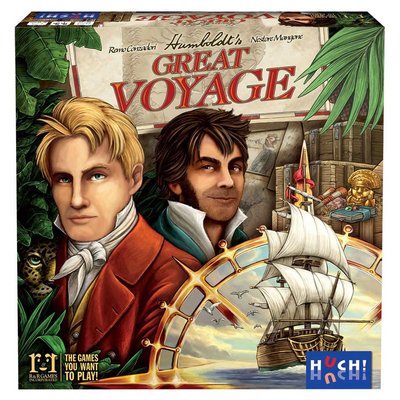
Moving on to uh Humbult's Great Voyage. So, this one kind of more Euro style borderline abstract strategy manala style game uh where you have a a big board with loads of manala dishes in them. And on your turn, you're going to be drawing a colored token out of a bag. You're going to be starting from one of these bowls and picking as Mala's fashion. You're going to pick up all of the tokens in that bowl and you're going to drop them off following these arrows as you go, trying to match the colors as you go along. For every color you match, you're going to get one of these crates. And these crates will let you complete these contracts, and the contracts will give you points, of course. Uh that's pretty much the flow and the, you know, the flow diagram of the game. Draw the token, move the dishes, collect crates, fulfill contracts. So, in that in in that respect, it's very clinical. Again, it's very paint by numbers. Decisions are normally pretty obvious. Um, there are a few little bells and whistles that are added on in terms of, you know, when it's not your turn, you can take these tokens and things, but it's not really worth mentioning. Um, all in all, it's too dry. There's no real flavor here.
There's no spark. Um, and it's just way too rigid and like almost like um transparent in what you can and can't do there. There needs to be some other moving part in this game to make it more interesting. It just feels like you're playing a very dated antiqu ant antiquitated game. Um, I messed that word up, but antiquated. There we go. A game that was um that that kind of has just been lost to time. And this isn't even that old of a game. And I can see why this is on a lot of um, you know, a lot of discount piles. I don't really think there's a big audience for it. it it's too it's too boring and um not tense enough for abstract gamers and it's too abstract for Euro gamers. So for me it just completely misses the mark and um overall it's boring. It's a very boring game and you know by the you know halfway point in this game I I'd had enough of it. I didn't want to play anymore. It was that dry. So that is Humbult's Great Voyage. I would give this one maybe a three or four out of 10. Uh just too too dry for me. Uh moving on to uh Escape the Island.
Almost like a a modern classic. Uh you can kind of put it that way. Uh this is a pretty ferocious um game where you are trying to make your little pieces escape this island kind of get on these rafts and head to the corners of the board um before a lot of bad things happen. So uh this is kind of one of those games that bridges the gap between older games from the '9s and 80s. um with more modern designs. Um I say that because the the movement system is very rigid. It's the structure itself is very um you know formulaic and it doesn't feel like you have much creativity here. You know the moves are pretty obvious. You're trying to you know move your people to these boats and get them to these islands. Um but there are other things that are conspiring against you. for example, uh these monsters will pop up and smash you off the rafts or these um animals will come and eat your pieces.
Uh the the coolest thing in the game is the actual island factor where at the end of each round, certain tiles will start to sink and based on the terrain type, meaning the island is getting smaller and smaller. You know, people are getting stranded. The concept itself is very cool, but mechanically, I think it's far too rigid. is far too nasty because you are obviously going to move the monsters away from you and towards your opponents and remove their pieces from the game. All these pieces are worth different amounts. So, you know, some of them worth like five points each, some are worth like one point. Uh if you've lost your five pointer and just by pure chance, cuz you know, your opponents don't know what what your piece is worth, then you know, you're pretty much handicapped for the rest of the game. Uh it's just not my style. It's far too in your face. It's far too um you know, it's not like the the the nastiness hurts the game because that's what the game is about. It's just not my taste. Um and I suppose, you know, to to put a positive slant on it. You know what you're you're getting into with this game. You you're going out there trying to take your opponents down and trying to save yourself. It's not like you're going in here playing this this eloquent euro game and there just so happens to be unwarranted nastiness.
That nastiness is what this game is all about. So, if you if you're up for that, then maybe you'll like it. For me, um I think maybe um people who aren't so involved in the hobby or play more modern games might like it because of the cool concept and more familiar game mechanisms. Um but there's just way way too many good games out there to waste your time playing this in my opinion. It's it's just too too rigid, too dated, and just too mean for my personal tastes. And I'll give that one maybe a three or four out of 10. Uh penultimately probably the this is a board game adjacent. This is Beat the Eight Ball. Uh definitely more of a novelty than a board game, but believe it or not, out of all these games, including the one that comes next, this was my favorite out of the bunch. Uh this one is this game where you and three other players um are basically trying to release your little ball from this little hinge mechanism. um to beat this eightball that's going down this kind of funnel.
This this like um basically yeah like a funnel basically and it's going to go round and round and round and eventually it's going to drop and fall down into this um into the chute and you are trying to get your piece as close to that eightball as possible. But the twi the twist is if you go too early you're going to get negative points uh or score nothing. But if you go too late and um you know and go after the eightball you're going to score negative points. So you want to be kind of after all the other players but before the eightball. And of course that comes down to a fraction of a fraction of a second. Um but it's so addictive. You can keep doing it again and again and again. It's just a great activity and I had great fun playing it. And if you want to burn 10, 15, 30 minutes doing this activity, you're going to have a good time with it. You know, it is a onetrick pony. It definitely is a gimmick, but it's a gimmick that works. It's a gimmick that's fun. And you can even use this for like other other things such as, you know, maybe deciding first player or, you know, being a tiebreaker or something. It's a great thing for that.
Um, so great toy factor. Um, and yeah, it's a lot of fun. So sometimes silliness works and in this case that is certainly the uh the truth. So yeah, really fun game here. That's beat the eightball. Um, I can't give it any more than a six out of 10 because there's there's nothing to it. Um, but fun factor alone, I would recommend it. And the final game here um color to leave on another negative is Colorfield. So this is a a very barebones tile placement game where you have a board in front of you with six spaces on it and you are going to be populating those six spaces with these tiles that has like splashes of different color on those tiles. And what you're trying to do is you're trying to match those colors so they're touching each other. not only tile to tile, but also the border or the board yourself, the edges of that will match the tiles as well. So, you can try and bleed in to the board itself to score more points. Um, you know, this is so simple in just trying to match color to color. As the rounds progress, sometimes the colors are worth more, so you might want to try and prioritize those. Um, but um, it's too basic. It's too boring. The point scoring is too incremental. you know, you score like a point for every every time you're matching. Um, sometimes more with those bonus tiles. But not only did I think the the scoring and the game style was just so uninspired and too bland, I
actually did not like the the graphic design or or the visuals of this game, how it was presented at all. It felt very messy because, you know, the colors are like all at these weird angles. So sometimes you have to look twice or you know or three times to see if they actually they're actually scoring. You know when you're color blind that's that's even more of a hindrance. Um and it just feels like a very boring uninspired game that's tried to almost deceive you by um presenting itself or almost like peacocking to make it look like it's this um you know this this cute and quirky vibrant style game when in reality the game itself is dry as a bone. Very boring. uh too basic. And again, there are so many good tile placement games out there. You know, even for this level, you games like, you know, King Domino are way better than this. And um you know, just as easy to play, if not easier to play. Even like Carson is is out of the game, this game's league. I think this game has no real has no real market. It just doesn't really um do anything for anybody. You know, gateway gamers are going to find this boring. There's way too many odd good options. Next step gamers are going to be playing something way more more advanced than this. Even kids, there's just no fun factor here. It's too dry.
Uh and there's just not enough going on. It's it's too boring. So that is Colorfield. Didn't like the game. Didn't like the production. I hate the way it looks. It's too messy, too confusing. Um so it was not for me at all. And I'd give that one probably another three out of 10. So that's it. That's eight reviews here to talk about. Again, very negative slant, but you know, I I was kind of struggling for content really, so I thought I'd go back and revisit some games that I've not talked about yet. But if anything, it'll give you um at least the information to try and avoid these games. Um apart from Beat the Eightball, of course, which was really good fun. Um but hopefully you've enjoyed it. If you have, please be sure to hit like and subscribe to the channel and check out my other content, too. But for everybody else, I'll see you next time on Chairman of the Board. Bye-bye.