Gezockt! Mehr spannende SPIEL 26 Neuheiten im Kurz-Check!
Games in This Video
7 games are featured in this video — they unlock as you watch.


Transcript
Hello and welcome. It's great that you're here. It's been a while since I've played games. As I said, I've been playing a lot lately, so there's a lot to report. I'll try to make a proper review video for some of these games, but I think there are currently 80 games on the list if I make a video. Without other content, we'll be out in the spring, so that the information is available and you know what the games are like, what I thought of them, and what you generally do with them, there will be one or two more games that I've played in the near future. And of course, let's start with the basic information, because it's very important: Maybe you're looking for a gift for Christmas, or maybe for next year, so you can give it this year and then there'll be a convention next Christmas.
We had a huge request or demand for the November convention. That was a day later, right? Registration for next year was online and filled up straight away. After a few hours, I think it was fully booked and there were so many registrations that I decided to do another one. There are still ten spots left, so it will definitely happen. And if you want to go now and say, okay , I'd like to bring lots of great days to Har from May 2nd, from December 2nd to 5th, 2027, and play games with wonderful people, then feel free to register. To do this, you need to be a Patreon member for € 5 and then you're in. The con will cost around € 260 to € 280. Then I'll have to see how the prices develop next year and accordingly, I'd like to say thank you again to all the people who support on Patreon.
The goal for this year was actually 333 supporters, which we reached. Now let's see if we can reach 350 by the end of the year. There are a few new people joining now. That means we now have 342 supporters and a huge thank you to Sabrina S and Markus S., both of whom are probably not related or in-laws. These are the two newest Patreons. Maybe we'll be on a constant soon, especially since it won't happen next year, but the year after next there will be a New Year's Eve con, which will probably run from December 28th to January 2nd, so over 6 days. Unfortunately, you have to stay at least five nights. But you can also arrive later or leave earlier. It's just a flat rate, since you have to rent the house for the entire time, but I think that's really exciting. Several people have already expressed their interest, and as soon as I have completed the registration for the November and December con, I will also open the registration for the New Year's Eve con in 2028 and 29, because there have already been four requests for it.
If that works out and a lot of people register, then this con will also be held regularly if I get the house by that time. Of course, it can also be gone sometimes , and if that works out, then we can do it. And yes, otherwise I would say, no, I don't mind the disclaimer. I don't have my tablet at the moment, so I have to make sure that I follow the chat here on the side. Many of you are probably also playing games yourselves or at the Christmas market tonight, but maybe you'll watch it afterwards. Of course, there will also be the emoji of the day at the end, which you can write in. Yes, everything here is just my own personal opinion. Sometimes after a first game, sometimes repeated games, sometimes a somewhat firmer impression, but since we are, no, after the game and I have played, I don't know, over 100, 120 new releases of the game, it is often a first call, where we try to play a game, a get-to-know-you game and if possible, play another game right after .
So I try to get the game on the table again in a different group with other people and yes, it's similar with 12 Rivers. We played that at the Pegasus press day and Flo and I played a game together and were somewhat, yes, impressed, not very impressed, and we also noticed, okay, this is more, you see the complexity rating of 1.9 out of 5, so it's definitely an advanced family game. And when you see that, it looks something like, is this the magical forest? This children's game of the year from 2 or 4 years ago at Kosmos. Um, here we have this river, where we can see it up there , I don't know if you can see it better in any of the photos, but here you can see the whole thing from the front. Um, yeah, but you can't see all the photos of all the stuff. Basically, marbles are simply drawn from this loot that you see.
There's usually a barrier at the top and we just randomly place a marble in each section of the end. We play a total of five rounds and we have, you can probably see that somewhere in the photos. Let's take a closer look at this board here. You can see the action markers that we have. They're lying here now, right? They're lying here too. And that's just how it is, when it's my turn, I can, when I'm in front, I can take one of my action markers and I can see if I can zoom in a bit. That works. I could then, for example, put it in this section here and when the barrier up here is removed, all the pearls and marbles will roll underneath and I can choose one of them that is there.
Then my marker is taken out here and placed in the next free slot. I can also somehow place my marker here, then I might have a larger selection of things that come down, but other people up there may have already taken the marbles that I would like to have away from me. And it's also like this, you probably only see it very small here. Here it says a three, here it says a two, here it says a one. That means I have to discard that many cards if I want to put something up there, right? It's a bit like hydropower. The higher up I want to build, the more expensive it becomes for me and I don't get cards as easily. If I put something in the middle area here, I get a card. And then there are also places down here where I can put my barriers. It's simply the case that whoever is further ahead gets to take one of these orders first. And these orders are simple, well, at first you think you have to fill the pre-made fields there accordingly.
For some of them you have to do that, but usually they are just storage spaces for certain pearls and of course you can see here, the pearls simply give points . White pearls are rare, so they give five points. The green pearls are quite common, they simply give one point. And there is another slot here, which is down here in this lake. Everything falls down from above, so to speak, and we can take things away from there if we have placed markers, i.e. barriers, in there, but something will always end up at the bottom. Depending on how many markers we have there, maybe not one will arrive at all , but it could also be that 3, 4, 5 of these glass murres will arrive and then we will get a lot of them. And then each player has an alpaca here . This alpaca can carry six marbles from the mountains to the village, which means I can only horde a maximum of six per round.
So once, as you can see here, I had my marker in the lake and yes, in total I got more than six of these glass beads during the round and then I could only fit six here. I simply have to discard the other one and then I can distribute them to the corresponding slots here. Sometimes there's an arrow on it, then this card has to be filled with the corresponding requirement so that I get the corresponding points. But in other stories it's just like that, right? If I have the most blue beads, I get six points, regardless of whether I've filled it here or not. That always seems counterintuitive, and I've never experienced a game where someone didn't say: "Hey, give me the instructions." And I always tell you beforehand that there will come a part somewhere where you want to look at the instructions and you say, "Hey, that's not right." Trust me, that's how it is. And, um, that's where it always is. It seems incredibly unintuitive at first, but it's like this , which will also have no translation errors in the German introduction, because on some of these pieces there are these colors here.
The cards are also very important. I always have to play cards in pairs and then I can sometimes take two marbles instead of one marble, or I can place one of these barriers down here first and then I get a card for it. Then I can maybe place another barrier here. Come on, also get a card for it and then I can play two cards to place my barrier somewhere higher up for free, or I can move down here in the order to the next free space and then even get two of these cards here, where I can simply collect marbles and where I then also get points for five-pointed objects when I hand them over. And then there are also special goals here. The first player who somehow manages to collect three blue or four green on their alpaca gets four extra points, and there's also, what else?
Well, that's basically it, right? Of course, there are many more cards that you only want to use as a farm, to be precise. There are these magical fairies, magical markers that are sometimes on the board on certain fields, which would just somehow end up here, and if someone then places an adjacent barrier and it is resolved, then you get the magical error that is there. And there are also cards where you can say, simply take a magical error from the game board. Yes, and then you might also remove the one that the person who supposedly leads has just placed. We play a total of five rounds, which means that the round sequence is very simple. At the beginning of the round, the marbles are placed on top and you look, okay, what do I want to do? Then, normally, at the end of the game, the tiles would be placed in the reverse order of the last round, and whoever is in front can then place their tile anywhere they think they like.
Here, they get a marble and a card. Up here, they are sure to get a specific marble. If it is a white one that scores five points, it can be useful. Or down here, they get certain of these tasks that score points. You want to do all of this. You also look at which cards you have in your hand, are they good? Do I want to give them up for a good position or do I want to go further down, because I don't really care which marbles I get . The main thing is that I have a lot of cards so that I can do a lot with them later on. And when we have all put everything in, we pull out the barrier at the top, then the marbles roll down, then they are dealt with from the top, i.e. from left to right, from top to bottom, so that everyone can usually always take a marble that is in front of their barrier . Or when we get down here, we can get these villagers here with whom we can trade.
And yes, after we've done all that, the whole thing starts over again with setting up marbles, placing marker barriers, taking orders, drawing cards in between, playing cards for some special action, and we do that five times in total. This is counted with these magic tiles, there are simply so many that, depending on the situation, there simply aren't any left in the last round. And that's it. We played it in a round of four, three, three, so first I played it with Flo in a round of two, then we only used half the game board. We used the entire game board. Um, games like this can sometimes be a bit more complicated than they actually are, because we had a player who felt, um, he was a bit like me: He did everything according to the rules, but didn't listen, um, because then there were always situations where you did something and people said: "Oh, you can do that too?"
And: "I wanted to do that, but that's not possible, I wasn't allowed to do it ." And he found that a bit odd, but I also said: "Yeah, okay, you also only half listened, you didn't notice-that's not a problem at all, because that's what games are for, right, in the learning phase." And just because that went a bit wrong doesn't mean that the game is bad. It simply means: Now you understand how the game works, what you can do, you see all the possibilities-well, maybe not everything yet, but you've already seen what else the game can do in addition to what you actually thought. And yes, it's best to play another game at the same time, and then you'll like the game better. Also, of course, feel free to ask people in the chat, feel free to write hello, it's always nice when you see that people are there and they're probably having dinner or something. By the way, if you watch it later, feel free to leave a comment under the video . I'd be very happy about that. So this is TRF R. It came up when Flur and I played, we weren't really into it, but it's a good thing that this isn't a game for Flo, that's surprising. And in the group, we played it with four people.
With one player, it was like, yeah, okay , maybe you should play normally or not . Uh, but the others actually found it quite good and entertaining. It's definitely a really nice family game, but I think it's easier if you have a lot of experience playing. Because the interaction with the players, there are just so many things where you can make mistakes, where you simply don't know things, where you do things wrong. If you only get it halfway through, that's usually the case in a family setting, that there aren't just game experts sitting there, but people who maybe don't have that much experience with reading the rules, and you still have to look something up every now and then. So it's not super catchy, that's why it got a 1.9, it's kind of on the verge of being a connoisseur game, but it was definitely fun, entertaining and I would definitely play it again. I probably wouldn't buy it myself and it wouldn't be the game where I would say we absolutely need it as a family game for Christmas, but you could definitely still play it on a player.
At least for me, everything is always very individual here. Then we played Bella Vista with two people and with Bella Vista it's just that we have a really cool game setup. Weight rating here is 2.13, which is a bit higher than normal and what does it mean higher, higher than the other one in any case and this is a city building game with a quick clean up. So basically we have, so this is what it looks like towards the end. It's definitely an eye-catcher visually . The buildings always have different numbers on them. This basically always speaks to their level and that's like, I want to earn money and I earn money, for example. Of course, when I fill orders, they look at me right away, in case I think I didn't take a photo of them.
But above all, if I put a building somewhere and it's the tallest building , the one where there are no other taller buildings next to it, I'll say three money, and for every building that's taller, you'll get another money . That means you can make a lot of money there. I think we never have more than five money here, I think, the maximum. And there are parks, there's a river, there are different sectors with different colors. And if we take a look here, you can see , let me give you a case. A card is always revealed here that specifies building conditions. This means, for example, that in this round you can only build on hatched fields, or that you are not allowed to build on the river, or that you are not allowed to build on parks, or that you can only build on the sun symbols, regardless of whether they are hatched or completely filled. These are basically the specifications that you have to look for, okay, right?
Because I also had the goal here, for example, that you have to fulfill that, then you can take it from the display, that I have built a total of four buildings on the edge. You then get ten money for that at the end. That means you still have to look, right, where can I build now? Also according to the specifications of course every round and then I can simply take the goal from there if it is on the right in the display after I have performed an action . It's also exciting that we have a beat mechanism. That means we have cards like this, we played two, that's why we have two, otherwise you only have one. And when it's your turn, then in this order, you can think about where you want to place your card up here. That costs either 0, 1, 3, 5 or 7 money. And that's kind of the problem, because money is also victory points at the same time. And if I spend a lot of money to get there early, then: Whoever is further ahead gets to place their building first.
And according to the placement rules, where we are allowed to stand in this round, there may not be that many great options, and then there are also not that many ways to fulfill the orders of the beds. That's why I have to think, okay, should I spend seven money now to fulfill a nine-order order and somehow only make up two points and let the other person be further back for zero, who can perhaps prepare another order. You also don't know which orders will come. But not all of them are in the game, at least not with four people. With more people, it might rotate more and, um, that's a really nice beat mechanic that also worked quite well with two people. So I don't think you have to force three or four people to play. Although I played it with Diana and she beat me hard. I think 50 points more than me. Um, it probably went quite well for her somehow. Then there are these end goals here, where you just look at the end of the game, right? Who meets the condition like on the fetuses do you get points for? Here, for example , there were groups of buildings that you had to have built or the total height of the buildings that you built on the river and then you get the points for that and as I said, here again, the round sequence.
When it's my turn, it's my turn to place my card. I also always have three building cards in my hand, which tell me which building I'm building. Then I place the building I want to build face down on one of the free slots, either 7530 or 1. Once everyone has done that, we reveal them one by one. Whoever is next reveals their building, takes the corresponding building from their supply , and places it somewhere on the game board. If you can then complete an order , you take this order and, in principle , you draw cards again. You do this until all the buildings have been built. Then there is the final scoring and then you see who has won. The rules aren't complicated. It looks quite nice. There have been quite a few city-building games recently and there always seem to be different approaches. The games that Pegasus have released in the last two years have had plastic buildings relatively often, which is nice.
They are stable. Especially when you have to stack them, that is of course better, because the buildings here don't have to be stacked. Um, I find these cardboard buildings much nicer, of course, if I were to imagine that there is a game mechanic in them where we gradually build the buildings. Then of course the version where we have these plastic things that function a bit like Legos is much better. In any case, it's a nice city-building family mission fulfillment game. A bit of luck is always involved in the combination of building regulations that we have, conditions that we have to fulfill or places where we don't build at all, plus the external missions. That can work out well for me, can't it ? It's relatively difficult to plan. You know when you've been involved with these building regulations. That won't happen again. I hope you can always see the arrow when I draw it here and don't let go, right? So here and here, these missions that are there, they can go well together or not. And also knowing what kind of a pool is, what kind of missions come up, that can be helpful, but you also don't know which ones are actually being played. So it's definitely a game that I would easily play. I don't know, it'll take about an hour and a half. J What kind of player is Neem playing this case when I draw it ?
I'll have to correct that later. Yeah, but that's Bella Vista. Then we played Melodies, and Melodies is a bit like Take Time, maybe a group mission completion card discard game, but it's also a bit like Scout, because we have about ten missions here, and in each mission there are always three songs that we have to play, although it sometimes sounds like it's-yeah, it's like Take Time, just different. No, it feels different, but if you like games like Tag Time, then you should definitely take a closer look at Melodies. Yeah, in Melodies we just have cards in our hands, right? This is maybe my hand of cards that I have and we want to play a song and a song always consists of looking somewhere here to have it better . Exactly. Here in the middle we see this card here and this card. I'll make it a little bigger.
This tool here is really practical. It simply means that we're playing in total and this will probably be very big now. Here's a 2, 3. No, you can see. I have to make things a little smaller again, but I'll just fine-tune it. So, we play one hand, then we play another hand and you can see that, all the cards that we play in the trick, so to speak, are then checked to see which card was in it the most. If there were the most threes, the most twos, the most fours, if there were two numbers tied, then the higher one goes. And here it's simply like this, the first one doesn't really matter, but the second one has to be higher than the first note. And when we play the third hand in the third trick, the third note has to be significantly smaller or lower in number than the first note.
Because when we play the fourth hand here, the most common number in this trick has to be higher than the note we played, but lower than the very first note we played. And the last note has to be in between. You usually already know which note it has to be while you're playing the whole thing. And now in this game, because it's a song, you have to play the first card and the first number has to be an even number, the second to last has to be an odd number. The symbols there simply tell you that. And now in the middle you can see fans whenever we have cards left. At the end of the round, I have to play all the cards, then we have to give up a fan. If we don't have any fans, we have to give them up, we've lost the game. Here's another instrument that gives him a special ability and we just have, no, just deal the cards to all the people playing and then I just pick up the cards similar to Scout. I have to leave them as they are.
I'm allowed to tune my instrument once before we start playing. That means I can put a card somewhere else and then I have to play with this hand and then you can play whatever you want. If I, well, it's when we play the first note, it doesn't matter at all who starts. It doesn't matter at all who plays the second. It doesn't matter at all who plays the third. We can all play at the same time, whether we want to mix things up or one after the other, it doesn't matter at all. I just have to, when I play, so either I don't play at all. I say, no, I don't want to now, you can do it, but you have to do it anyway . You can play a single card, you can play a row, which has to be in your hand. Also, 2 3 4 5 6 would work or 23 would work, but if I wanted to play a 3 4 5 6 or a 6543, that would have to be in my hand as well.
If it were a 3 4646, that wouldn't work because it wouldn't be a continuous row . And I can play pairs, right? I can play eights. And now, when I look at my hand, I have to think about how many tricks we're going to play in this round? What combinations can I play? For example, here I would know that I can, if we don't know, there are uh z notes lying there, I could look all the way to the right and play the 34, that would be one. Then I could play the 89, that would be 2. Then I could somehow play the 23, that would be 88, that would be four. And if I pulled out the 88, then the two twos would be next to each other, that would be the fifth trick. If I had a five left, I could see if I could just say, "I'll tune my instrument and take the far right five and put it next to the four so that I have 543 and I'll get there with five tricks."
And that alone requires me to think about how to build my hand so that I can definitely get rid of all the cards over the course of the tricks, but then I also have to think about which combination we have to play and which cards I have to somehow get through and which cards we might need. So that's how it always works, it always feels very lucky, but it works relatively often. We played this here on Thursday in the Spieleburg and I think we played the first three or four missions. It was also very well received at first . So, man, that was really fun, really cool. Um, for me it always felt a bit too much, I didn't feel like I had that much control and decision-making, because I built my hand in such a way that I got rid of everything, and then it was already clear: In this situation , I play the cards in which the, in which the, in which the. If you compare it to Take Heim, which doesn't work any differently in F, but there I also have to make a decision, depending heavily on what the other people are doing, where I play my cards and how do we solve the problem and who do I need to help right now? Here I can see, of course, okay. Um , here somehow all the threes were played. Um, then I might not even play all the eights that I have in my hand, because then the eight would win in the event of a tie.
So I can react to that a bit, but I usually have to do something with the sets and combinations that I built at the beginning of the round. Of course, I can spontaneously check: Okay, can we somehow manage to make it through the round if I play differently , if I overrun the cards, if we overrun the fans? But that's relatively easy here, rarely the case, and we played three or four rounds and then it was like this: We actually made it through almost all of them. I think we didn't make it once and then we just did it because you can't fail right away, right ? You need these fans, you basically always have them for the whole clock and yes, then you usually make it or you fail relatively late. You have to start at the very beginning. There were also times when after four boxes, three, three or four boxes, people also said, okay, that's fun, that's good, but somehow there's always a different little twist in it, but it always feels very similar, right?
Of course, I compare a lot of things that go in that direction with Take Time , because that's simply the gold standard. And not like I said: After working in the game castle so far, I still can't understand why it didn't win Game of the Year. But well, Jin, people are definitely happy about it, but they're still excited about Time, that it's still relatively high up in the best-selling games list this year, because it's just really well received and, um, this this this this drive that it created, this addictive feeling, this "We can do it now", simply because you can do it relatively often, at least on the first few levels. Melodies didn't have that. So, if you've only played Melodies so far, I recommend you try Take Time. If you liked Take Time or something like Scout or something and you're thinking, I want something different, mission-based or something like that, try Melo. I really enjoyed it. I, well, it's another game that I'd like to play through.
For this, I ideally only need two other people or maybe three who are up for it and just say: "Okay, let's sit down for 3 or 4 hours and play through all the missions." But it can definitely be the case that even in such a group, after five games or five boxes that we've played, people say: "Okay, yes, we played, it's fun, but maybe something else." At least that's the impression I've had with it so far, but overall it's definitely a well-made game, it works very well. Then I'm not sure anymore whether I've played it yet. I looked through the last ones earlier and since that's not in there, I'll talk about Raindrops again now. And Raindrops is a game by Div Games that we got before the game, that we also played before the game and about which we said here on site while we were streaming it : "This is such a game, it's the ultimate deceleration, it robs you of all your energy, once you've played it once, you don't really want to play it again."
During the stream, there was a comment like 18 and 2 or something like that, where it said: Wow, "Wow, I need this game." It's really mega deceleration, mega relaxing and yes, you have to want to play it. In any case, the basic concept sounds pretty cool at first. Again, for two to four people, it takes about 45 minutes, although it can definitely take much longer. From 10 years old in the Phen complexity, I don't know, it will end up somewhere between 1.8 and 2.1, I guess. It doesn't have a weight rating yet because not that many people have bought it, apparently they've rated it. You see, first we have our board, then we have the orders, and at the top is the window pane. So, in this window pane, I always start at the top. For example, let's take the first yellow water droplet that's here.
Then I look down and find a way down where I can collect as many yellow ones as possible. That means there would be a yellow one here that's adjacent, there would be a yellow one here that's adjacent, and then the path would end. That means I'm only allowed to take these three tiles and place them on my board. But I could also look and see what else we have here, right? Here, for example, this blue and yellow one. Now I can say, okay, I'll continue with blue. I hope it's blue. Then there would be one here, then there would be one here, then there would be something like this adjacent. Yeah, and then it would stop, but I would get four of these tiles, but that's how it works. If I go all the way to the bottom, then I get some extra tokens, where I get a little bit of a special bonus. But first, it's a lot of looking at this board and seeing where I can get as much biomass as possible, as many tiles as possible.
But it's also important that I have to look at what orders do I have here and which tiles do I need now, which ones can I put on there so that I can fill these orders, right? That was from a two-player solo game I played. But we also played it to, I think, four in one round and then you just want to fulfill these orders, you get the points for it, you get the symbols and for the symbols you get some sets and even extra points for it. But what's always important is that you can see three options here in this area on my game board. You can either turn over one of these tiles that are on the board, which always show two raindrops. Then you move your marker there or you can swap two adjacent tiles or you can take a tile and put it on top and you always have to go somewhere else. That means you only ever have two options, if I remember correctly. Uh, but of course that means I first have to look at what kind of mission I have, what kind of tiles I need, then I look where I can get them.
Is there a combination somewhere where I can go down as long a chain as possible ? If so, great. I don't really need to look any further. But you can do it anyway, because you always want more. If I can't find it, I have to look and see if there's a really good combination for me if I flip one of these pieces and then I have to go through all the things in my head, which one can I flip? If I can't find it, I have to scout the board again. So if I swap tiles now, there's a combination. And that's just how it is: It's your turn. You can only look at the board again, logically, when it's your turn. Because by the time it's your turn, so much can have changed, even for the previous person, as soon as they've taken their items and refilled them. But then you can basically start looking , but that's basically your turn. But then, no, if there are too many players , everyone has to look: What kind of situation is there? What do I need? How can I manipulate it? Scout the entire board for all possibilities, then it's updated. Then the next person looks at a new board and has to look again: What possibilities are there? What possibilities arise if I lose mine? If I turn the bottom right, what happens then ? If I turn the next right, what happens ? If I turn the next right, what happens ? If I turn the next right, what happens ? If I turn the next right, what happens ? If I turn the next right, what happens ? If I turn the next right, what happens ? If I turn the next right, what happens ? One level higher, if I turn it, if I take the left, if I go there, I have to go through everything in my head. You don't necessarily have to. You can also play it more from your gut feeling, if you see two combinations that are somehow good for you, then you say, okay , I'll take them and fulfill them. But you can definitely play it that way.
And honestly, if you say: "Okay, I also want to win somehow and this is a game that I definitely want to play competitively", then you should do that -you should always play a game, it's always individual, you can decide for yourself-but if you then lose two or three times against someone who plays that way, that's already difficult. And I'm someone who always plays from my gut feeling. I didn't check out all the possibilities. I just looked at what I needed, what I wanted and then I looked at how I could get it. But even then I can sometimes have to search for a long time, because the combination of cookies is always very different. And please let me know if I'm on air, so that no one can comment in the chat. But I'm a little worried that the technology will be working and I'll be talking for half an hour and no one will hear it. That would be a shame, of course, but in my view it definitely looks very good.
Um, exactly, that's Raindrops and yes, it definitely found its fans in the chat . None of us on site were actually fans. 1 2 D four people who played it and ah, but someone says, if you come to the stream, especially when it's live, feel free to come in and say hello. You'll see that there's usually a lot going on in the stream or in the chat. Depending on who's there, there are people who might write something about the games, or have already played them, or would like to play them and watched them, and they found them quite entertaining, right? Of course, there's also the advantage of these streams-you can exchange ideas with each other and, if in doubt, ask questions and make comments. And especially when it's a cozy stream like we have today, a Tuesday evening stream , where it's a bit quieter because people are probably all watching from the comfort of their TV. YouTube is now estimating how many people are watching from their TVs, so you also have the chance to ask questions, and I can see them in between.
So, of course, I'd like to point out that you can also buy all of these games from Spieloffensive if they're already available in German stores. As always, if you have a local games store, go there. Ask if they have them or if they can order them for you, but not everyone does. And if not, you can support this channel by buying your games or Christmas presents via this link on Spieloffensive . If you enter a Spiele-offensive.de des of the PSB and you see this landing page , then you are basically in my–not my account, but in my referral–and then the channel gets a 5 percent commission for everything you buy, without it being more expensive for you. I would be very happy. Especially now around Christmas, a lot of people are using it for online purchases. So, as I said, I really enjoy doing that.
Then we played Tanbo, a game that was released in German by Allgo Games and that definitely surprised me. At first, I couldn't make sense of the cover. When I saw the car, I thought, okay, that somehow comes from the Japanese Chinese region and uh, let's see what it is. That was also a rather small package, right? Age 8 plus complexity 2.0 and oh, there were a few more people in the chat, uh, that's where I didn't have my place, but basically it's a Mankala game. What is a Mankala game for all those people who don't know ? Um, it's a game. You see here, we have these, right? They're basically 1, 2, 3 , 4, 5 sectors. So here I can also take the numbers, right? This is basically a sector, here's the second sector, here's the third, here's the fourth, and here's the fifth, right? Always separated by these barriers.
And it's just like this, when it's my turn, I can take all the elements from one sector and then have to distribute them to the next elements. That means, for example, if I were to take one or four, then I would take the two up there and then put either corn or snake in sector 5 and the other in sector 1. And depending on where I put my last element, I check what the status is. If there's somehow less rice than snakes , then new rice is created, and as many as there are rice. Under different conditions, snakes also come out again. Under different conditions, a complete element can also be released, and then somehow I can also bring in new rice, and that's what I need now.
Unfortunately, I didn't take a photo of this damage, where all the conditions are listed, when and how something comes in, but in principle I have to, um, overall I can score points, which I don't even know where they are noted, but I have to play my own manker there. Actually, I don't really care about my fellow player. I just want to be the first, I think, to either get 25 points or score 20 more points than the other player in one move. That means, if the other player has 24 and I have two points, then I can still win the game if I manage to score 20 points in one move . In any case, I won. And so, it just caught me completely off guard because I didn't expect that in this little box, with all these wooden components that we made out of it, that it would basically be a Mankala game, where I would basically just do my own thing. I'm not even sure anymore if there was any form of interaction anywhere. And I had to look at this scoring story again, but it's still here. Wait. Haha.
The good thing is, if you have order here, that everything is in place, right ? Tannenbo is really just a really small box here, where these wooden components are and thank you very much for the L. Praise Buff Buff the Buff, uh, I'm looking forward to the next Kummer for the following year when it's seven, if everything works. Uh, exactly, right? There are basically just a few wooden components that you have in here. Plus these corn stories that are in this little loot here, right, that you then pull out, which also have different colors. That's also important. Wow, this is a game that really, I don't know, I think we've only played one game and exactly, you always check if there's a surplus of rice, then you harvest rice. If there's more rice than snakes, you find out that there are also more snakes than rice. Then you add to the rice.
Um, if there's something missing because all the rice has been harvested, then you remove the tokens from the rice field and simply add the Fehypen. And you can also rest sometimes, then you can do some extra actions, or if there are the same number, then you can simply exchange tokens. The other person can do that too, and then you can basically make another move . And this, I also find it exciting that it's really only for two people, because I'm just thinking about it, it's been two weeks already, it's been a long time , three weeks is already. Um, there wasn't really much interaction , but here again it's all about being faster than your fellow player. And yes, that was really cute earlier. So, once you figure out how to do everything and so on, we have to think about it a bit. But as usual, once you've figured it out and really understood it, you can probably explain it in another way in 5 to 10 minutes, and the game only lasts 5 to 15 minutes . I don't know if there are more variations in there, but that was really cute. I don't know if it gets a German distribution somehow. Yes, it is. I thought it was from DV Games, but it's not.
The original was from Musoka, Gigamik in France, and in Germany it was released by Org Games. So, if you're looking for a cute little abstract two-player game, if you like Mankala games, then definitely check out Tanbo. Then we played Terrorista. This is from Schillox Games and it's by Elif Zwenson and Asmut Zwenson. Usually, with games like this that come from the Scandinavian region, you can also say that you're doing a Revive or Recall. I hope to do that tomorrow evening. I need to quickly check my WhatsApp. Uh, there's a chance that we might do a Revive Recall evening tomorrow, subject to conditions. Both might take a bit longer . That's why we have to see if we really both play, or if it's just a Recall. But if I can get it prepared, there's definitely a chance that both will work out.
And then tomorrow we'll take a look at the two things that he-one of them, I think-worked on. And maybe you still remember Corona. Back then, we spent a lot of time sitting at home, doing a lot of things online, and we once played Cartographer with over 350 people. That was a lot of fun. That was really cool. I think we only did that once, and then I looked at which games you could play with as many people at the same time? We saw, oh, Trades of Tana, that also works wonderfully. There were only about 100 people, so it was still a lot and a lot of fun. And Terraista is basically the dice version of Trades of Ducana. In Trades of Ducana, you had a board in front of you, just like here, where you had different landscapes. Two cards were always revealed, showing two landscapes , and you could then connect these two landscapes.
And here they simply said to themselves , let's play the same game again, only now with dice instead of cards, also with different probabilities. So grain fields are relatively common, these water fields are relatively rare, and then the basic principle of the game is that everyone goes to the board in front of them, they're still different, right? So, no square landscapes, then someone rolls the dice, it doesn't matter who it is, the same person can always do it, the two dice and then I can simply connect a mountain field and a desert field, always these middle points. And when both have done that, then the dice are rolled again and then you connect two fields together again and then the dice are rolled again and two fields again. We don't do anything in the whole game except connect fields. There are always these markets that you sometimes see. So then zoom in, then we see here there is a marker on this red background. Here is a forest market on the green background. I have the advantage that I can also draw arrows in . So here is a market and here is a market and if I manage to do it, right?
Now I mean exactly, we have the mobile phone gone in a flash. Let's delete everything here. We have a green market here and we have a green market here. You're wondering now how the color blind recognizes that both are green in the background. And if I now manage to connect these two green markets, then I proceed on a scale from a bar and if I have connected my, uh, specific markers, i.e. moved them forward, then I have simply won the game and it's over. And now I would have to, I can also draw lines: If I were to draw another connection here and if I, for example, were to draw another connection here and if I were to perhaps connect this here and then I would somehow connect this here and then I could also connect this here and then at some point I could also connect this here, then I would now have-sorry-I would now have a continuous connection from this green market to the other green market and then I would be able to simply move forward one space here on this bar at the very top of the markets.
There are different target markers, because there are also, as we can see here, some fruits there. There are oranges or lemons or whatever . Whenever I manage to connect a fruit with a new market, I can move forward one space on this bar and sometimes get some extras. Basically, there's mainly the extra, uh, that we can see here, for example, that I can then draw an additional decoration and maybe progress even faster with it. And yes, the first person who manages to get all their horse and wagons across this line here wins the game. That's all. It's super relaxed, super cool, if you say you like cool games that are easy to play.
Why is it crashing now? My app is overwhelmed. I'll do a few things in the background so that it runs better. Here's number 4. Don't save.
That's the first time. It's always worked great so far. Do a little more here. Exactly. Play together separately on a new level. That was definitely really good. Uh, let's continue immediately. I need to quickly check why my computer is acting up. It's actually relatively new and shouldn't be doing this.
Image. I'll have to figure that out right away. I'm still closing more things and maybe I'll just re-enable the program. In any case, that's just how it is. So if you already liked Trades of Ducana, then Ah, I have an idea why it's running so slowly, because I didn't turn on the power and the battery is empty right away. That's the problem with this relatively new Mac. It draws power without end. Hopefully it'll run better again soon. Phew, I was lucky before the screen went black. Uh, now I need to power it up briefly and then hopefully it'll work again. Or maybe not.
Let's have a look. A fruit game. Exactly , this is definitely a fruit game. So, let's close this and that again. You never know what's currently using up resources in the background. Well, maybe that's the instructions for
now. Okay, now the power is working again. Okay, yeah, it's still not live.
Okay, for those of you who can watch it , fast forward a few minutes until it works again. And here's more for fruit games. Fruit is definitely an underdeveloped topic. There's still a lot more to it.
Gives me 2 seconds. I've never had this thing not work. But it'll definitely work again in a moment. Oh, it's filled out inside. It shouldn't be like that.
I'll definitely have to figure out how to put it into a timestamp myself. Here's the Bretch Content Manager. Yeah, that's just how it is with self-created things. They sometimes have their quirks.
But I could have it, except for OB.
and the Content Manager. Maybe you can tell me and then there are only ah, there are still some nice games coming out now. Okay, hopefully that will work again now . Presentation. Okay, fade in.
Okay, next try. Let's continue. Uh, is that correct? Yes. Yes, it works again. Sorry for the little delay. Get lost right away, guys. That's after all, if things aren't going well technically. We're working on making everything better. The happiest cat in the world is what it's called in German , and it's a tile-laying, deck-building game, something like that, because we have our own little apartment here, which we're building. And in this apartment, I can move two spaces orthogonally with my cat, or I can also move further. But I have to give up tiles. I always draw five tiles from the pile, like five cards, as we know it. And if I want to move more tiles, because I want to go to certain places in my apartment, I throw away a photo apartment.
If I throw away an apartment, I throw away a tile, and then I can place a tile where my cat is, so here in this case, no, let's take a look at it again with a file. I could just place a tile here or here, orthogonally adjacent. Whenever I place the same color three times, I also get an extra turn, so I can place extra tiles somewhere. That's really nice and I get different advantages depending on what kind of tile I place. Bowl tiles, for example, are great because when I move over them, I get points, the balls of wool that are printed on them. But I can only place them on other tiles . Then there are different scoring methods for how the whole thing works. For example, with tiles that show a mouse, I can place my mouse on the playing field the first time, and the second time the mouse runs from tile to tile, making shorter connections, then I get as many points as the mouse has run . Then of course I always try to place the tiles somewhere in alternation so that they cover the longest possible distances, so that I get as many points as possible for them.
With the cards here, with these shelves that we see here, I might want to have groups because whenever I place a shelf tile like this, I get as many points as I have shelves in this connected group. And then I always have to look: Where do I play on it? How do I get my points? And it just keeps going until one person reaches 60 points. Then there are final scoring goals. One, no, here's the other. I also get, this is the reminder for Wolknoll in my hand in my stack. So all the ones I haven't used also get points and then the person with the most points wins. This is the display, right? As you can see on these tiles that I have, there's a price on the top left and top right here. That means this tile would cost four money. Then we have the money that they generate, so to speak. That means if I have it in my hand, I can discard it to generate money and then buy something from the display.
Then they still have points, which they usually bring when you play them and sometimes even get a lot in the game, depending on which one you play, and then there's also a symbol that says how this tile is valued. And then it's really the case that, of course, I think that's very nice. I'm an old Dominion player. I like slim decks, so that I don't have a huge number of cards in my deck, but only the ones I need. And as you can see, when I buy something new, I also put it in my apartment, if I have a double turn, I even have one more tile. I always automatically keep my deck slim. Then of course I have to think about which tiles I want to use, because they might have a really cool scoring effect , but they also bring in three money and then I can buy the cool Ser Pettchen or do I rather keep my hand and put down a worse tile instead. That was definitely, um, fun.
So, if you like cat games, if you like deck building games, if you like tile laying games, if you say you want to see a tile laying game combined with a deck building game, if you like games where there is also a final scoring, where there are always different scoring systems. I think there are four tiles in the middle for each game element, they are always double-sided and I don't know if there are even two for that, so at least , um, two different scoring systems per element, maybe even four. And I can imagine that a lot of people like it. Here again, right? We are in the age of cozy games, right? The ones you just play in comfort, but you can still think about them a little bit. Okay, sometimes things happen where you wonder why the back of the chair opposite you fell off.
Like Tom B would say, if someone were to drop the game, you could just eat it, no problem at all. Yeah, that's definitely a nice thing. I liked it quite a bit. Then we have the House of Birds, the Game of Birds, not the House of Birds, The Game of Birds. And I thought, as you can see, Board Gaming Rating of 6.5. In the game I played myself, I thought, oh my god, what is that? There was already something called the Game of Lost Words or something like that about four years ago at Kosmos, where I also thought, man, that must be for a very specific target group that buys the game, puts it on the shelf and says, great game, and hopefully never plays it. I didn't get that impression about Spielervögel until I played it and realized that it's a game where people initially think, "Ah, mixed forest , Wingspan Reforest , cool, no way."
It's much, ...And, uh, there are different scenarios—why the scenario is called...but here the two cards are now face down at the top and bottom of the middle column. And here is, scenario F. It's simple: We play one round, then a new scenario is revealed. That means that in the next round, in scenario F, the three diagonal cards will be face down, in scenario B, the ones in the corners will be face down, so you don't know what you're going to get. And then I have this layout. If I want to get the cards from this column here, you can see a bird flight symbol up here. I have to discard a card from my hand that has a bird flight symbol and then I get all three cards that are here in my hand. And then, when it's my turn, I can play up to two of the cards I have in my hand , always in columns.
Here would be the egg column, here would be the bird flight column, here would be the beak column. These are also kind of miracle columns, because these are the wounds of the birds. I think you have to have played the book or read the book and also like it, so that you can do something with the term . But that's just how it is. And then I always want to have as many identical birds as possible. If I play identical birds, then I'm somehow a particularly great species conservationist, then they are also upgraded. That adds a point token. And if I even, like we can see here with the starling I have, if I manage to collect three identical birds -and it's not always the case that only identical birds win with every type of wound, but that can vary-then they are even upgraded and I get ten points for it. And, uh, of course you want that. But sometimes there are still these threat cards and with the threat cards it can of course be the case that they are either completely open here and I say, okay, I absolutely need the Seatler now, I only have one feather, I have to take this threat with me.
Or it could also be that I simply have to take a corresponding card here, because I may not have a bird flight card in my hand and then I have to play this feather card here to get in line and get to the seal. And yes, then the face-down card is revealed and if that is also a threat, I have to play that right away. I am never allowed to take that into my hand. That is another one of my two cards that I can play and that is not so good because I can only get rid of this threat with these dice. I always roll all the dice that are here . And there are always these negative dice here, I just forgot, the black dice , which always say that you are not allowed to play a certain type in the respective base. So no feathers, no snails, it is simply a small blocker.
And then we have these white dice, which are usually always good. When it is my turn, I can take one of them. With the eye I should look to see what is underneath. I can keep that to myself. In this case, where the black die is crossed out, I can ignore the black die in this round. There is also, as you can see here, for example, one with which I can discard threat. If I have space in the column for more positive points, there are cards here where I can somehow swap two cards on the board with each other, or here I would simply get two points, or here I would be allowed to place another card in my bird display, and here it looks wild with all the arrows. Here I can then ignore the black die. That, yeah, is basically what all these things are about. But here again, the feeling of the game. How does it play? It's my turn. I look at what I want.
I look at which cards I have in my hand , in which row or column or diagonal I can take a card in order to be able to take all the cards there. Then, no, it's my turn, I put the card down, and I take the three cards that I then get from the display. Think about which white die to take, benefit from the effect, then I play two cards in my display, done. Then it's the next player's turn, next player's turn, next player's turn. Then the cards are cleared, a new scenario is laid out, then the next player in the order in which they play is up. Look again at what's on display. What do you want? Where can you score the most points? Play the corresponding card, take the corresponding cards, place the corresponding cards in the display, also resolve the white die, consider the black die, and then after 8 rounds, I find it strange, it takes eight or nine rounds with the number of players and there are six scenario types.
Maybe you could have put eight or nine in there, so that you say, okay, this one is specifically for a three-player game, and then you take it out instead of playing with three, and then you also have the round counter at the same time . So you can also manage that so that you know, okay, we've gone through a stack, we still have to play twice, but that's a decision. I have no idea why it was done this way, but that's just how it is . I'm definitely not going to replace the term environment with the term " environment". And that's basically what the game is. Here you can see the markers, right, that you place there. These are also very simple markers. They're not fancy or anything. And here you can see the black dice again, right? You're not allowed to have any birds, so everything is written on them. That means you can definitely get into it relatively quickly, and this is the game of birds.
It has a nice nature theme. I think you can play it well with people who aren't usually so-well, actually, even if this sounds mean and meant to be mean, but let me put it this way: Before I play a round of Phase 10 with people, I ask them: Don't you want to see a nice game and do you like birds? And then I would rather play the game of birds with them. In terms of complexity , this is a 2.0. Maybe I don't see something in the game that others do, or maybe you didn't notice something. It's not that demanding, not that complicated. People can explain it relatively quickly. However, I have to say that I don't think the instructions are well-written . Everything is explained well. Everything is explained in there. Let's put it this way. I wouldn't say that they are well-explained. I still had to look things up quite often, and maybe it's also because I'm colorblind and that's why I have to use markers to figure out when to put something where and so on.
It never made 100%sense to me. I've read about 2,300 instructions now, but maybe I'm just blind to the rules and other people go into it without any expectations. But I didn't find it that easy to get into, even though there are only three pages of rules, you quickly get the hang of it. The game is relatively easy, but, uh, yeah, I can definitely imagine that if it also happens in the book, that is, if you say that some people like this book or buy it because of the book, then at least they don't have a complete dud here, a game that is somehow completely , completely, completely pointless and makes no sense at all, which would explain why you would make a game just to make money. So they thought about how we can somehow implement this theme in such a way that it isn't complete crap as a game, but still simple and real enough that you can put it next to the book in Talia, that people can take it as a Christmas present for themselves and their loved ones, and you can do it even if you're not really into gaming.
And then we have Villa. I'll see, I'm doing pretty well on time. If I hadn't had this, uh, small performance dip. It would have been a bit better in between. I think that was because the electricity wasn't on. We played Willa again that evening. Daniel was there with a tablecloth, again from DV Games, ages 7 and up, however they call it, two to four people . It's a game. You can basically see most of it on the cover and it looks exactly the same, except for the beautiful backgrounds, because here you play on my Terf Masterfish plate that I've been breeding for decades. You grab the bag and pull out one of these wooden pieces. They're not snakes , but are supposed to be, like you see on the cover, gardens.
And then I put it on and whenever a garden is scored, you look from, I'm yellow here, what color, right? Should we, for example, look at the whole thing here. Here would be a yellow symbol. No, there would be a yellow symbol here , a yellow symbol here and a yellow symbol there. And I played against red here and red only had a red symbol here. That means I have the most symbols in this closed system. So my vomit goes in there. If we had the same number, markers from both would go in. When at some point there are no more blocks, the game is over. And then you would simply count how many sections such a sector consists of, right? If we were to say, for example, that we somehow, no, this here is just one big, it gets one point.
We score that, that gets one. This thing here would already get four, because there are basically four fields in it. But if we go over four fields like here , so we have five fields, then it doesn't get any more points. So four is the maximum and that's the whole game. Pull a piece from the loot, put it somewhere, see if I can score it or if I can prevent other players from scoring well. Can I even block something somewhere, whether I can sneak in somewhere or if he thought he had it somewhere, I can then build something so that he doesn't get all these points on his own and we do this until one player has no more of these beads. Done. That's the easy version. You can also play the whole thing as a team version. I can't select that yet because there were only two of us playing, but I always like games that have a team version.
And if we want to play the whole thing in advanced mode, then we can turn over three of these blocks that we have, then the other player can turn over exactly the same three and they still have some special scoring, sometimes for colored blocks that are around them or there are like 10, 12 different scorings that you then have, and you can also include them in the team version and that's definitely quite nice. I think my mom actually wanted to play that on the Conor. I had brought it with me especially, but a Conn is always far too short for you to not get there. But that's really, uh, in terms of the process, right, in the loot grab, take part. You always take what you have first and don't try to pull out anything really special . You don't know which symbols are distributed on it anyway, and yes, even a cozy gardening game would definitely look good on the Playmate, my favorite mom, because it supposedly has a beautiful green for me.
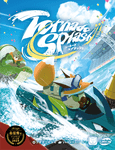
It looks absolutely poisonous green, but it would probably stand out a bit better with these gardens. And then we played Tornado Splash. We played it here once with two people and I took it to the play castle on Thursday. I didn't play it myself, but another group said, come and borrow it, it looks really fun and I have to honestly say, the tabletop presence of the game is awesome, I think. It looks awesome and it's just such a jetski racing game. It really feels like the old days on Nintendo. There were stories like that too. We can have a race with our jetskis. I'll have to check the App Store to see if there's a game that lets me play a round and here are a few more photos.
What's really nice is that we always have these cards, you can see them here . The leader always has four of these cards in their hand, everyone else has five, and the last player always has six of them in their hand. We can then lay them out and basically have to continue along this middle line. And as you can see, sometimes we have this X here, so here, these are options where you can't place a card straight, but rather so that it goes along this slanted edge, so that we can basically drive around a curve. And that's how it is with every one of these racers, it's also really cool. So that alone is probably enough for five people now, because they say: "Wow , cool, I can combine a bear with a jet ski of my color, awesome. You can also put them out on this little winner's podium." That's really well done and you have to play something like that these days and every single jet ski also has a slightly different handling.
It simply means: They don't all have exactly the same set of cards in them, but some of them have more speed, can drive straight for longer, but they can't take the curves as well. Some of them can take the curves better , but they have shorter straights, where there are multiple sub-segments. And then you always have to think: Okay, where am I, what equipment do I have at my disposal and how do I best approach this curve? Do I try to cut it really tight, but then the turning circle will probably be relatively large, or do I try to approach it further and get around it completely smoothly? I can ignite a turbo once per lap and then I can basically drive one more field. Uh, but that's not possible. So once per race I'm allowed to do that and I was already concerned about whether they would get to play it on the table because I thought, yeah, no, the table is the natural limit, if you fall off there, you're simply out. But they made it, and we have it here too.
For example, no, here you can also see how they were kind of at the end and no , the paths kind of cross and that, so it has a cool presence. If at some point you don't have any more cards, just remove the cards from behind , you also know what's coming next, and that's kind of the standard scenario: just drive one lap, good for getting started. There's also the boat ride, where we basically start here and then we have to , like we did here, somehow get around this gust and then take this curve as tightly as possible in order to be the first to reach the finish line. And that was definitely quite fun. There are various other requirements that you can do. There's something where you have to drive three curves. That's Really wild, I think. And I also read the comments there...well, I played this and I think we played two rounds, and that was around 4 in the morning. And yeah, my...again, bo, totally, it's really fun . And I also thought to myself: This is actually the perfect game for people who don't like playing games, so to play this with them. Reading the comments yourself might be a bit overwhelming, but it's still a nice gateway game.
And then I read the comments on board, and they often said something like: "No , the rules aren't clear, the game is a bit fiddly, not so good." And...h, what kind of 'not' did you get ? 6 com...something or something? 7.4. Okay, better than I thought, because that was also in my round here with Jana . The two of us had a lot of fun. I thought that it would be just as much fun, but they also played at least one race. I don't know if they played a second one . They had a lot of fun too. Yeah, cool that you brought it with you, it was really great and it's now been released in German by MM Spiele. It was also a bit of an insider tip at the last game last year. I think it was on Saturday. In any case, all the games are already sold out and, um, it's good. So, there will probably be opportunities to release updates for it, to somehow release new scenarios, maybe new racing cars, maybe add some stuns or something .
I don't know if that's necessary now, because the game is on the easy level, where it's already very good. I think that's also a Excellent game and I think reading the instructions the first time took longer than the game itself and the second game was definitely a bit faster. Um, yeah, the question is being asked in the chat, is it better than Room? I think I played Room once, it was quite funny. It's just completely different from Room. Room is kind of like a racing game where we have to estimate how far the other person is driving and here we just have to step on the gas and take all the corners better than the other people instead of being the first to reach the finish line. Um, I would compare it more to Heat, because Heat is also a racing game, but Heat is much more complex, much longer, much more strategic. You really have to think about how to drive, how to position it, where do I want to stay tactical, do I want to be behind in order to draw more cards, do I want to drive white or short here? I think if you've played it 20 times, you've probably optimized it to the point where you know which racer to drive with and how to drive in order to somehow to drive curves in a certain way. But I also have to have the corresponding cards. It's just very entertaining, very funny from me, I definitely recommend it .
And then that was already in the usual hour, which I need about hour 10, but we had about 5 minutes of technical problems. Uh, all of today's games. I didn't find a jet ski emoji. So, if you've looked this far and are still looking at it, maybe on a Wednesday when the thing has been online for half a day, then feel free to put a surfer emoji in the comments. That's the closest thing to what I had before and yes, that's it for a quick reminder. There's another con next December, there are still ten spots available. Uh, I'll have to check right away if I can get something to do to see if there are still ten spots available or if there have been fewer. Accordingly, if you registered for November, but were also able to in December, re-register quickly, then you'll have In any case, a spot is guaranteed, because anyone who registers now will have that spot, at least until the spots are filled.
And um, yes, then I would like to say thank you very much for watching. That's it from me. We'll probably see each other again tomorrow in a new video. Feel free to check it out. Please give the video a thumbs up, leave a subscription, and the corresponding comment, and then I would like to say thank you very much for watching. I apologize again for the technical problems. This is live in a studio that doesn't really exist. Take care, see you soon and goodbye.