Two Player Games We Recommend - Three Reviews
Games in This Video
3 games are featured in this video — they unlock as you watch.

Transcript
Welcome to Allies or Enemies. I'm Jess.
And I am Shawn, and today we are talking about two-player games. So, we're going to talk about three two-player games that we like.
A couple of these were provided, and we'll put that in the description, but let's just get right to it.
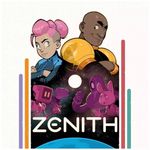
So, the last time we did a two-player video, a bunch of people in the comments said, "You guys have got to play Zenith. You guys are going to love Zenith." So, we're talking about Zenith. And Zenith is a tug-of-war game. And what you're doing is you got a hand of cards. They're all space folks. They're robots and people and aliens and like creatures. And you are trying to influence these five planets. So, you're trying to get those planets over to your side. That's what the tug-of-war part is. On your turn, you're going to play a card. You're either going to pay for that card, play it next to one of those planets, do whatever its action is, usually also move those different planets towards you in some way, or you are going to use the technology tracks. You're going to discard a card. You're going to move up that technology track, get all kinds of different bonuses, or you're going to use one of the three leadership bonuses. Again, you're going to discard a card. You're going to get that leadership thing, which lets you have more cards, and you're going to do that stuff. So, the whole thing is about getting those planets to your side.
You're going to win the game if either you can manage to get one planet to your side three times, get four different planets, or get five planets in total.
Yeah, and it very much feels like a tug-of-war because the planets are constantly [snorts] shifting. As soon as a planet gets close to the opponent, you're going to want to stop them and move that planet back. And I really like those different win conditions because I find that certainly influences how you play. Like, if you, for example, have already gotten a blue planet, and I see that blue moving again, then I'm thinking I need to stop that. I don't want him to only have to win three times on blue. I'm going to start focusing on blue.
Yeah, and there's the opposite as well where I see that you've got a few different ones and I think, uh-oh, this is going to get tough for me now. So, I need to focus on one because it only takes three times. If I can really get that one. And they also have this interesting thing where it gets cheaper to put things down in each one of those columns. So, however many cards you already have there, you get a discount of that much to play other cards. And some of those cards are really expensive. So, there's cards that cost like 10. But, if you've got six down there, all of a sudden those cards are a lot more affordable and those cards are superstars.
Yeah, and so it is interesting cuz there's not a lot of resources you're managing, but I do find that it is quite tight because there's the [clears throat] money that you need to be able to pay for the cards to play, but then also the yellow tokens that you need for the technology track. And so, between those things, you can I find you can usually do one of those two options because the worst thing I feel like you can do is just discard a card for the leader bonus, but it's not often that we're doing that.
Yeah, it is a little bit what we always call the loser action, but also getting that leadership token is not bad. Especially if you flip it twice cuz you usually only have four cards in your hand. If you got that, now you got to have five cards every time you draw up. If you get it a second time you flip it, now you can get six cards every time. Obviously, that gives you an awful lot more options. So, it's not like the loserest of loser actions, but mostly you do want to be able to afford those big cards. You want to build up kind of in those in those different spaces, but you're also stealing cards from your opponent. There's a lot of interaction in this game. And I like all of the variability, too, because those technology tracks all have two sides to them, as well, and just all the different cards.
Yeah, there are a ton of different cards that all do different things. And like you said though, you said you can get rid of your opponent's cards, you also often end up also getting rid of your cards. Cuz a lot of cards will be like, "Oh, if you get rid of some cards, you'll get this extra bonus. If you like pay this money, you'll get this extra bonus." So, you're always like tempted to spend more to be able to just do more.
There is one kind of little caveat is there are a lot of powers, there are a lot of icons. So, you are certainly for your first few games, you are going to be using your hint sheet a lot. Luckily, there's a really good sheet that does list all that stuff, and I don't think there's been anything we've had to look up that hasn't been on that. So, they do a really good job. But, you are going to have to go to that at least for your first few games. And another big plus for this game that I really like is that in the three different kinds of cards, the people, robots, and aliens, I like that they've got these themes. So, the aliens are all like historical characters, especially Roman emperors. There's a ton of those. And then the robots are all sci-fi authors. And then the people are just kind of like random names, but they do feel like they've got little sci-fi references hidden in there.
Yeah, I like the overall look. Like I think the art's really nice. It's done by Naiade. I think it's really like nice and clean with the white board. And I like the planets, cuz the planet tokens are the are made of re-wood, which is really neat.
I love re-wood.
Yeah, and they have these great different like patterns and textures. So, what feels like mostly like a card game, I think just it looks really nice.
Yeah, it does. This it looks beautiful. And like I said at the start, a lot of people told us we were really going to like this. You guys were right. We really like this game. And I know this game, a lot of people were talking about it last year. So, we're like a little bit late to this party, but I'm glad we joined this party. Mad Cala is an interesting take on the one versus one kind of fighting genre. There's been all sorts of different takes on this genre with deck building or bag building or dice rolling, but this is a Mancala game. And so, you're using a Mancala to fight each other. So, you're going to have a bunch of these shards on your side of this table. You're going to pick up all those shards from one space, drop them off one at a time bread crumb style. Wherever you put the last one, that is the thing you're going to do.
And that's just going to do a few simple things where you are going to gain more shards, take shards away from the board. You're going to get these commoner cards that are one-time use. And really importantly, you're going to harm the other person. You're going to be knocking down their health. And you're also going to heal your own health. And what you want to do here is knock their health down all the way down to zero.
And most interesting are the characters because the game comes with six different characters. And they all have their own powers and their own plus one cards, which are characters and things from the books. And they all play very differently. And so, for example, Alice lets you refresh your plus one cards and stops your opponent from being able to refresh theirs. The Jabberwock does a whole bunch of damage. The Cheshire Cat has you rolling a die instead of using your doubler. So, throws a bit of like chaos into the mix.
And then the Red Queen kind of nickels and dimes you with her card soldiers. The Mad Hatter blocks off spaces with the Dormouse. And he lets you use cards from the discard pile. And then the White Rabbit uses a ton of those commoner cards. So, they do all play very differently.
Yeah, and so you really want to try and maximize their strengths and use their cards. But part of being able to use their cards is managing your shards because they all cost you shards. but shards are how you do actions. So, it's an interesting balance.
Yeah, you got to spend those shards to use those cards. And it I what I really like in this game though is just that creative use of a Mancala because I really like Mancala as as a mechanism. And I don't think it's in enough games. I really like Five Tribes for that and I think a lot of folks really like Five Tribes. So, it's nice to see it being used at all, but to be used like this creatively because I would not have thought of a Mancala being something to fight with.
Yeah, and so using that mechanism to do damage and have it be a battling game is really interesting. And it is like I think a little bit more challenging than you expect because you often find yourself trying to plan like a couple of turns ahead, but then the board looks completely different and where you were hoping to maybe go the next turn now has more shards and that's throwing it off and you have to go in a different direction.
Yeah, and that is a big part of it is that you can see that they cuz that doubler we didn't talk about that. You've got this big shard and when you use that you get to do whatever the thing is double, which is why it's called a doubler. But so, you really want to stop them from being able to put that in certain places. Usually the one that's going to do a ton of damage. So, often you're going to leave shards on those spaces so that they can't possibly get to one space. They have to move too far. And you do also want to there's kind of this thing where you're trying to get all the shards to your side because that's going to stop that's going to give them fewer options cuz you can only move shards that are on your side of the board.
Yeah, and so that that's the core mechanism of what you're doing. And like generally things are helpful because the spaces will let you heal if you need healing or get the commoner cards which can be really powerful, but obviously it's a race to get your opponent down to zero. So, the damage spots are really the spots that you tend to target.
But, this isn't going to be a game for everyone as well because it is it's a little bit of a a weird one where there's a bit of a disconnect. And I like the disconnect. Like, it's not it's not so much that I like the disconnect, but I like the creativity of using a mancala to fight. But, for some folks, they're going to be like, "That's, you know, it just it is a little bit of a strange um system." And like most of what you're doing is fairly simple on a turn where you are, you know, getting rid of that shard, gaining a shard, um getting a commoner card, just doing some damage. But, again, I do like that. I like how fast these fights are, how fast these matches are. And I like that a lot of the characters come with these special tokens. They come with a bunch of different stuff. They really does differentiate them.
And then there's also an expansion that adds two other characters. And so, you have Tweedledee and Tweedledum. And anytime you use their power, you have to like flip their card to use the other one. And there's also the caterpillar who starts with less health, but once he gets down to zero, comes back with a little bit more health. And who uses his hookah to get extra turns.
Yeah, and that's interesting the how the hookah moves. I will say the hookah art is weird. It looks like like an inhaler. It does not It looks like he's hiding his hookah in an inhaler. It's a weird It's a weird thing. But, yeah, this this whole game it's just it's really interesting. It's really different. I like the neoprene mat in this game as well. It's just it's going to be a little bit Marmite. This is not going to be for everybody. But, if you like a mancala and you like a fighting game and you like Alice in Wonderland. And it's also got the art from Wonderland's War. Like, it's kind of set in that same world. And I just I like that world, too. So, Everdell is one of our favorite games. And when we saw Everdell Duo was out, we kind of ignored it at first because we thought, "You know what?
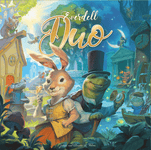
Everdell plays fine at two players. What is the point of a duo game?" But then, we did pick it up cuz we found it for cheap, and it is interesting. It's more different than I expected. It's It's just tighter. It's just a little bit different. So, what happens in Everdell Duo? The most important thing is there is going to be this shared board. It's got a bunch of the different actions that you know and love, or you're going to be getting all those different resources. You are going to be getting doors that you can use to put creatures into buildings. You are going to have a bunch of goals. I really like how they do the goals in this game. But most importantly, you are going to have a sun and a moon. Every time you do one of the actions on that board, you're going to move the sun. Anytime you play a card, you are going to move the moon, and you can play a card either from your hand or from the meadow. You can build your town as big as you want as well. But as soon as the sun and the moon get to the end of that track, that is going to be the end of the round. You're going to reset those again. You're going to get different things depending on if you are the tortoise or the hare who are competing in this game. And that's basically it. But that makes more of a difference than you expect.
Yeah, and the other thing that comes in Everdell Duo is a cooperative mode, and this was the core reason why I was interested because I love co-op games. I love Everdell, and so I really wanted to see how it played. And it's quite neat cuz you're building a town together, but you have your own like cards. You've got your own resources, and it uses the same system that it uses in the competitive with the moving of the sun and the moon. So, you really have to communicate and work together because if I go and collect resources three times, like you may not be able to collect any, and you're working your way through a campaign. So, it's a 15-chapter campaign that has like skunks that take up spaces and goals that you're trying to do for each chapter.
And those chapters are hard and they're hard right out of the gate. I think the first game is kind of easy, then the second game kicks your butt like right out of the gate. And there's a normal and a hard mode. We've played all the way through twice on the normal mode. The first time we failed a few of those, the second time we did pretty good. But that hard mode really ramps it up. And the second time through when I felt like, "Yeah, we're doing pretty good." I was kind of eyeing that hard mode and there's a lot of times we would have failed at that and I thought, "We're acing this." So you really have to kill it to beat that hard mode. But I I like the building the city together and then the things the different cards do as well because blue cards are going to get you stuff when you play other cards. Green cards are going to get you stuff at the beginning of certain seasons and when you play them down. Purple cards are going to get you end of game points.
Great cards get you immediate stuff when you play them. So you have to be thinking about having enough of a mix of all those different cards. So orange cards as well, those are going to get you kind of extra spaces as well to add stuff from what you start with.
Yeah, but you're going to be thinking about that within the specific chapter, too, because
[clears throat]
they will there will be certain things you need to do. Like there'll be ones where by this season you have to have so many cards in your town or you have to collect a ton of resources or you need to have like these specific events achieved. And I always like it when you are given these different goals that do get you to focus again on like different things.
Yeah, and some of them are really specific. Like you've got to get the robber and put him either put him in jail or turn him into a monk or you've got to get the doctor and then use the doctor to heal this other thing. Like it's really specific and it is a fun challenge.
Yeah, and I feel like the the challenge for us is the right level where it is hard but for the like most part we can win the games but it work pretty good. But it really does come down to us like really figuring it out. By that final round every single action counts.
Yeah, there's so many times when it is the very last thing and it's just it's really creative. We already love Everdell but this is such a different Everdell and I know you especially like this one.
Yeah, I I really do. I just love cooperative games and Everdell is one of my favorite games and so I think if you're interested in playing a cooperative version of Everdell, this is definitely worth it. I think the competitive does do something a little bit different but like you said at the start Everdell like the regular game works great at two. So I think the draw here really is that cooperative campaign.
And that is it. That is three pretty cool two-player games. Are there other two-player specific games that you have played recently that you have really enjoyed? Please let us know.
Please put those in the comments and as usual please like and subscribe and hopefully we'll see you next time for another game.